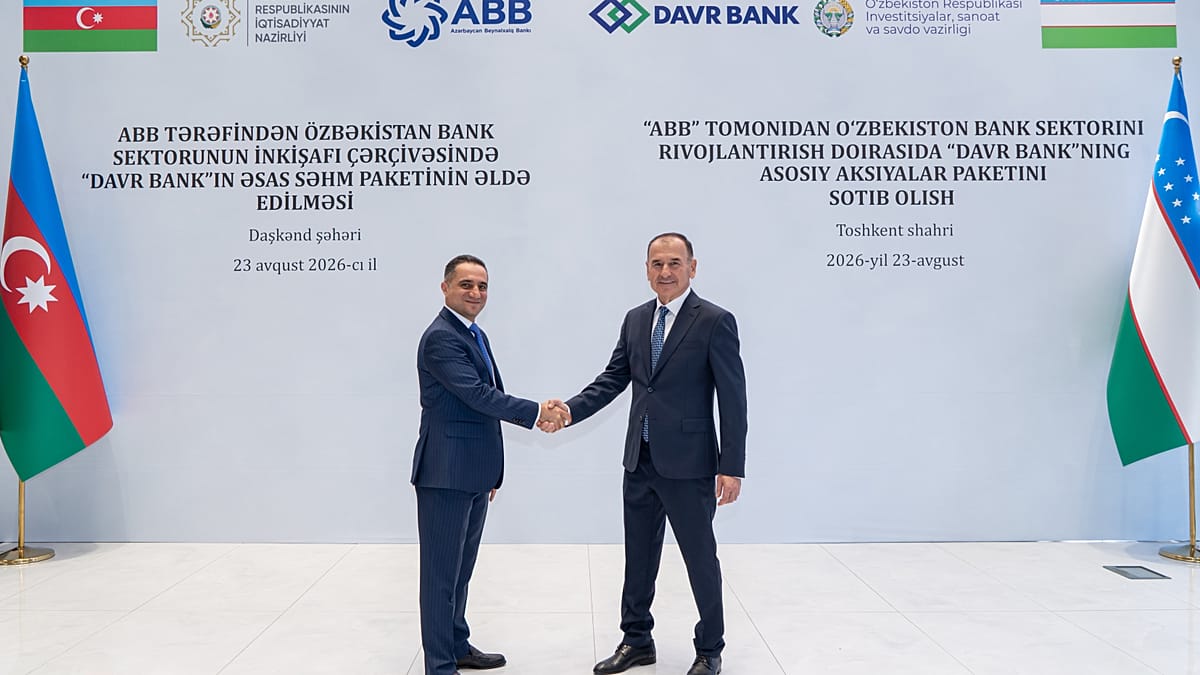
Azerbaijan's largest financial institution, the International Bank of Azerbaijan (ABB), has taken a decisive step into Central Asia by acquiring a 51% controlling stake in Uzbekistan's Davr Bank. The transaction, valued at approximately €86 million according to S&P Global, ranks among the biggest direct investments by South Caucasian capital into the region's financial markets.
The acquisition gives ABB a direct foothold in Uzbekistan's rapidly modernising banking sector, which has been opening up to foreign investors as part of a broader reform agenda. S&P Global has placed Davr Bank's long-term issuer credit rating on CreditWatch with positive implications, reflecting expectations that the new ownership will strengthen the lender's profile.
Strategic rationale and market potential
Bilateral trade between Azerbaijan and Uzbekistan is projected to reach €856 million by 2030 under existing state agreements. The merged entity is expected to become a key clearing and credit hub for that growing commercial flow, combining Davr Bank's expertise in small and medium enterprise financing with ABB's substantial corporate banking resources.
Abbas Ibrahimov, Chairman of the Management Board of ABB, called the deal "the first historical step towards the geographical expansion goal" and described it as a "great honour." He added: "We assess this project as the beginning of our long-term activity in Uzbekistan, and we want to be a reliable financial partner for business, citizens, and the country's economy."
Ibrahimov also framed the acquisition as a qualitative leap for banking services, noting that "experience, innovative technologies, and sustainable capital of our new partner will allow Davr Bank to provide advanced financial products to its customers in the shortest possible time."
Lutfulla Ubayev, Founder and Chairman of the Supervisory Board of Davr Bank, welcomed the partnership, saying it will "guarantee higher stability and a strong technological leap for our bank."
Financial profiles and outlook
ABB manages total assets of roughly €7.8 billion, serving more than 17,500 legal entities and 3 million individual clients through 78 branches across Azerbaijan. The bank reported a net profit of about €60 million in the first quarter of 2026.
Davr Bank, registered in 2001, is the 20th largest lender in Uzbekistan by assets, which stand at approximately €910 million. It operates 43 branches and serves over 1.4 million customers, focusing on micro and small business lending. S&P Global notes that Davr Bank's return on average equity has consistently exceeded 35% in recent years, reaching 35.6% in 2025, and expects profitability to remain robust at above 20–25% over the next three years.
Upon completion, Davr Bank is expected to account for 10–11% of the consolidated ABB group's total assets and equity.
Technology and regional integration
As part of the acquisition, ABB will synchronise its digital banking platforms and risk management systems with Davr Bank's infrastructure. The move is designed to support Azerbaijani companies operating in Central Asia, providing banking services for import-export operations and broader economic activity.
Uzbekistan has been actively courting foreign capital, and the partial privatisation of its banking sector is a key element of that strategy. The renewed institution will serve both Davr Bank's existing local clients and Azerbaijani enterprises in the region.
The deal still requires approval from regulatory and anti-monopoly authorities, with all legal procedures expected to be completed in the second half of 2026. Once finalised, the new entity will begin formal operations, marking a notable milestone in the deepening economic ties between the two countries. This follows the recent friendship treaty and $1bn trade target signed by Tashkent and Baku.
For Azerbaijan, the acquisition is part of a broader strategy to diversify its financial footprint beyond the South Caucasus. For Uzbekistan, it brings in a well-capitalised partner with experience in corporate banking and digital innovation, aligning with the government's €1bn plan to boost business, AI and exports. The move also comes as Central Asia attracts growing attention from international investors, with European policymakers urging greater market integration to remain competitive globally.