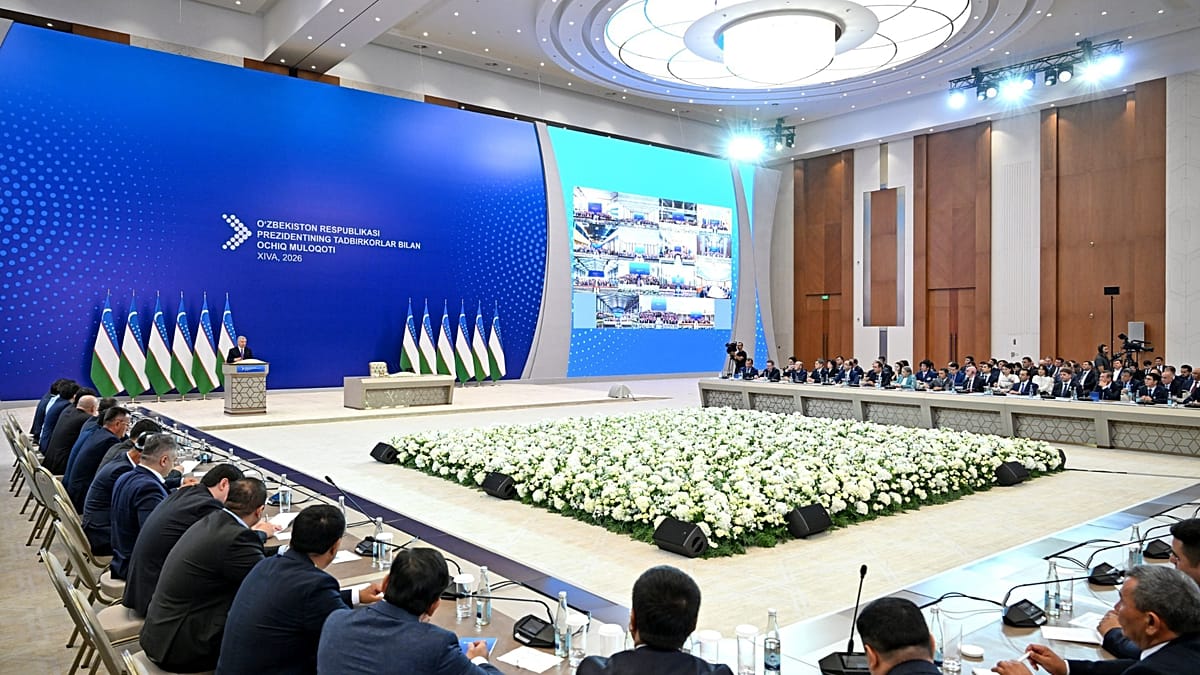
Uzbekistan has announced a comprehensive five-part business reform plan, backed by nearly €1 billion in dedicated funding, aimed at stimulating business growth, artificial intelligence adoption, and export expansion. President Shavkat Mirziyoyev presented the measures during his annual open dialogue with entrepreneurs in Khiva, a historic city in the west of the country, on Entrepreneurs Day (20 August).
The event, which has been held for five years, drew around 25,000 business representatives from across the country, many participating via district studios. According to official figures, the business loan portfolio has nearly tripled to about €33 billion over that period, and company investment in fixed capital has also tripled.
“Today, our entrepreneurs are moving from the stage of ‘starting a business’ to that of ‘growing their capital’,” Mirziyoyev said.
Finance and working capital
A new digital credit portal will allow businesses to submit a single application and receive competing offers from banks. New entrepreneurs can apply online for loans of up to around €365,000. A separate guarantee system aims to make larger loans more accessible to smaller companies: for loans up to 10 billion soums (about €731,000), businesses will need to provide only 25% collateral themselves, with the remaining 75% shared between the state, the Business Guarantee Company, and banks.
Another measure is designed to free up working capital. Businesses connected to automated electricity and gas metering systems, and compliant with payment rules, will see advance payments fall from 100% to 15%. Goʻzal Tojimirzayeva, director general of B.A. Technopark, said the previous system could tie up substantial amounts of company capital. “Sometimes, across several of our factories, 20 billion [€1.5mn] to 30 billion soums [€2.2mn] could go towards advance payments alone,” she said. “Now that this has been reduced to 15%, a significant amount of that money will remain in our working capital.”
Banks will also be allowed to sell 2,500 properties on their balance sheets, worth around €658 million, on preferential terms including no initial payment and interest-free instalments. This measure concerns the value of the assets being offered, rather than direct government spending.
AI and access to capital
Under a new programme called “AI Partner for 10,000 Enterprises,” the state plans to cover half of companies’ costs of introducing AI. Businesses developing models for new products will also be offered free access to supercomputing capacity. At least $100 million (€86mn) is earmarked for the programme’s first phase.
The government also wants to give larger private companies greater access to international capital markets. Under a planned acceleration programme, the government will select 50 companies a year with annual revenues above 1 trillion soums (€73mn) and cover half the cost of preparing them for initial public offerings and bringing financial reporting in line with international standards. The stated aim is to help private companies attract at least $1 billion (€862mn) in foreign capital each year — a target for private financing, not government expenditure.
Expanding beyond the domestic market
Exports form the largest explicitly funded part of the package. The government says $1 billion (€862mn) will go to a unified export-support system. A planned Export Navigator tool is meant to give companies information on foreign demand, tariffs and logistics, while authorities plan to identify 100 products with export potential. The plan also calls for adapting production at 2,000 companies to foreign market requirements. Support is also meant to cover part of the cost of international branding, selling through online marketplaces and participating in international tenders.
Umida Rahmonova, head of lighting company Miss Lighting, which operates showrooms in Dubai and Milan, said expanding abroad was a natural next step for growing businesses. “The next stage after moving from small business to medium-sized business, and from medium-sized to large business, is developing the brand and fully entering export markets,” she said.
Changing the relationship with regulators
The package also includes changes to inspections, penalties and disputes between businesses and state authorities. Small businesses will receive a three-year moratorium on inspections, except those related to harm to human health or the interests of other businesses. Business fines are also due to be cut by half on average, the government said.
From next year, the government plans to introduce what it calls a “presumption in favour of the entrepreneur,” shifting the burden of proof to the state in disputes. This is a significant shift in the regulatory environment, aiming to reduce the administrative burden on businesses and foster a more entrepreneurial climate.
While the plan is focused on Uzbekistan, it reflects broader trends in the region and beyond, where governments are seeking to modernise their economies and attract investment. The emphasis on AI and export support is particularly notable, as countries across Europe and Central Asia look to harness technology and global markets for growth. For a deeper look at how AI is reshaping industries, see this recent study on AI in music. The move also echoes similar efforts in the EU to support small businesses and innovation, as seen in the EU's recent tax proposals.