Azerbaijan, Georgia and Kazakhstan are deepening their cooperation on the Middle Corridor, the trade route that links China and Central Asia with European markets via the Caspian Sea, the South Caucasus and the Black Sea. The three governments have agreed on a joint strategy to upgrade transport infrastructure, simplify logistics and cut transit times along the route.
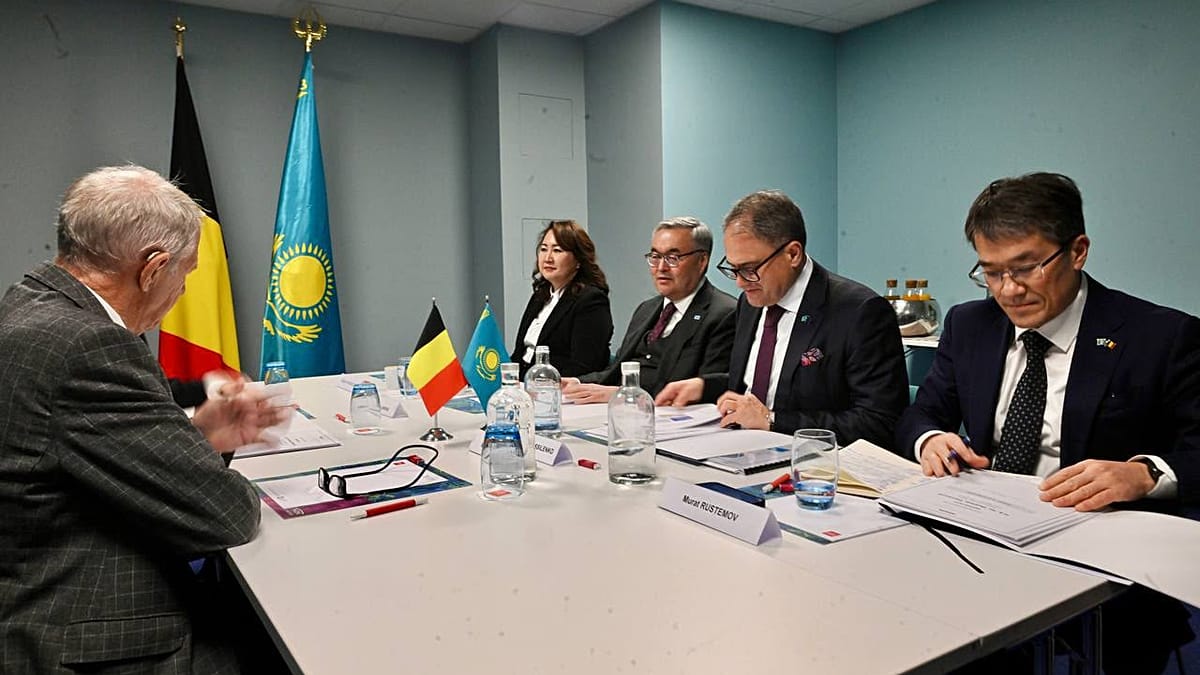
The plan comes as European companies look for new investment opportunities in the corridor. During a working visit to Brussels on 16 November, Kazakhstan's Foreign Minister Mukhtar Tileuberdi met with executives from Belgian firms Sarens Group, Ahlers Logistics and BIM e-Solutions to discuss a proposed $50 million (€45.4 million) logistics hub in Kazakhstan's Zhetysu Region, near the Chinese border. The hub would include a 2.1-kilometre bypass road, temporary storage facilities and specialised infrastructure for heavy cargo, according to Kazakhstan's Ministry of Foreign Affairs.
The project is designed to ease congestion at the Nur Zholy border crossing, one of the main entry points for goods arriving from China. Reducing bottlenecks there could improve the flow of freight into the wider Middle Corridor network, which has gained strategic importance as the war in Iran has disrupted shipping through the Strait of Hormuz.
Target: 30 million tonnes by 2029
In an interview with Georgia's Imedi TV, Deputy Prime Minister and Minister of Economy and Sustainable Development Mariam Kvrivishvili confirmed the joint plan. She said Georgia was working "very closely with partner countries, particularly Kazakhstan and Azerbaijan" to improve transport links and increase cargo volumes. "This plan aims to ensure the transportation of 30 million tonnes of cargo through the Middle Corridor by 2029," she said, adding that the countries had "identified joint regional measures" and were cooperating constantly.
Reaching that target will require improvements across railways, ports, shipping services and border crossings. Kvrivishvili said Georgia plans to invest approximately $7 billion (€6.4 billion) in transport infrastructure by 2029, covering ports, railways, roads and aviation. The joint measures focus on harmonising customs clearance, aligning tariff policies and expanding port and rail capacity across the Caspian and South Caucasus segments.
Regional analysts say hitting the 30-million-tonne mark could change how international shippers view the route. "The Middle Corridor has grown in strategic importance, but limited freight capacity remains one of its biggest constraints," said Bako Kheladze, a research fellow at the Turan Research Centre. He noted that the World Bank estimated in 2023 that the route could triple its freight volume by 2030 and halve transit times with the right investment and policies, but it still operates on a much smaller scale than the Northern Route through Russia.
"If the three countries can reach that target and offer reliable transit times, the Middle Corridor could become a regular route for shippers between Asia and Europe," Kheladze added. "The Northern Route would still have an advantage in scale, but the Middle Corridor could compete for a meaningful share of freight even if transit through Russia becomes easier again."
The push to expand the corridor is also part of broader European efforts to diversify trade routes. In Brussels, EU foreign policy chief Kaja Kallas, Enlargement Commissioner Marta Kos and International Partnerships Commissioner Jozef Síkela met with foreign ministers and senior representatives from EU member states, Moldova, Turkey, Ukraine, Armenia, Azerbaijan, Kazakhstan, Uzbekistan, Turkmenistan, Kyrgyzstan and Tajikistan to discuss cross-regional connectivity. The discussions come as the EU seeks to strengthen ties with Central Asia and the Caucasus, a region that has gained new geopolitical significance. For more on related developments, see the Caspian green corridor pact.
For European businesses, the Middle Corridor offers an alternative to the traditional Northern Route, which passes through Russia. The war in Ukraine and subsequent sanctions have made many companies wary of relying on Russian transit. The proposed logistics hub in Kazakhstan, backed by Belgian investment, is a sign of that interest. Sarens Group, a global heavy-lift specialist, and Ahlers Logistics, a Belgian freight forwarder, are among the firms exploring opportunities. Digital upgrades, such as those proposed by BIM e-Solutions, aim to reduce delays at border crossings, a key bottleneck for the corridor.
If the joint plan succeeds, the Middle Corridor could become a more competitive option for moving goods between Asia and Europe. But analysts caution that infrastructure alone is not enough. "The key is reliability," said Kheladze. "Shippers need predictable transit times and transparent procedures. If the three countries can deliver that, the corridor will attract more cargo."
The next few years will be critical. With investments in ports, railways and digital systems, and with political will from Baku, Tbilisi and Astana, the Middle Corridor could emerge as a viable alternative to the Northern Route. For Europe, that would mean greater supply-chain resilience and stronger economic ties with the Caucasus and Central Asia.