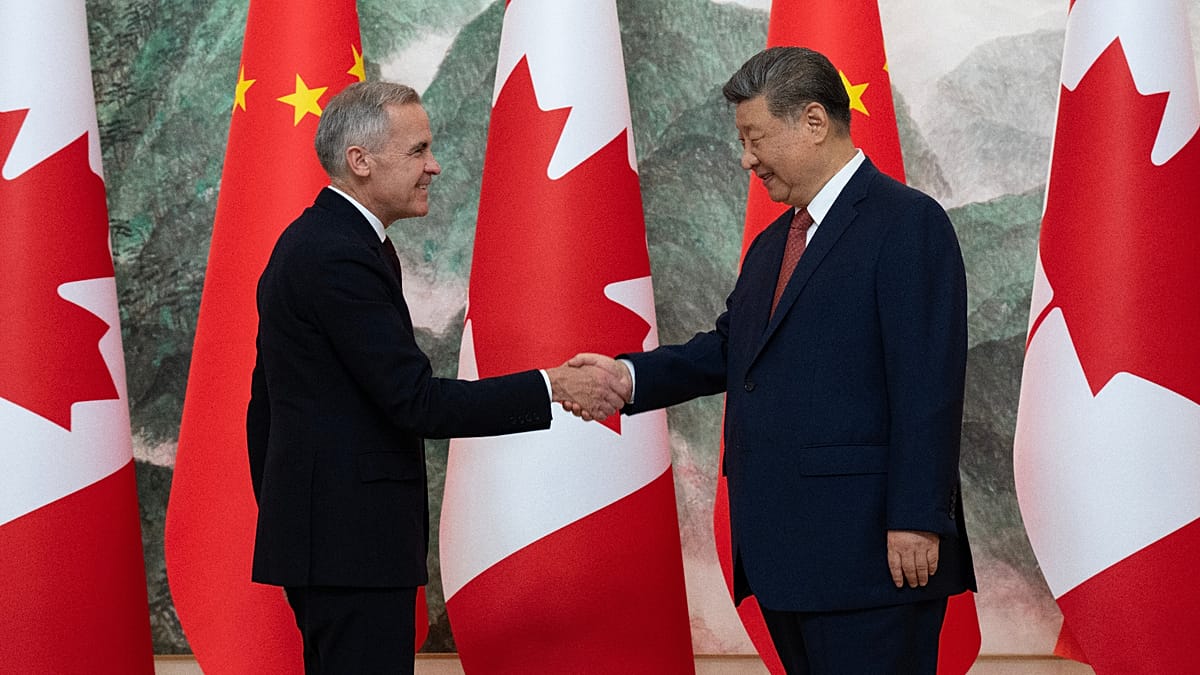
Canada and China have moved to further ease trade barriers, with Beijing suspending additional tariffs on Canadian pork and seafood and Ottawa extending exemptions for Chinese steel and aluminium. The agreement, announced after talks between Canadian Prime Minister Mark Carney and Chinese President Xi Jinping in Shenzhen on Tuesday, marks another step in the gradual thaw between the two countries as Canada seeks to reduce its dependence on the US market.
Under the new measures, China will suspend its 25% additional tariffs on most frozen pork cuts and several seafood products from 1 January 2027 to 31 December 2028, according to the Canadian prime minister’s office. The affected goods were worth roughly C$400 million (€254 million) in Canadian exports in 2024, before the extra duties were imposed. Eligible seafood includes certain frozen cold-water shrimp and prawns, some molluscs, sea cucumbers and Greenland halibut.
In return, Canada will maintain existing tariff exemptions for selected Chinese steel and aluminium products until the end of 2028. Ottawa will also introduce full or partial exemptions for an additional 32 product categories where domestic supply is insufficient or unavailable. The agreement builds on measures announced earlier this month, which extended Chinese tariff relief on Canadian canola meal, peas, lobster and crab through 2028, alongside Canada’s extension of its metals exemptions.
Canada looks beyond the US
The deal comes as US President Donald Trump’s tariffs continue to pressure Canadian exporters, prompting Ottawa to diversify its trade partners. Foreign Minister Anita Anand said on Wednesday that Canada was taking a gradual approach to rebuilding relations with China while working to reduce its reliance on a single trading partner. Speaking in Shenzhen, Carney noted that Canadian exports to China had risen by more than a third this year, but stressed that negotiations with Washington remained a priority.
“The United States fundamentally changed its trade objectives, and we are focused on getting the right deal for Canadians,” Carney told reporters.
On Monday, Carney warned that Canada could turn to Chinese carmakers if talks with the US failed to protect the closely connected North American auto industry. He reiterated that negotiations with Washington were his main focus, but the threat underscores the shifting dynamics in global trade. The two countries began easing trade restrictions under an agreement reached during Carney’s visit to Beijing in January, when Ottawa agreed to allow up to 49,000 Chinese electric vehicles a year at a reduced tariff of 6.1%, and Beijing lowered tariffs on Canadian agricultural products including canola.
For Europe, the Canada-China rapprochement carries implications beyond North America. As the EU pursues its own trade agenda with both Beijing and Ottawa, the easing of tariffs on metals and agricultural goods could affect global supply chains and pricing. The EU has been seeking to reduce its reliance on China for critical materials, while also navigating its own trade disputes with Washington. The Canadian move to diversify away from the US mirrors efforts in Brussels to strengthen ties with other partners, though the EU’s approach to China remains more cautious, particularly on technology and security.
The tariff relief is not without limits. China’s suspension of extra duties on pork and seafood is temporary, and the broader trade relationship remains fragile. Canada’s exemptions for Chinese steel and aluminium are also conditional, reflecting ongoing concerns about dumping and overcapacity. Still, the agreement signals a pragmatic willingness on both sides to manage tensions while pursuing economic gains.
For Canadian exporters, the new market access offers a lifeline as US tariffs bite. For China, it provides a foothold in a G7 economy and a counterweight to US pressure. The deal also comes as Carney warns that US tariffs could push Canada’s auto industry toward China, a scenario that would have ripple effects across the integrated North American manufacturing base.
As the Asia-Pacific Economic Cooperation summit approaches, the Canada-China agreement is likely to be a talking point among leaders. For Europe, it serves as a reminder that trade alliances are shifting, and that the continent must remain agile in its own trade policy. The EU’s recent push for electrification as a competitive edge against China highlights the delicate balance between cooperation and competition that defines the global economic landscape.