Ageing quietly erodes the body's capacity to regenerate, hitting blood production especially hard. As the biological clock ticks, understanding how blood stem cells change becomes vital for developing interventions that could slow their decline and restore their youthful function.
Now, a team in Barcelona has built an artificial intelligence tool that spots ageing in blood stem cells by reading the three-dimensional structure of their DNA. Named ChromAgeNet, the system was described in the journal Aging Cell and developed by Maria Carolina Florian at the Bellvitge Biomedical Research Institute (IDIBELL) and Paula Petrone at the Barcelona Supercomputing Center (BSC-CNS) and ISGlobal.
From supercomputing to biomedicine
The researchers trained convolutional neural networks on 3D images of nuclei from mouse stem cells. ChromAgeNet decodes how DNA ages by picking up subtle structural variations that escape the human eye. One of the biggest hurdles in using neural networks for medicine is their 'black box' nature—but ChromAgeNet is explainable, offering a transparent AI system that shows which features drive its predictions.
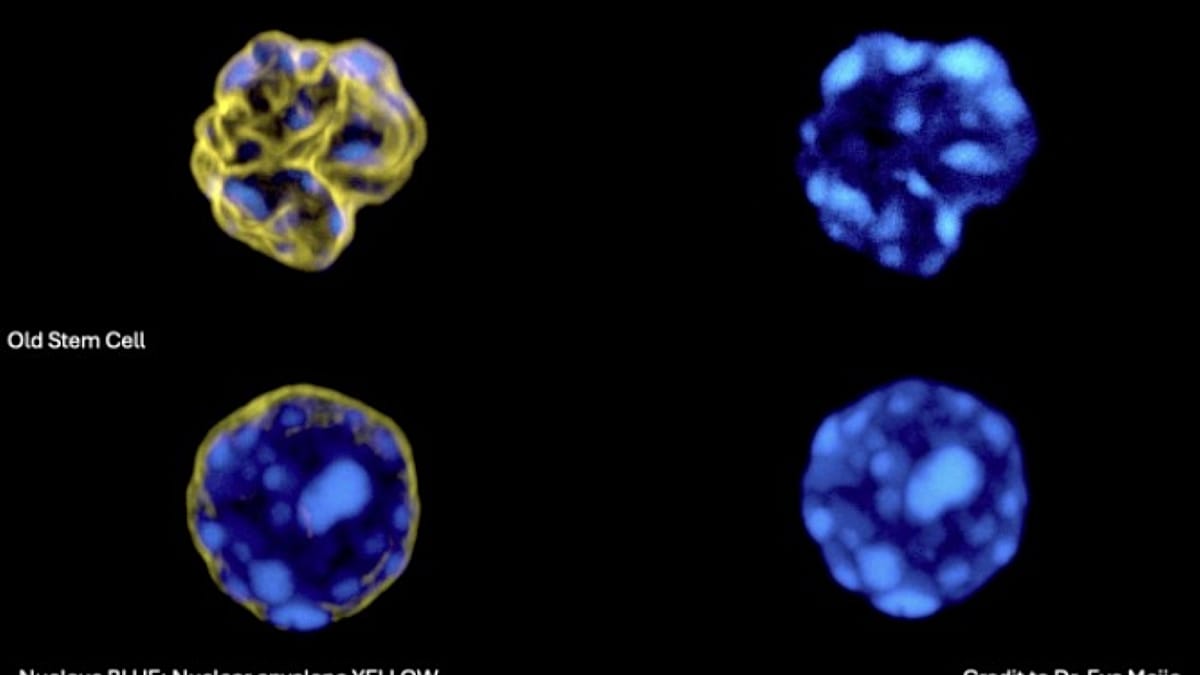
On average, the tool correctly classified about 68% of cells as coming from young or aged mice, using images stained with DAPI, a standard and inexpensive dye. The analyses highlighted changes at the periphery of the nucleus: in young cells, chromatin is compact and neatly organised at the edges, while in aged cells it appears dispersed.
As a proof of concept, the team applied ChromAgeNet to aged cells treated with various epigenetic drugs. The tool detected changes in chromatin organisation that align with a more youthful pattern, suggesting it could be used to screen treatments that regenerate blood tissue and strengthen the immune system. The code and image database are already open to the international scientific community.
Bridging labs and clinics
Dr Florian told European Pulse: "Currently, we have developed a tool that works as a proof of concept in murine haematopoietic stem cells. We are now working to optimise it and adapt it to human stem cells, with the hope of using it to evaluate new drugs that can act on nuclear architecture and be used to rejuvenate aged stem cells."
She added that the project "has found the ideal ground to become a real tool thanks to the expertise of Dr Paula Petrone. We plan to continue developing it and expand it for use with human stem cells. In addition, we are applying for further EU funding and seeking to establish links with other scientists in Europe who are interested in the practical application of our work."
Dr Petrone emphasised the accessibility of the method: "This research shows that a deep-learning algorithm can tell apart young and aged stem cells by analysing images of cell nuclei stained with a low-cost substance called DAPI."
Mapping the nucleus to fight ageing
The internal map of the cell nucleus reveals a distinctive signature: in youth, chromatin is tightly entrenched at the edges; with age, that architecture falls apart. Identifying these patterns could help study the decline of blood stem cells and assess strategies to regenerate haematopoietic tissue, potentially triggering benefits throughout the body.
To accelerate discoveries, the team has released the tool's code and a public database of 3D stem cell images. The goal is to find drugs that reinforce the immune system and improve quality of life in old age.
Dr Florian noted that numerous international studies underline the immune system's central role in ageing. "In our laboratory, we have contributed by demonstrating the possibility of stimulating and rejuvenating aged haematopoietic stem cells to improve not only immune system function, but also life expectancy and the health of the organism as a whole."
Caution and promise
While the long-term promise is significant, the science calls for prudence. ChromAgeNet will help understand the basic molecular mechanisms of haematopoietic stem cell ageing, which could become targets for rejuvenation therapies. "We hope to deepen our knowledge, consolidate our findings and identify new tools and drugs to improve the function of aged haematopoietic stem cells," Florian concluded.
Petrone sees a future where the technique screens new drugs: "By treating aged cells with different candidate compounds, AI could use image analysis to identify those that induce changes consistent with a more youthful state." She stressed that "extending life expectancy is not as important as extending healthy life expectancy."
The work builds on Barcelona's growing reputation as a hub for biomedical innovation, alongside other advances such as quantum chip fabrication and zinc-air battery research. As the team seeks EU funding and European collaborations, the hope is that ChromAgeNet will one day help clinicians and researchers turn back the clock on ageing blood stem cells.