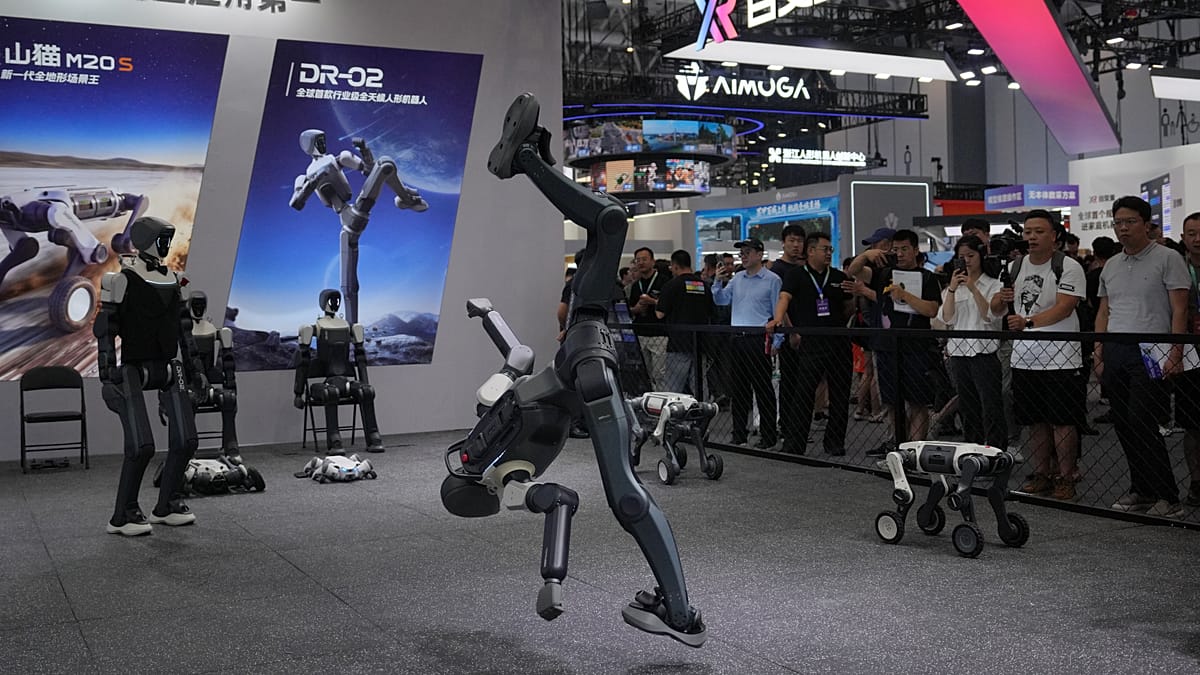
Beijing's World Robot Conference, which opened on 19 August, has become a showcase for China's ambitions in robotics. More than 300 exhibitors presented humanoid, industrial, and service robots, with a clear emphasis on moving these machines from research labs into factories, warehouses, and everyday commercial environments.
The event comes at a pivotal moment for the global robotics industry. Washington's tightening export controls on advanced semiconductor technology are pushing Chinese firms to accelerate domestic innovation and seek new markets beyond the United States. For European observers, the developments in Beijing carry significant implications for supply chains, industrial competitiveness, and the future of automation across the continent.
Humanoids take centre stage
Among the most striking displays were humanoid robots designed to work alongside humans. Several Chinese companies, including Unitree and Fourier Intelligence, demonstrated machines capable of walking, grasping objects, and performing tasks with increasing dexterity. The TienKung humanoid robot, which recently made headlines for sprinting 100 metres, was also present, underscoring the rapid progress in bipedal locomotion.
The conference's focus on practical applications is telling. Unlike earlier showcases that emphasised entertainment or novelty, this year's exhibits highlighted robots in simulated factory settings, sorting components, operating machinery, and even performing delicate assembly tasks. This shift reflects a broader strategy to position China as a leader in industrial automation, a sector where European manufacturers have traditionally held a strong edge.
US curbs and global ripple effects
The timing of the conference is no coincidence. Recent US restrictions on advanced chips and manufacturing equipment have limited Chinese access to cutting-edge technology, prompting a surge in domestic research and development. At the same time, some Chinese robotics firms are expanding overseas, seeking partnerships in Europe, Southeast Asia, and the Middle East to circumvent trade barriers and diversify their customer base.
For Europe, this creates both opportunities and challenges. On one hand, European companies could benefit from cheaper, more advanced robotic components and systems. On the other, the influx of Chinese robots into the EU market may intensify competition for established players like Germany's KUKA and Denmark's Universal Robots. Policymakers in Brussels are already debating how to balance technological openness with strategic autonomy, a debate that echoes the broader tensions in EU-China relations.
The Beijing Robot Games, held earlier this year, offered a glimpse of the entertainment potential of humanoids, but the conference's industrial focus is far more consequential. Analysts note that China's robotics sector is growing at a double-digit pace, with the government setting ambitious targets for automation in manufacturing. By 2025, China aims to have the world's largest market for industrial robots, a goal that could reshape global production networks.
European companies are watching closely. Several EU-based firms have already partnered with Chinese robot makers, while others are investing heavily in their own automation technologies to stay competitive. The Hungarian government's recent move to bar corrupt firms from EU-funded tenders highlights the broader governance issues that can affect technology adoption, but the robotics race is primarily a story of innovation and industrial strategy.
As the conference continues, the message from Beijing is clear: China is not just catching up in robotics; it aims to set the pace. For Europe, the challenge is to respond with its own investments in research, education, and manufacturing, while maintaining an open but vigilant approach to technology transfer and data security.
The surge in Unitree's share price after its Shanghai debut is a reminder of the financial enthusiasm surrounding the sector. Yet the real test lies in whether these robots can deliver reliable, cost-effective performance in real-world settings. European industries, from automotive plants in Stuttgart to logistics hubs in Rotterdam, will be among the first to judge.