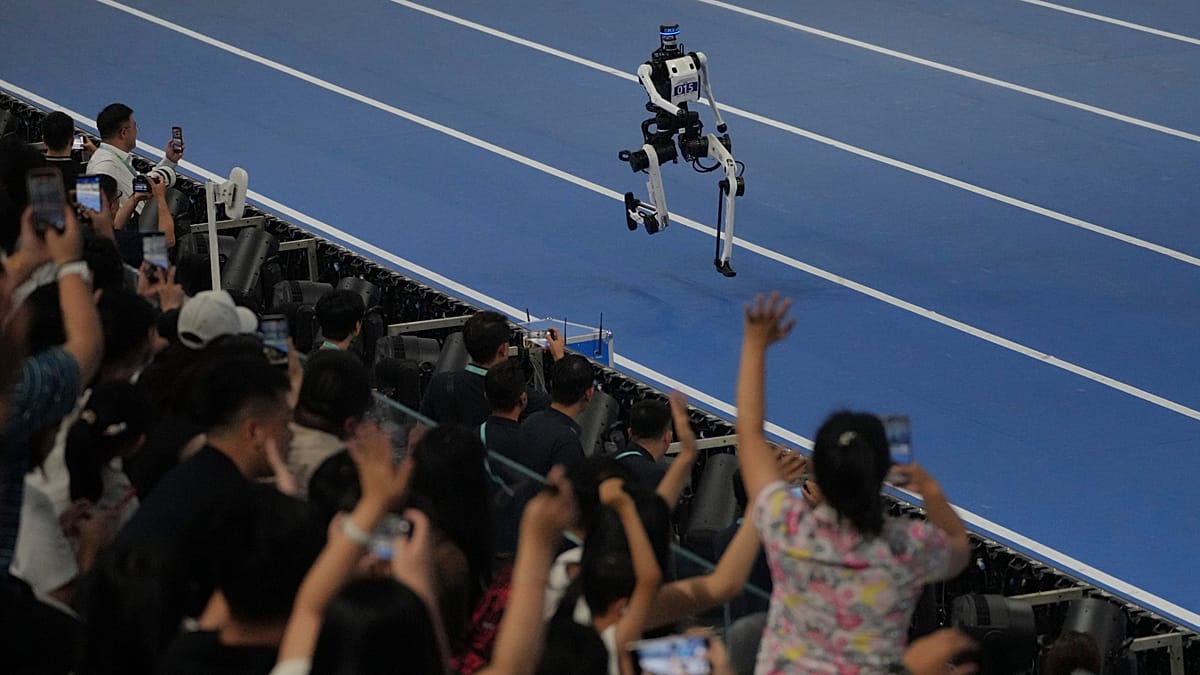
Beijing's recent Robot Games brought together over 2,000 machines for a spectacle that blended sport, technology, and tradition. Humanoid robots sprinted down tracks, dribbled footballs, and performed tai chi routines, offering a vivid demonstration of how far bipedal robotics have come.
The event, held in the Chinese capital, was less about medals and more about testing the limits of balance, coordination, and real-time decision-making. For engineers and researchers, it was a practical stress test: can a machine run without toppling, react to an opponent, or flow through a slow, deliberate martial arts sequence?
More than a spectacle
Behind the playful competitions lies serious engineering. Humanoid robots are notoriously difficult to stabilize, especially when moving at speed or adapting to uneven surfaces. The Beijing games pushed these systems to their limits, with many robots stumbling or falling—but that, organizers say, is part of the point.
"Every fall is data," noted one robotics engineer at the venue. "We learn more from a failed sprint than from a perfect walk." That sentiment echoes across the industry, where progress is measured in incremental improvements in actuators, sensors, and control algorithms.
The event also highlighted the growing global interest in humanoid robotics. While China has made significant strides, European research institutions and companies remain key players. From Germany's Fraunhofer Institute to Switzerland's ETH Zurich, teams are working on similar challenges, often in collaboration with Asian counterparts.
The record-breaking sprint by the TienKung robot earlier this year showed that humanoids can approach elite human speeds, at least over short distances. The Beijing games built on that momentum, with several robots completing 100-meter dashes in under 15 seconds—still far from Usain Bolt's 9.58, but impressive for machines that weigh as much as an adult.
Football matches were a particular crowd favorite. Robots passed, tackled, and occasionally fell over in comical fashion, but the overall level of play was a clear step up from previous years. Teams from universities and tech firms fielded five-a-side squads, with some robots even executing penalty kicks.
Tai chi, a discipline that demands slow, controlled movements and precise weight shifting, proved an unexpected challenge. Many robots struggled with the fluid transitions, but a few managed sequences that would not look out of place in a human class. The inclusion of tai chi underscores a broader trend: robots are being designed not just for industrial tasks but for social and cultural roles.
For Europe, the implications are twofold. On one hand, the event showcases the rapid pace of innovation in Asia, which could spur European investment in robotics. On the other, it raises questions about regulation and ethics. As humanoids become more capable, European policymakers will need to consider how these machines integrate into society—from care homes to factories.
The surge in interest in Unitree's dancing robots after their Shanghai debut is a reminder that public fascination can translate into market value. European investors are watching closely, and some are already funding startups that aim to bring similar technology to the continent.
Meanwhile, the planned rollout of robotaxis in European cities by Uber and Pony.ai shows that autonomous systems are moving from labs to streets. Humanoid robots may follow a similar path, though the challenges are greater.
The Beijing Robot Games may not have the global following of the Olympics, but for those in the field, it is a key date on the calendar. As one European attendee put it, "We come here to see what the future looks like—and to make sure we're part of building it."