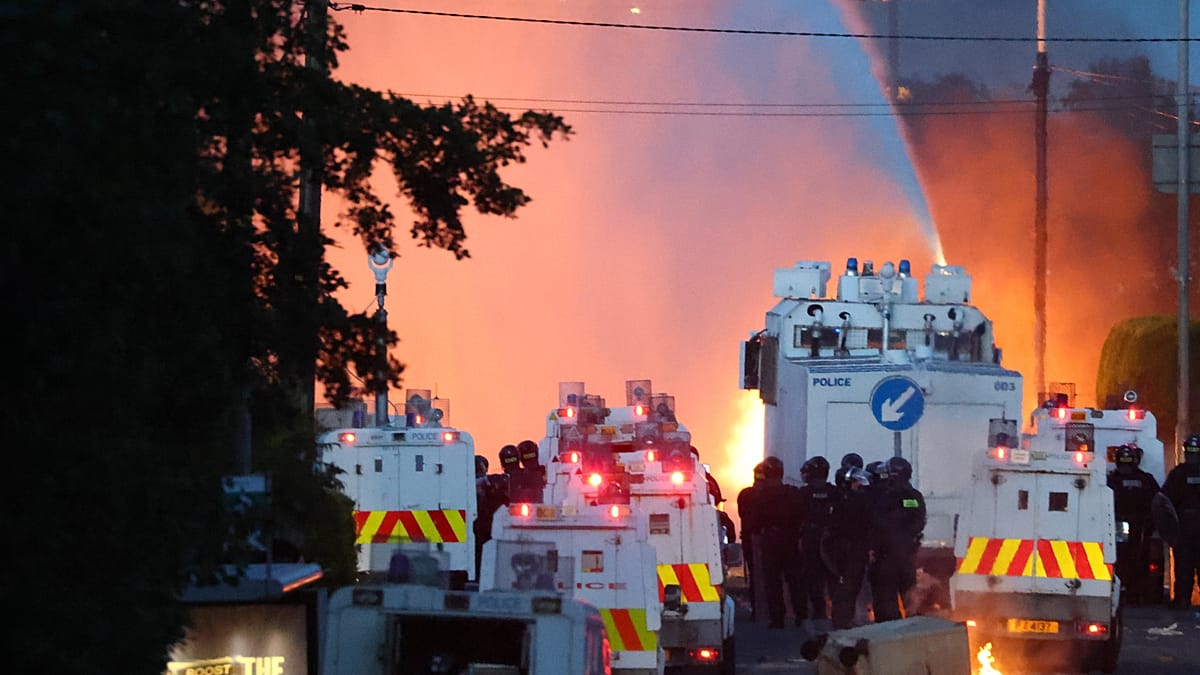
Police in Belfast deployed water cannon against protesters on Wednesday evening as anti-immigration demonstrations escalated for a second consecutive night. The unrest follows a brutal knife attack earlier this week that left a local man with severe injuries.
Hundreds of demonstrators, many dressed in black and wearing masks, gathered in east Belfast, hurling bricks and bottles at police lines and setting vehicles and bins alight. Officers responded with water cannon, a tactic rarely used in Northern Ireland, as they sought to disperse the crowds. The violence came despite repeated calls for calm from political and community leaders.
The disorder began on Tuesday night after graphic video footage of the stabbing circulated online. The clip showed a man straddling another in the middle of a street, slashing at his face and neck with a knife before bystanders intervened. The victim, Stephen Ogilvie, remains in hospital with severe injuries to his eyes, face, and back.
A 30-year-old Sudanese man, identified in court as Hadi Alodid, has been arrested and charged with attempted murder in connection with the attack.
Victim's Family Condemns Violence
In a statement released on Wednesday, Ogilvie's family expressed devastation over the attack but said they were "disgusted" by the subsequent violence. "We have many migrants who make a deeply valuable contribution to our country, including from within our healthcare system and hospitality sector, and we depend on them to make our country work," the statement read. "We do not want this terrible tragedy to be used to divide people or fuel hostility — do not do this in the name of our loved one as we do not share the same values."
The family's appeal stands in stark contrast to the actions of far-right figures who have sought to exploit the stabbing to stoke anti-immigrant sentiment. Similar unrest has been reported in parts of Scotland, where protests also turned violent on Tuesday night.
British Prime Minister Keir Starmer condemned the disorder as "completely unacceptable" and urged calm. "There is no justification for the acts of violence and arson that we saw in Belfast last night," he wrote on social media on Wednesday. "We must let the police get on with their work."
The violence has drawn comparisons to previous anti-immigration protests in Belfast that left homes burned and families displaced. Northern Ireland has seen a rise in tensions over migration in recent months, mirroring trends across Europe. In Brussels, mass protests over alleged police brutality have also highlighted deep societal divisions, while in Paris, protests surged after the murder of an 11-year-old girl, underscoring the continent's struggle with violence and public anger.
Local community leaders in Belfast have called for dialogue and urged residents not to let the actions of a few define the city. "This is not who we are," said one community worker who asked not to be named. "We have a long history of overcoming division, and we must not let hatred win."
The police have vowed to maintain order and are investigating the stabbing and the subsequent protests. As the city braces for further possible unrest, the focus remains on the victim's recovery and the broader implications for social cohesion in Northern Ireland and beyond.