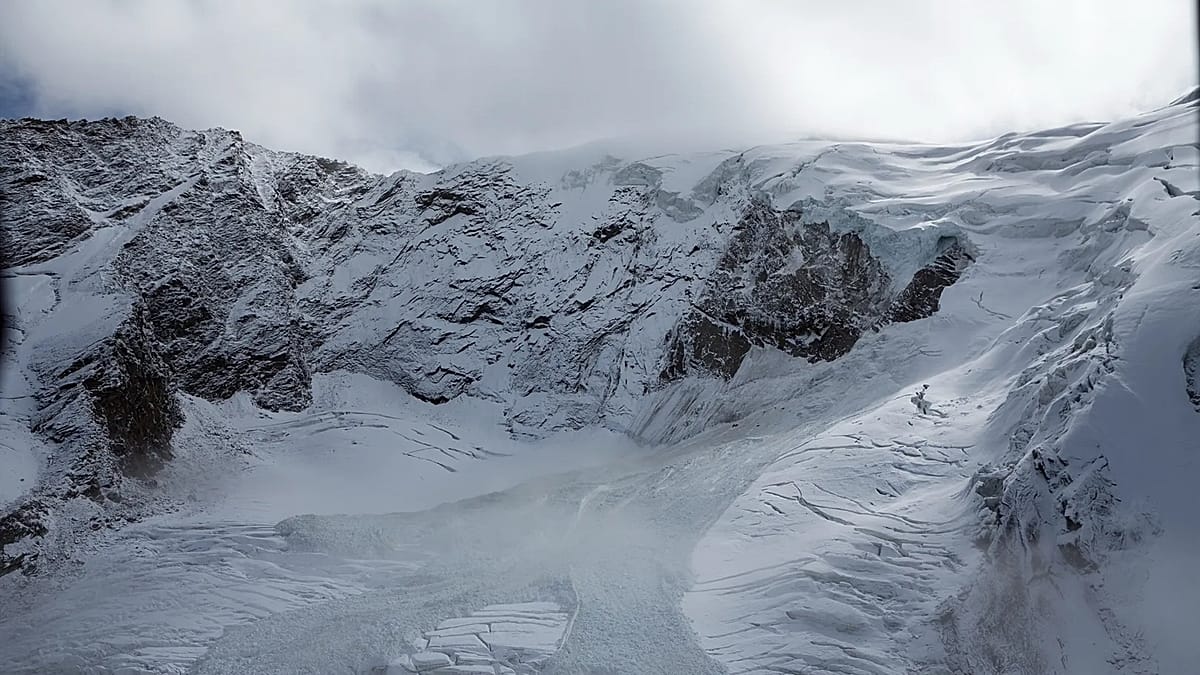
Nearly 34 years after they vanished during a storm on a Swiss peak, the remains of two Belgian climbers have been recovered from the melting Trift Glacier, authorities in the canton of Valais confirmed on Wednesday.
A hiker spotted the remains on 26 July on the glacier in southern Switzerland, close to the Italian border. Police in Valais said the bodies were transported to the Institute of Forensic Medicine at Wallis Hospital in Sion for examination.
“A direct comparison of DNA profiles has formally established that these are two mountaineers who went missing in the Weissmies region in 1992,” the police statement read.
The two men had set out from the Weissmies hut on 4 September 1992, intending to summit the 4,017-metre Weissmies peak and continue to the Almagell hut. But they were caught in severe weather and never arrived. In the following months, search teams found a rucksack but no trace of the climbers.
A glacier’s slow reveal
The Trift Glacier, like many across the Alps, has been retreating at an accelerating pace due to rising global temperatures. As the ice withdraws, it has increasingly uncovered the remains of mountaineers who disappeared decades ago—a phenomenon that has become more frequent in recent years.
Valais police maintain records of missing persons dating back to 1925, with most cases linked to mountainous terrain and rivers. The canton, which includes iconic peaks such as the Matterhorn and Monte Rosa, has seen several such recoveries as glaciers shrink.
In 2017, the remains of a German climber missing since 1987 were found on the Theodul Glacier. Two years later, the body of a British mountaineer who vanished in 1970 was discovered on the same glacier. Each case brings closure to families who have waited decades for answers.
The identification of the Belgian climbers was made possible through DNA profiling, a technique that was not available at the time of their disappearance. The forensic team in Sion compared the profiles with samples provided by relatives, confirming the match.
While the recovery brings a measure of resolution, it also underscores the broader impact of climate change on the Alpine environment. Glaciers in Switzerland have lost more than half their volume since the early 1930s, and scientists warn that many will disappear entirely by the end of the century if emissions continue unabated.
The melting ice has also revealed other artifacts, from lost equipment to, in rare cases, aircraft wreckage. In 2012, the remains of a German pilot and his plane, which crashed in 1968, were found on the Gauli Glacier.
For the families of the two Belgian climbers, the news brings an end to a long and painful uncertainty. The police have not released their names, respecting the privacy of the relatives.
As the climate continues to warm, the Alps are yielding more of their secrets. Each discovery is a reminder of the risks that mountaineers have faced for generations—and of the changing landscape that now reveals what was once hidden.