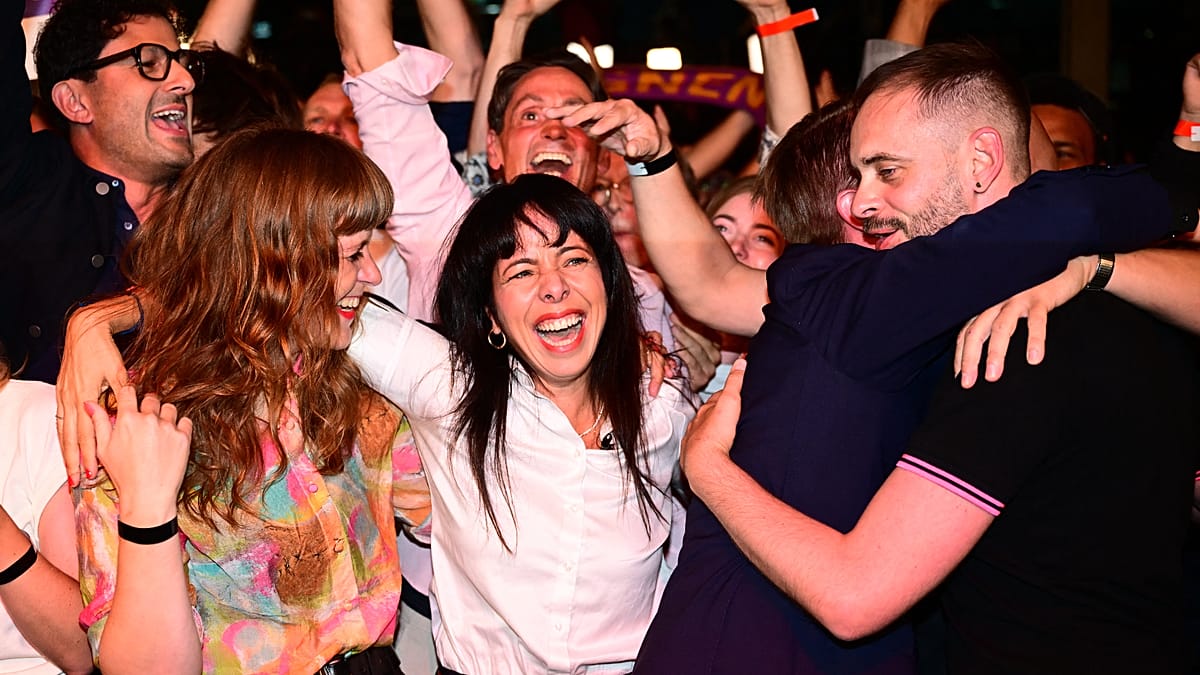
Germany's last state elections of the year have redrawn the country's political map. In Berlin, the Left party emerged as the strongest force for the first time, while in the northeastern state of Mecklenburg-Western Pomerania, the far-right AfD came out on top. The Christian Democratic Union (CDU) suffered heavy losses in both states, and the Social Democrats (SPD) made significant gains under state premier Manuela Schwesig.
According to the latest Infratest dimap projection, the Left won 25.7% of the vote in Berlin, followed by the CDU with 18.8%, the AfD with 16.3%, and the Greens with 14.3%. The SPD fell further behind to 12.1%, while the left-conservative BSW narrowly cleared the 5% threshold to enter parliament. The result means the previous CDU-SPD coalition in the capital no longer holds a majority.
In Mecklenburg-Western Pomerania, the AfD leads with 38.2%, closely followed by the SPD at 35.5%. The CDU recorded its worst result in the state's history with just 4.9%, while the Left, Greens, and BSW all hover around or just above the threshold for parliamentary representation.
Merz calls CDU result a 'disaster'
Chancellor Friedrich Merz did not mince words when reacting to the CDU's performance in Mecklenburg-Western Pomerania. "It is a disaster," he said at the party's headquarters in Berlin, adding that there was no way to "sugar-coat" the outcome. He said his party had been "squeezed out" as the contest narrowed to a battle between the SPD and the AfD.
If the CDU's final vote share stays below 5%, it would mark the first time the party fails to win any seats in a state legislature anywhere in Germany. In Berlin, by contrast, Merz acknowledged that CDU lead candidate Stefan Evers had secured a "respectable result" despite a difficult starting position.
Merz then broadened his remarks to the national situation, warning that Germany had become too complicated and that its economy was facing profound change. He noted that public debate was increasingly heated and trust in institutions was declining. He called for further reforms, arguing that the disruption they would bring—and the fact that they would not be universally popular—had to be accepted. He ended by warning of the "authoritarian poison" that he said was increasingly finding its way into society through the "fascination with authoritarianism." As CDU leader and chancellor, he said he wanted to take responsibility, and that Germany must once again become a "country of new beginnings."
AfD claims right to govern, but Schwesig may stay
Following the result in Mecklenburg-Western Pomerania, AfD lead candidate Leif-Erik Holm claimed the right to form the next state government. He said the party would "naturally also talk to all the other parties" in an effort "to get things moving." "It's about the people of our state. We want to improve politics," Holm told German public broadcaster ARD.
Asked about possible cooperation with other parties, Holm pointed out that the AfD in Mecklenburg-Western Pomerania is not being monitored by the Federal Office for the Protection of the Constitution. He described the party's programme as "conservative," covering education, the economy, and security.
Despite the AfD's lead, SPD state premier Manuela Schwesig could remain in office. During the campaign, she placed herself at the centre of the SPD's effort with the slogan "Woman against Blue," a reference to the AfD's party colour. Speaking to ZDF, Schwesig described it as the "toughest state election" her party had ever faced, but said the SPD had stood up to the AfD "with substance, with people, with clarity and with a united effort."
Schwesig's political record includes her past support for Nord Stream 2. In 2021, her state government set up the Foundation for Climate and Environmental Protection MV, which backed the pipeline's construction. After Russia invaded Ukraine, Schwesig acknowledged that her position at the time had been a mistake. During a visit to Kyiv in 2024, she said that "Ukraine must win this war" and backed further arms deliveries.
Berlin's 'Mamdani effect'
Berlin's Left party made social issues and affordable housing key themes of its campaign, with lead candidate Elif Eralp also looking to New York. After left-wing Democrat Zohran Mamdani won the New York mayoral election, she told the German Press Agency (dpa): "If a left-wing candidate can win in New York, then there's no reason it can't happen in Berlin."
The Left has now emerged as the strongest party in Berlin for the first time. If Eralp becomes governing mayor, she would be the first mayor of Berlin from a migrant background. Her parents fled Turkey for Germany in 1980, while Eralp was born in Munich. The housing crisis was at the heart of her campaign. She called for tighter regulation of rents, more social housing, and further moves towards bringing large housing portfolios into public ownership.
The results come amid broader debates about Germany's political future, including the appointment of a new NATO military chief and tensions over Chinese car imports. As the country prepares for a new political cycle, the outcomes in Berlin and Mecklenburg-Western Pomerania signal a fragmented electorate and a challenging path for coalition-building.