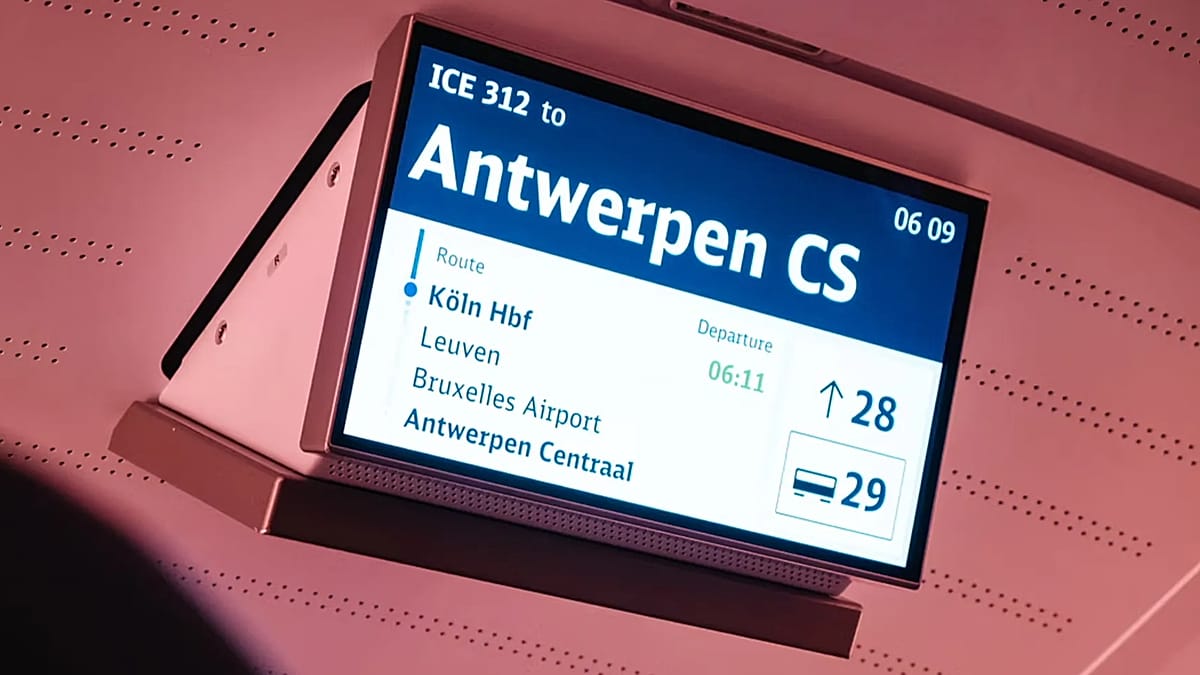
For the first time in more than ten years, international high-speed rail services are once again calling at Brussels Airport. On the morning of 7 September, a Deutsche Bahn ICE train pulled into the station beneath the terminal, marking the start of a new link that ties Belgium's largest airport back into Europe's fast-growing rail network.
The service originates at Cologne Hauptbahnhof and calls at Aachen, Liège, Leuven before reaching its final stop at Antwerpen-Centraal. Two return journeys will operate daily, giving travellers from western Germany a direct rail option to the airport and, conversely, allowing those flying out of Brussels to continue their journey into Germany without changing trains.
A new intermodal hub
The launch follows an agreement signed in February between Brussels Airlines and Deutsche Bahn. Under the partnership, passengers flying with Brussels Airlines from or to western Germany can book their rail and flight segments on a single ticket, with the train journey treated as a feeder leg. This opens up the airline's network of more than 180 destinations worldwide to travellers who previously had to navigate separate bookings or rely on short-haul flights.
Arnaud Feist, chief executive of Brussels Airport, described the arrival of the high-speed service as "an important step in the further development of Brussels Airport as an intermodal hub." He added: "We want to offer travellers a range of sustainable options to travel efficiently to and from the airport, across national borders." Feist also expressed hope that this would be the catalyst for even more high-speed connections in the future, as airports across Europe increasingly position themselves as multimodal gateways.
The airport's train station, located directly below the terminal, makes the transfer seamless for passengers. For those arriving by rail, the check-in desks are just a short escalator ride away. The convenience is a key selling point, especially as European travellers become more conscious of the carbon footprint of short-haul flights.
Early demand and top destinations
According to Brussels Airlines, more than 1,000 tickets have already been sold since the partnership was announced in February. The most popular single-ticket rail-and-flight itineraries so far are to New York, Accra, and Alicante, reflecting a mix of long-haul and leisure routes. The airline also notes that passengers benefit from a guaranteed connection in case of delays, and they can earn miles through Lufthansa's Miles & More programme.
Dr. Michael Peterson, Deutsche Bahn's board member for long-distance passenger transport, said: "Direct to Antwerp, direct to Brussels Airport, and all on our state-of-the-art trains: this is how we're making international rail travel even easier and more appealing for passengers."
The new service is part of a broader trend across Europe to integrate rail and air travel, reducing the need for short-haul flights and cutting emissions. Similar initiatives have been launched in Germany, France, and Austria, and the European Commission has been pushing for more seamless cross-border rail connections. The recent tests of Italy's Frecciarossa on German and Austrian rails underscore the growing competition and cooperation in the sector.
For Brussels, the return of high-speed rail to its airport is a significant boost. The city has long been a hub for EU institutions, and the new link improves connectivity for diplomats, business travellers, and tourists alike. It also aligns with Belgium's efforts to promote sustainable mobility, a priority that has gained urgency after a summer of extreme heatwaves that led to nearly 3,000 excess deaths.
While the initial service is limited to two daily return trips, both Brussels Airport and Deutsche Bahn have signalled that expansion is possible if demand warrants. The airport's CEO has been vocal about his ambition to see more high-speed connections, potentially to other European cities, in the coming years. For now, travellers between western Germany and Brussels Airport have a new, sustainable option that was missing for over a decade.