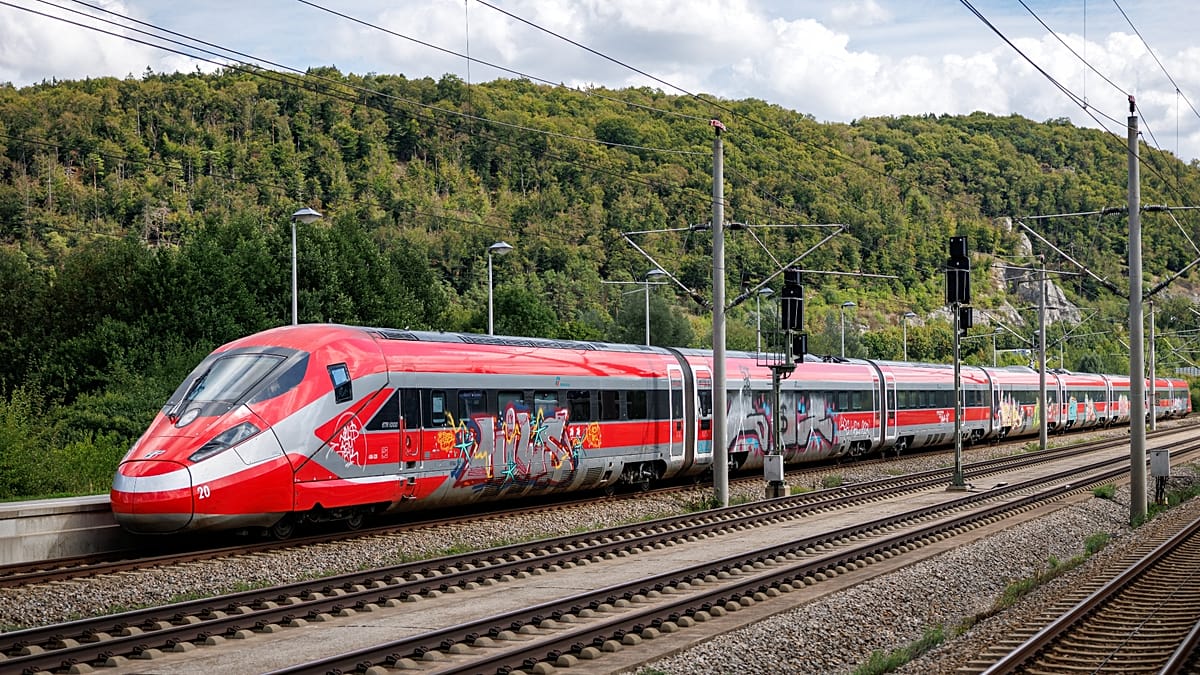
Italy's state-owned railway group, Ferrovie dello Stato (FS), has started trial operations of its Frecciarossa high-speed trains on German and Austrian tracks, moving a step closer to direct rail connections between Rome, Milan, and Munich. The tests are part of the international certification process required before the new services can carry passengers.
FS announced that, pending successful approval of the trains, commercial services between Milan and Munich and between Rome and Munich are scheduled to begin in the summer of 2027. The initiative is being developed in partnership with Germany's Deutsche Bahn and Austria's ÖBB, reflecting a broader push to integrate Europe's fragmented high-speed rail networks.
Expanding beyond France and Spain
Frecciarossa already operates in France and Spain, and FS has set its sights on the United Kingdom via the Channel Tunnel by 2029. The German and Austrian trials mark the next phase of this international expansion, bringing Italian high-speed technology into the heart of Central Europe.
The opening of the Brenner Base Tunnel, a major infrastructure project under the Alps, is expected to reduce journey times by roughly an hour. From December 2028, the full timetable will include ten daily connections between Italy and Germany, covering Milan–Munich and Rome–Munich, with later extensions to Naples and Berlin.
Planned stops and journey times
The commercial plan envisages four daily services on each of the two routes. On the Milan–Munich line, with a journey time of about six and a half hours, the main intermediate stops will be Brescia, Verona, Rovereto, Trento, Bolzano, and Innsbruck. The Rome–Munich service, taking around eight and a half hours, will call at Florence, Bologna, Verona, Rovereto, Trento, Bolzano, and Innsbruck.
These connections are designed to cater to both business and leisure travellers, offering a competitive alternative to air travel on one of Europe's busiest corridors.
Towards a 'European Metro'
Gianpiero Strisciuglio, CEO and general manager of FS, described the start of test runs as "a step towards delivering a project that confirms our ambition to make the train the benchmark mode of transport for mobility across Europe." He added that the partnership with Deutsche Bahn and ÖBB is "moving towards creating the High-Speed 'European Metro', offering passengers a service able to bring regions, people and economies closer together."
Strisciuglio also stressed that Frecciarossa's international growth path "takes the FS Group's technological and industrial excellence abroad and helps to develop an increasingly integrated European rail network."
Italian Transport Minister Matteo Salvini welcomed the milestone, calling it "a further step confirming the growth of the FS Group and its ability to win new markets abroad, while providing better services and infrastructure in Italy. More jobs, more connections, more Italy in Europe."
The collaboration with Deutsche Bahn extends beyond track access. The two companies will share technical expertise to adapt the trains to different power-supply and signalling systems, a process that is often a bottleneck for cross-border rail operations. Training programmes for German and Austrian drivers have already been launched alongside the construction of the prototype trains.
The Frecciarossa, built to European interoperability standards, is designed to operate on the rail networks of Italy, France, Germany, Spain, Austria, Switzerland, the Netherlands, and Belgium. The new connections are also expected to capture demand for onward travel to destinations such as Frankfurt and Krakow, further extending the reach of Italy's high-speed rail into the continent.
As Europe pushes for more sustainable cross-border transport, the success of these tests could signal a new era for rail travel between the Mediterranean and Central Europe. The transformation of Munich as a hub for business and innovation only adds to the potential demand for faster, greener connections.