The first Cappadocia Biennial has turned the surreal valleys and rock-hewn settlements of central Turkey into an open-air gallery, inviting visitors to reconsider the relationship between contemporary art and the land it inhabits. Running across Göreme, Ürgüp, Avanos, Uçhisar, Ortahisar, Mustafapaşa, and Kayaşehir in Nevşehir province, the event is less a conventional exhibition and more a curated journey through a landscape shaped by millennia of human and geological history.
Organised by the art collective Sinemasal, the biennial adopts the theme “Birth” as a metaphor for renewal and transformation, both personal and collective. The curatorial vision deliberately moves beyond aesthetics, encouraging audiences to reflect on urgent issues such as natural disasters, armed conflict, economic instability, migration, and inequality. Basic needs—housing, food, education, healthcare—emerge as recurring motifs across the works, grounding the art in lived realities rather than abstract concepts.
Art embedded in place
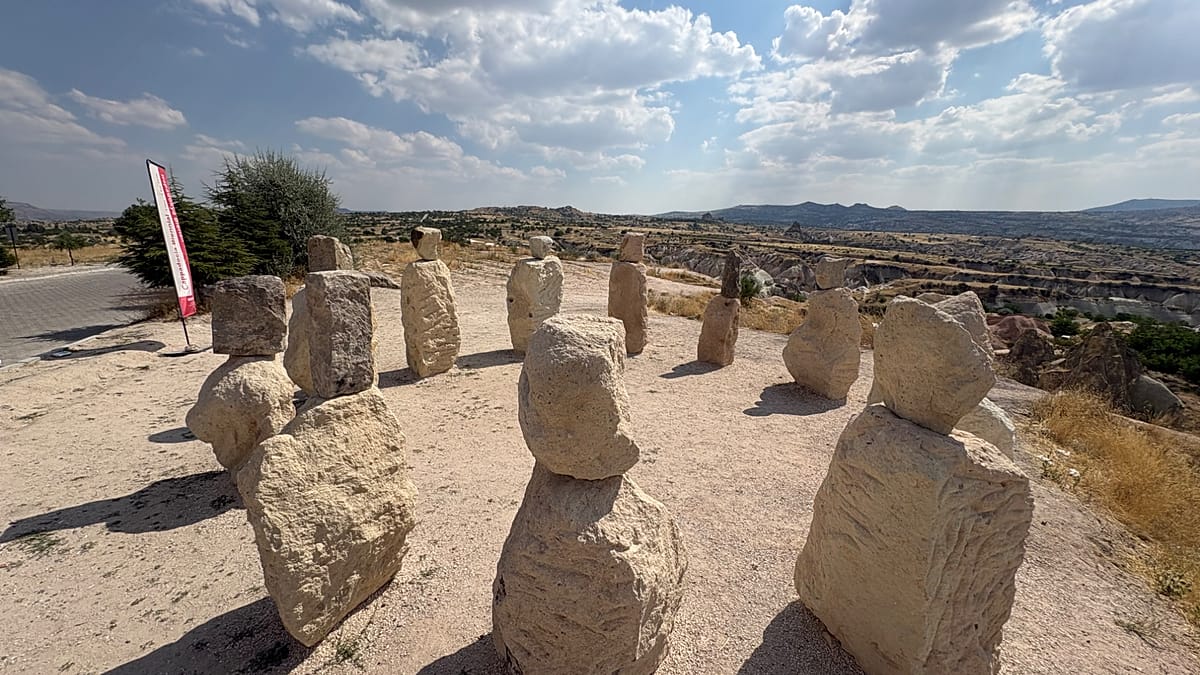
What distinguishes this biennial is its insistence on site-specificity. Works are placed inside caves, between ancient stone walls, and in the quiet of the valleys, so that each piece becomes inseparable from its surroundings. A photograph of a migrant family gains new resonance when viewed from a hollowed-out dwelling that once sheltered generations; an AI-generated installation feels eerily at home in a landscape that has inspired human creativity for centuries.
The theme of “Birth” is explored through a wide range of media—photography, video, installation, AI-assisted pieces, and works crafted from natural materials. Some artists address migration and belonging, others turn to the memory of stone or the power of human imagination. At every stop, visitors encounter a different facet of the same idea, making the biennial a layered, almost archaeological experience.
One of the most striking aspects is how the region itself becomes a protagonist. Cappadocia’s timeless atmosphere, its fairy chimneys and underground cities, do not merely serve as a backdrop; they complete the artworks. Many pieces establish such a strong spatial dialogue that they would lose their meaning if relocated. This symbiotic relationship is the biennial’s greatest strength—the works do not borrow Cappadocia’s spirit; they coexist with it.
Interactive elements further deepen the experience. In several installations, the audience shifts from passive observer to active participant, shaping the narrative or the production itself. This participatory approach, championed by the organisers, is not just theoretical—it is built into the visitor’s journey, turning each walk through the valleys into a personal discovery.
Cappadocia already draws millions of tourists each year, and the biennial adds a new layer to its appeal. By weaving contemporary art into the region’s natural and historical fabric, the event strengthens cultural tourism and offers a fresh way to engage with a landscape that is often seen only through postcards. The new luxury hotel in Uçhisar is a sign of the area’s growing allure, but the biennial suggests a more thoughtful kind of travel—one that values discovery over spectacle.
The inaugural edition has made a confident start, with a strong curatorial concept and a deep respect for place. If it can raise its international profile in the coming years, the Cappadocia Biennial could become a major meeting point for contemporary art and cultural heritage, not just in Turkey but across the wider European and Mediterranean region. For now, it offers a compelling model for how art can help us see familiar places anew.