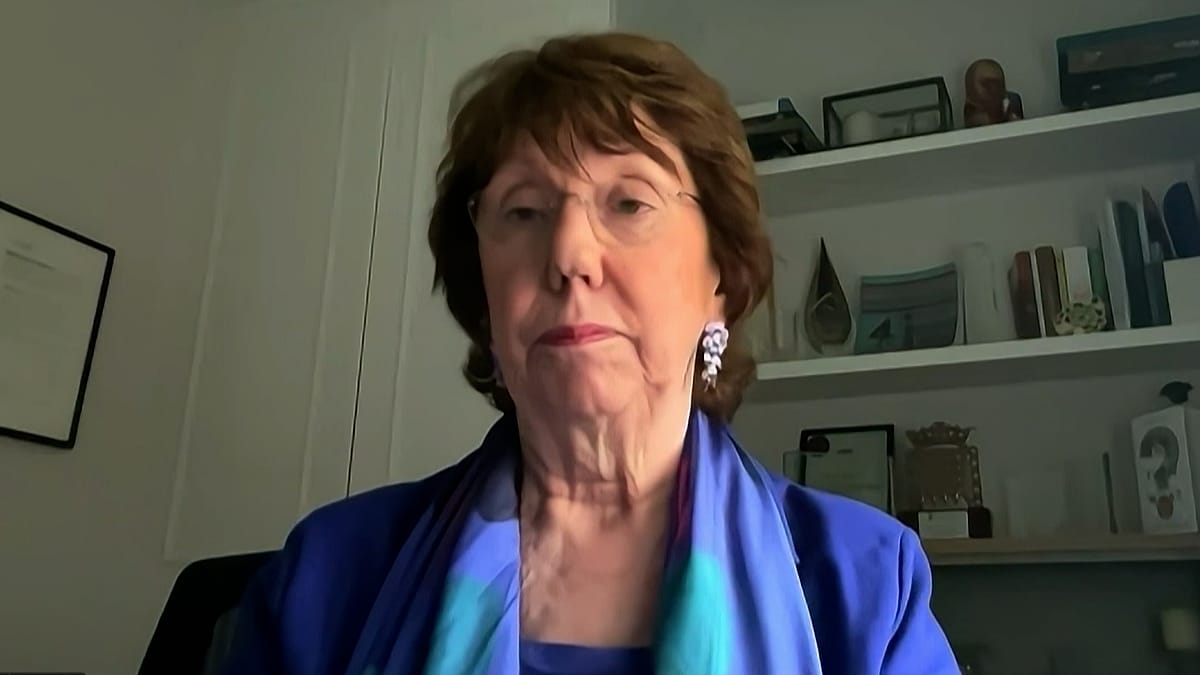
Hours before EU-US trade negotiations resumed in Brussels, Catherine Ashton — who served as both the European Union’s High Representative for Foreign Affairs and its Trade Commissioner — offered a blunt assessment of the transatlantic dynamic. Speaking to Europe Today, the British-born diplomat argued that US President Donald Trump approaches trade not as a mutually beneficial exchange but as a tool of coercion.
“Being a transactional president is the way that he wants to go forward, and I think that’s how Europe — or any country — has to respond: by trying to work through that,” Ashton said. She elaborated that Trump sees “the willingness of others to talk to him about trade as both an important part of the conversation, but in a sense, almost to weaponise it, to make clear that if we don't do things that he thinks are really important, then we can't expect the benefits.”
The comments come as the EU scrambles to formulate a response to Trump’s threat of a 25% tariff on European cars and car parts — a move that would hit manufacturers in Germany, France, Italy, and beyond. European Commission President Ursula von der Leyen has insisted that “a deal is a deal,” pointing to the final stages of implementing a key pillar of the EU-US trade agreement designed to eliminate tariffs on a wide range of American products. French President Emmanuel Macron warned on Tuesday that the EU has “tools to respond,” referencing the bloc’s anti-coercion instrument.
Ashton’s Confidence in Šefčovič
Ashton, who helped resolve a transatlantic beef dispute during her tenure as Trade Commissioner in 2008, expressed confidence in the current EU Trade Commissioner, Maroš Šefčovič. “I don't want to give him advice because he will know this particular team far better than I do,” she said. “He was there when I was there and he's still there and there's a good reason for that.” Šefčovič, a seasoned Slovak diplomat, now leads the EU’s efforts to finalise the deal from the European side.
The stakes are high. The EU has already prepared a range of retaliatory measures, as detailed in our earlier coverage. But Ashton warned that the trade dispute cannot be viewed in isolation.
Geopolitical Pressures Demand Collective Action
Ashton pointed to the broader geopolitical landscape, particularly the conflict in the Middle East, as a reason for Europe to prioritise cooperation. “With everything happening globally, especially in the Middle East right now, we are entering a period where additional challenges will require collective action. The more we can work together on trade, the better,” she said.
The crisis escalated after US and Israeli forces launched operations in Iran on 28 February, prompting Tehran to effectively close the Strait of Hormuz — a vital chokepoint for global oil and gas exports. The US subsequently imposed a naval blockade on Iranian ports. Trump has indefinitely extended what was initially a two-week ceasefire, but the conflict’s economic fallout continues to drive energy prices upward. The US has paused its Hormuz naval escort mission, as we reported, but the situation remains volatile.
During her tenure as the EU’s top diplomat from 2009 to 2014, Ashton helped broker the temporary suspension of Iran’s nuclear activities in exchange for sanctions relief, working within the P5+1 group (the US, UK, Germany, France, Russia, and China). With Iran’s chief negotiator Mohammad Bagher Ghalibaf warning the US on Tuesday that “we have not even started yet,” Ashton expressed concern about the escalation of rhetoric. “I think there's a different approach that's being taken (now). It's much more to raise the temperature rather than to lower it,” she said. “But the European Union's always had a role, a potential role, to play in all of this. Now it is about trying to find and work out exactly what that could be.”
As the EU navigates both a trade confrontation and a geopolitical crisis, Ashton’s message is clear: consistency and collective action are essential. The bloc’s response — whether through tariffs, diplomacy, or a combination of both — will test its ability to act as a unified force in a fragmented world.