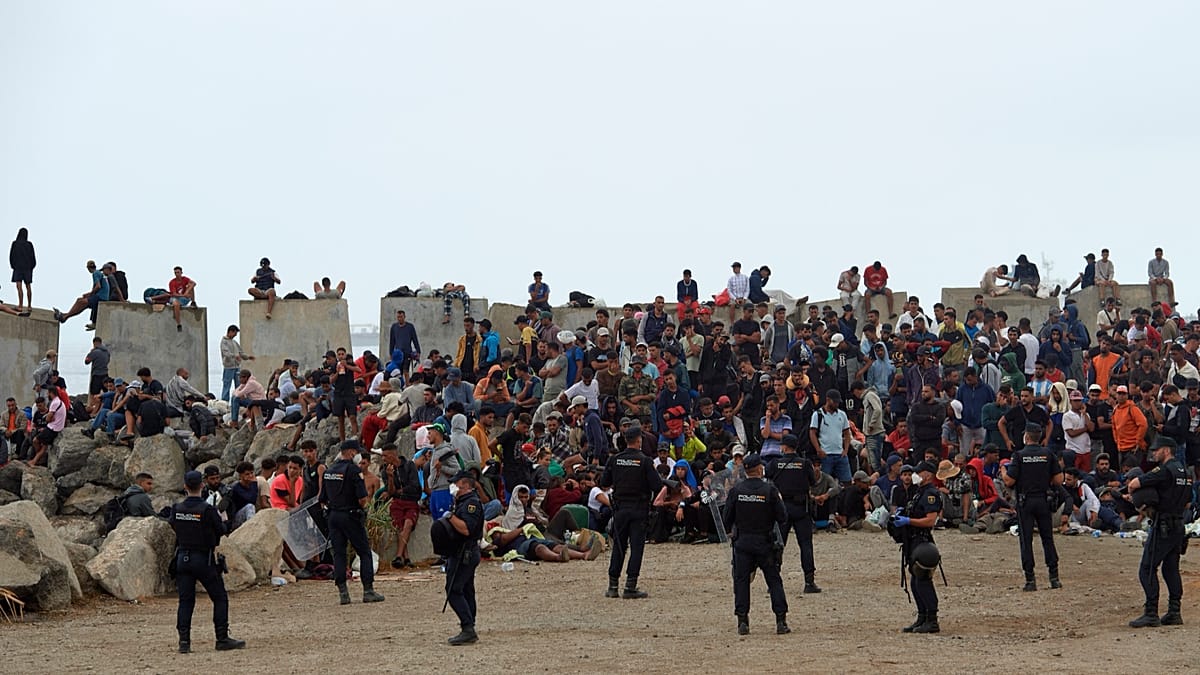
The Spanish government has formally requested assistance from the European Commission to help manage the ongoing migrant crisis in the North African enclave of Ceuta. According to multiple Spanish media reports, Interior Minister Fernando Grande-Marlaska has asked for the deployment of Frontex, Europol, and the European Union Agency for Asylum (EUAA) to bolster the screening and processing of migrants who remain in the territory irregularly.
The Interior Ministry in Madrid has also called for the extension of Operation Minerva, a joint initiative between the Spanish national police and Frontex, until 2 September, or until the situation in Ceuta is resolved. The request includes EUAA support for conducting interviews and providing interpreters, with the process expected to be carried out electronically due to space constraints in the enclave.
Ceuta, a Spanish autonomous city of roughly 80,000 people, has been under severe strain since at least 72,000 migrants crossed from Morocco in a mass influx in July. While most have since left, thousands remain, many sleeping on beaches and wandering the streets. The city's assembly unanimously approved an institutional declaration on Friday, warning that Ceuta is in an “extreme situation, on the verge of collapse.”
“Ceuta has lost its way of life and its calm. We do not have much time to avert disaster,” said Juan Vivas, the city's president. The declaration calls on the central government to act “immediately and without further delay,” urging the return of those who entered during the mass influx “in accordance with the law” and supporting the right to peaceful protest, while condemning recent violent incidents.
Vivas stressed that no one should take the law into their own hands, adding that “the defence of Ceuta and the interests of its people can only be pursued through legality.” The city has also requested a package of “extraordinary” border measures, including extending the Tarajal and Benzú breakwaters, installing permanent maritime containment buoys, deploying aerial drones, and adding light intervention vessels and remotely operated underwater devices.
Violence and political tensions
Meanwhile, tensions have boiled over into clashes between residents and police. On Thursday, protesters at a beach where migrants have been sleeping confronted officers, and some belongings were burned. A soldier was injured in a separate incident when migrants threw stones at troops, and 12 Moroccan migrants were arrested. Two more arrests followed after an attack on a police officer.
Interior Minister Grande-Marlaska appealed for calm in parliament on Friday, saying, “Violence is not the answer.” He called for an end to any form of violence, noting that it is not the way to resolve problems of such complexity. He also accused right-wing and far-right parties of “inciting hatred and confrontation” in Ceuta, after they demanded that all migrants be rounded up and deported.
The Spanish government maintains that each individual must be identified to determine whether they qualify for asylum or are subject to deportation, with special protection for unaccompanied minors. The situation has drawn attention across Europe, with earlier clashes and unrest continuing in the enclave.
Spain's request for EU support comes as the bloc grapples with broader migration challenges. The European Commission has yet to respond publicly, but the move signals Madrid's desire for a coordinated European response. The crisis has also reignited debate over border management and solidarity among member states, with Ceuta serving as a flashpoint for the EU's external borders.
As the situation evolves, the Spanish government faces the delicate task of balancing security concerns with humanitarian obligations. The coming weeks will be critical in determining whether Ceuta can regain stability and whether the EU's assistance will be sufficient to prevent a further deterioration.