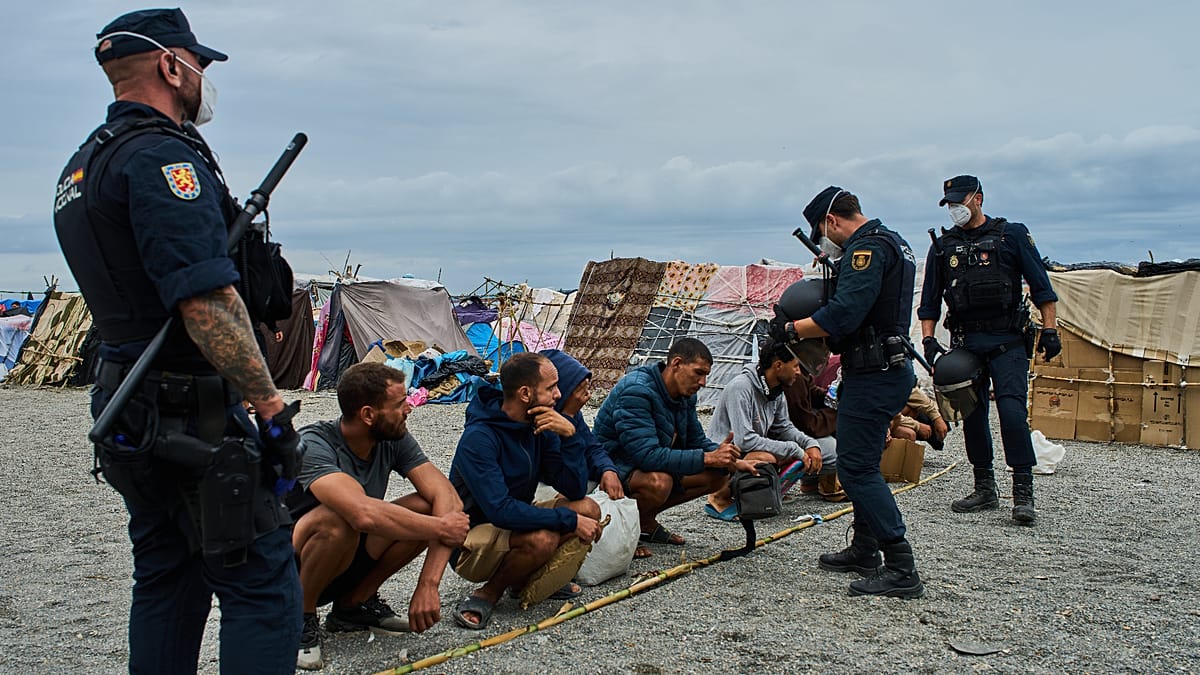
Spanish riot police began clearing the largest makeshift migrant camp in the North African enclave of Ceuta on Sunday, in an operation timed ahead of a visit by King Felipe VI and Queen Letizia. The camp, located on Trampolín beach, has been home to roughly 3,500 people for more than two months, living in tents and shacks under increasingly precarious conditions.
Operation Trampolín, as it has been named, involves officers from the Police Intervention Unit (UIP) brought in from Seville, Granada, Málaga and other mainland cities, alongside local Prevention and Reaction Units (UPR) and intelligence personnel. Police sealed off all access points to the beach early in the morning, blocking both escape routes into the surrounding hills and potential clashes with residents.
Authorities justified the operation by citing the deteriorating situation at the site. The waters off Trampolín are contaminated, they said, making it impossible to guarantee safety. They also pointed to a clear health risk and a rise in violent incidents, including recent stabbings and other violence that have heightened tensions in the enclave.
Extra vehicles were shipped from mainland Spain this week, including two BMR armoured vehicles and a Vamtac S3 off-road vehicle, according to local newspaper El Faro de Ceuta. A drone monitored the operation from above, providing aerial surveillance of the sprawling settlement.
Relocation begins
Officers went tent to tent and shack to shack, informing occupants they had to leave, while interpreters explained in Arabic where they would be taken. The first phase includes women and children, though most of those affected are men. Buses began ferrying migrants to the Tarajal CATE reception centre, where triage and identification are carried out. The first bus departed shortly before 9 a.m., according to Radio Televisión Ceuta.
Some migrants may choose to return to their home countries, as several did after earlier clearances in the Benítez area. For now, reception facilities are available at Loma Colmenar, which can hold more than 1,000 people, and at the port. But the shortage of places remains the main obstacle. In mid-September, the port camp, built for 1,700 people, left more than 2,000 outside, forcing them back to the beaches.
This is the third such operation in a matter of weeks, following two in Benítez. The government has set 15 October as the deadline to complete the eviction, and the King and Queen are due to visit on the 13th. The royal visit is seen as a gesture of support for the enclave, which has been under severe strain from the migrant crisis.
The situation in Ceuta has drawn international attention, with French President Emmanuel Macron backing Spain and urging firm EU action. Meanwhile, the Spanish government has ordered a probe into alleged abuse of migrants by soldiers, adding to the sensitivity of the operation.
As the clearing continues, the focus shifts to the long-term challenge of managing migration flows into Europe's southern border. The European Union has been urged to adopt a more coordinated approach, but so far, member states remain divided. For Ceuta, the immediate priority is to complete the relocation safely and humanely, while addressing the root causes that drive people to risk their lives crossing into Europe.