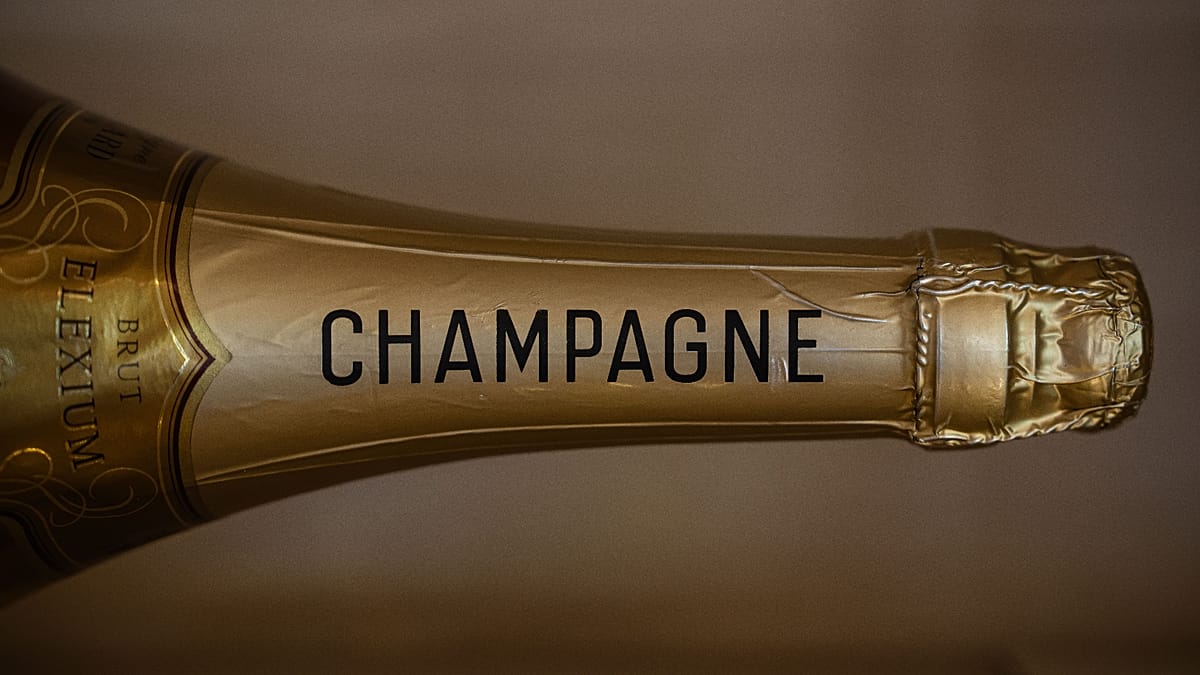
The Champagne region of France is bracing for one of its smallest harvests in decades, with output expected to fall by roughly half compared with a normal year. Yet consumers should not expect supermarket shelves to empty overnight. The reason lies in the long production cycle of sparkling wine and the industry's habit of keeping substantial reserves for exactly this kind of season.
According to preliminary figures from Agreste, the statistical arm of the French agriculture ministry, total French wine production in 2026 is forecast at 3.39 billion litres. That would be 6% below the previous year and 28% below the five-year average. If confirmed, it would be the smallest national crop since 1957. The decline is driven by a combination of spring frosts, hail, and an exceptionally dry summer that has shrunk grape bunches to their lightest weight in two decades.
Champagne is the hardest hit of all French wine regions. The harvest there is expected to plunge by 49% compared with 2025, and by 47% against the five-year average. Other regions are also suffering: Jura is down 36%, and Bourgogne-Beaujolais is off by 33%, with Burgundy's Pinot Noir losses exceeding 50%.
Why shelves won't empty immediately
The dramatic drop in this year's grape yield does not translate directly into fewer bottles of Champagne on the market. Champagne typically matures for several years before release, and producers hold large stocks of reserve wines from earlier harvests. These buffers are designed precisely to smooth out the impact of poor vintages.
Jean-Marie Cardebat, a professor at the University of Bordeaux and a specialist in wine economics, explained: "Champagne has lost roughly half of a normal harvest, but this will not translate into an immediate 50% fall in sales because producers can draw on extensive stocks and reserve wines."
The industry had already set a cautious sales limit for the 2026 harvest at 8,800 kilograms of grapes per hectare, only 2% below the previous year's cap, reflecting weaker demand and the need to manage inventories. The actual harvest is now expected to average no more than 7,000 kg/ha, according to the Syndicat Général des Vignerons de la Champagne — the lowest level since the 1980s.
Growers who fall short of the permitted yield cannot make up the difference. But the big Champagne houses can soften the blow by tapping into their reserves. Cardebat estimates the lost production is equivalent to roughly 140 million 75-centilitre bottles, representing about €2.7 billion in potential commercial value based on average turnover per bottle in 2025. He stressed, however, that this is not an immediate revenue loss because of the stock buffers.
Longer-term risks and a silver lining
While the immediate impact may be cushioned, the professor warned of a "major production and productivity shock" if small harvests become the norm. "Then stocks would decline, costs would rise, and Champagne could eventually become less able to supply all its markets," he told Euronews Business.
This would be the third consecutive very small French harvest, and many producers are already financially fragile. Demand has weakened while costs for energy, labour, machinery, and financing have climbed. Lower yields force producers to spread fixed costs over fewer bottles, squeezing margins. If another poor harvest follows, cash flow and investment capacity could suffer.
There is also a commercial risk: if Champagne cannot supply retailers consistently, it may lose shelf space to competitors such as Prosecco or Crémant, which could gain ground among shops and consumers.
Yet the smaller harvest is not entirely bad news. France has been struggling with excess supplies of some wines, particularly red wine, as consumption declines. A temporarily reduced crop can help drain surplus stocks and bring supply closer to demand without the need to uproot vineyards. As Cardebat put it: "Economically, lower production can be a way to rebalance the market."
The paradox is that a bad year for Champagne may actually help stabilise the broader French wine sector, even as it tests the resilience of the region's growers.