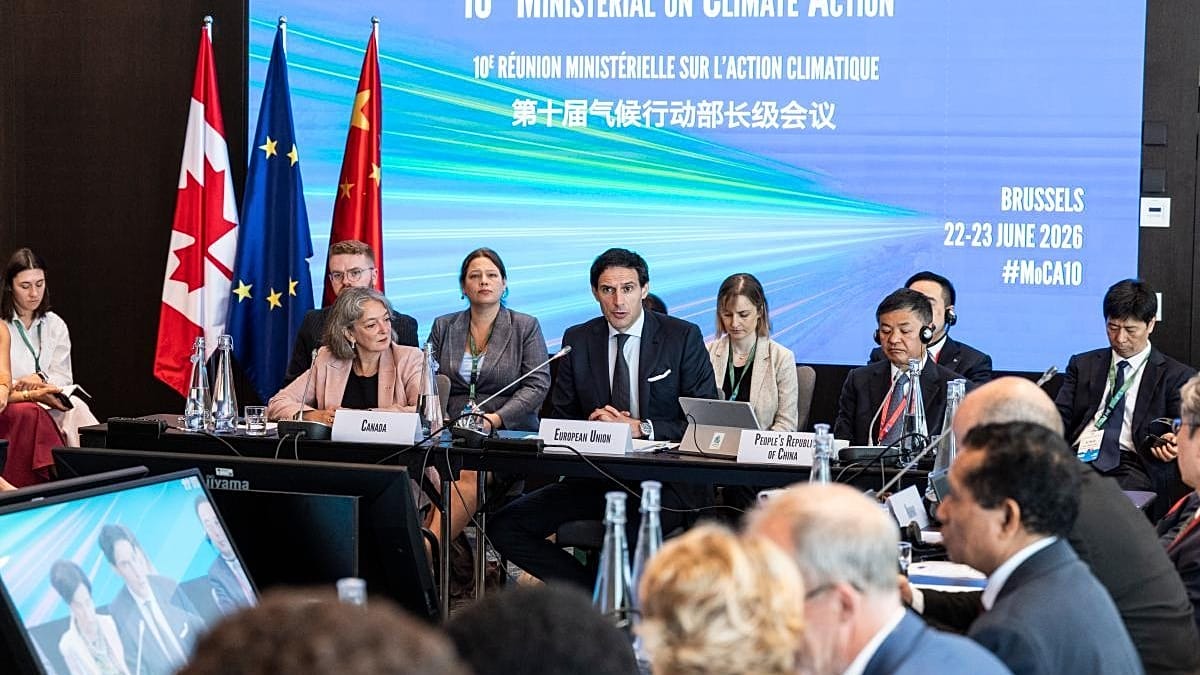
BRUSSELS — The European Union, China, and Canada used the annual Ministerial on Climate Action in Brussels to signal that global climate cooperation must continue despite the United States' retreat under President Donald Trump. Speaking on Monday, China's Minister for Ecology and Environment, Huang Runqiu, warned that “changing political circumstances” and the absence of individual leaders should not undermine collective commitments.
Huang's remarks, delivered alongside European Climate Commissioner Wopke Hoekstra and Canadian Environment Minister Julie Dabrusin, came as the three major economies discussed priorities for the upcoming COP31 summit in Antalya, Turkey. Washington, the world's second-largest emitter after China, skipped last year's COP30 in Brazil and formally quit the Paris Agreement, leaving a void in multilateral climate governance.
“We have a shared responsibility to safeguard commitments and ensure that international cooperation is not weakened by the absence of individual leaders or changing political circumstances,” Huang said. He stressed that China remains determined to do “even more,” pointing to Beijing's 15th Five-Year Plan, which outlines a roadmap for accelerating the green transition across economic and social development. China is also advancing an eco-environmental code that includes a dedicated chapter on low-carbon development and climate change response.
Huang highlighted China's achievements, including what he called the “world's largest carbon emissions trading market” and the “world's largest and fastest-growing renewable energy system.” He acknowledged that global turbulence—from Middle East conflicts disrupting energy markets to geopolitical uncertainty—tests countries' resolve. “It is precisely in such times that we must strengthen cooperation rather than retreat from it,” he maintained.
EU: Slowing the Transition Is Not an Option
Commissioner Hoekstra pushed back against any notion of slowing the green transition, despite high energy prices and industrial closures in Europe. “Climate action, energy, security and economic prosperity are mutually reinforcing and increasingly inseparable objectives,” he said. Electrification powered by clean energy, he argued, offers a pathway to greater energy security, stronger industrial competitiveness, and lower long-term costs.
Hoekstra reaffirmed the EU's support for climate science, including the work of the Intergovernmental Panel on Climate Change, and called for ambitious, credible Nationally Determined Contributions (NDCs) from all countries. He urged those that have not yet submitted updated NDCs to do so “as soon as possible,” noting that such plans provide certainty for investors and citizens while keeping the Paris Agreement goals within reach.
Looking ahead to COP31, Hoekstra described the conference as an “opportunity to move beyond promises and focus on implementation.” He emphasized the need to accelerate the transition away from fossil fuels, expand renewable energy, improve energy efficiency, and strengthen climate resilience. Delivering on these objectives, he said, is essential to preserving the possibility of limiting warming to 1.5°C.
Canada's Dabrusin presented her country's approach as “practical climate competitiveness,” aiming to reduce emissions while growing the economy. She cited policies such as decarbonizing transport and heavy industry, tightening methane regulations, modernizing electricity grids, and advancing biodiversity targets—including conserving 30% of land and oceans by 2030. Canada's economic expansion alongside declining emissions, she argued, proves that growth and decarbonization can go hand in hand.
“We're looking forward to COP31 in Antalya, Turkey, with a clear purpose: from promises to progress, from plans to implementation, from ambition to action,” Dabrusin said. She called on all parties to harness the mobilizing potential of the UNFCCC process to highlight how effective climate action strengthens competitiveness and fosters economic prosperity at the local level.
The meeting in Brussels comes as southern and western Europe grapple with a severe heatwave, underscoring the urgency of climate adaptation. The three ministers' unified stance signals that, even without the United States, major emitters are determined to keep the Paris Agreement process alive and push for tangible outcomes in Turkey later this year.