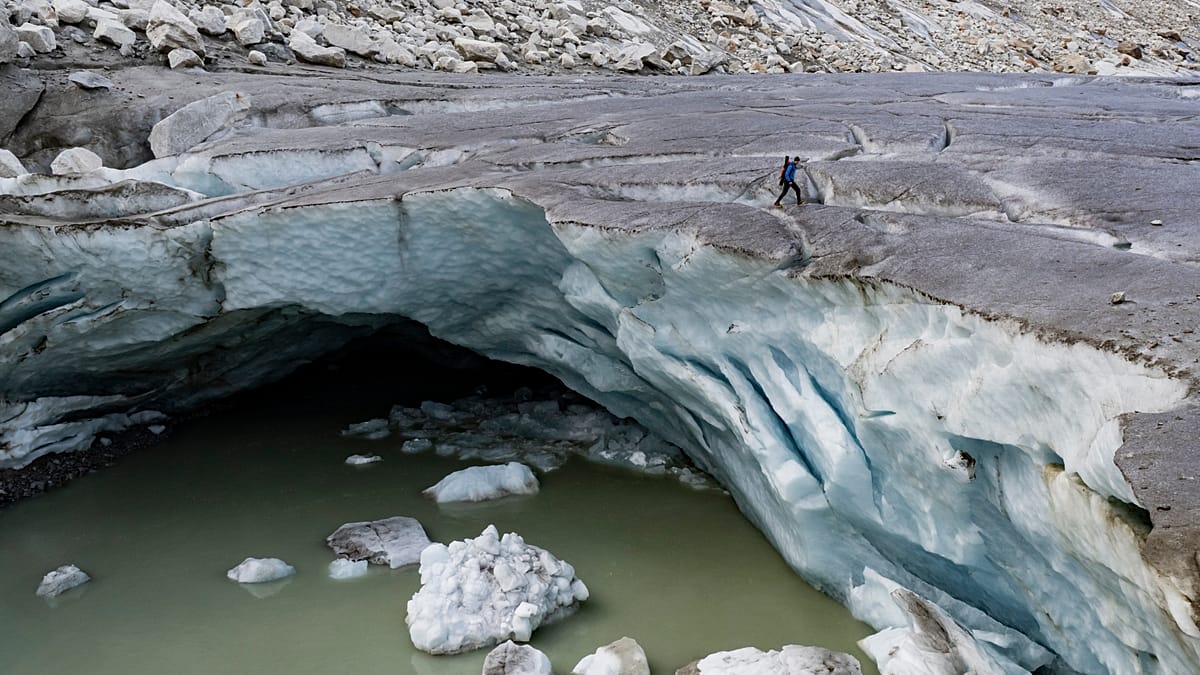
In the heart of the Swiss Alps, the Rhône Glacier is disappearing at an alarming rate. Over the past month, the glacier has shed more than four metres of ice, a direct consequence of two intense heatwaves that swept across Europe in June and July. The rapid melt is a stark reminder of how climate change is reshaping the continent's most iconic landscapes.
According to the Swiss Glacier Monitoring Service (GLAMOS), the glacier has been losing an average of 10 centimetres of ice per day since mid-June. Glaciologists attribute this accelerated loss to a combination of unusually low winter snowfall and sustained high temperatures, which have stripped the ice of its protective snow cover. The result is a glacier that is not only melting from the surface but also being eroded from within.
Melting from within: a new threat
Matthias Huss, glaciologist and head of GLAMOS, described the situation in stark terms. "This is a collapsing pit. The stream flowing beneath the glacier has carved out a large cavity. This cavity then collapsed. In recent years, we have been seeing more and more cases of glaciers melting from below, in addition to melting from above. These processes are eroding the glaciers from within. This is a major problem that is further accelerating the melting."
Measurements taken on the glacier illustrate the speed of the change. "We measure the amount of ice that melts. Since my last visit two weeks ago, we've lost 1.40 meters. That's a loss of 10 centimeters of ice per day! Since mid-June, when I first visited the Rhône Glacier this year, the loss has exceeded the height of this pole. So about 4 meters have disappeared in one month, between this point and that point. This is a significant amount of melting and, of course, very problematic for the glacier," Huss explained.
The rapid retreat is transforming the landscape. The lower sections of the Rhône Glacier are expected to vanish within years if current trends persist. "With these high melting rates, the glacier is retreating very rapidly. I think that in this area, there will be no more ice within 5 to 10 years. The glacier will only remain higher up on the mountain, where it's colder and there's more snow," said the glaciologist.
This year's poor conditions were set long before the summer heat arrived. Below-average snowfall left glaciers without the protective layer that normally slows melting. "So far, 2026 has been a very bad year for glaciers. We had little snow this winter, which resulted in a poor protective layer for the ice. We experienced early heat waves in May, June, and now in July," Huss noted.
The implications extend beyond Switzerland. Across the Alps, glaciers are retreating at unprecedented rates, affecting water supplies, tourism, and ecosystems. The coolcation trend is already reshaping European tourism as travellers seek cooler destinations, but the very landscapes they flock to are under threat.
Scientists warn that the current heatwaves are part of a broader pattern. Fire tornadoes have arrived in Europe as heatwaves intensify blazes, and the ECDC warns that longer heatwaves are expanding infectious disease risks across the continent. The melting of glaciers is yet another symptom of a warming world.
GLAMOS will continue to monitor the Rhône Glacier throughout the summer, but the latest measurements underscore the accelerating pace of glacier retreat in the Swiss Alps. If 2026 continues on this trajectory, it could rival the record losses of 2022, a year that already shocked glaciologists.
For now, the Rhône Glacier serves as a visible and measurable indicator of climate change's impact on Europe's high mountains. As the ice disappears, so too does a vital source of freshwater for millions of people downstream, and a symbol of the continent's natural heritage.