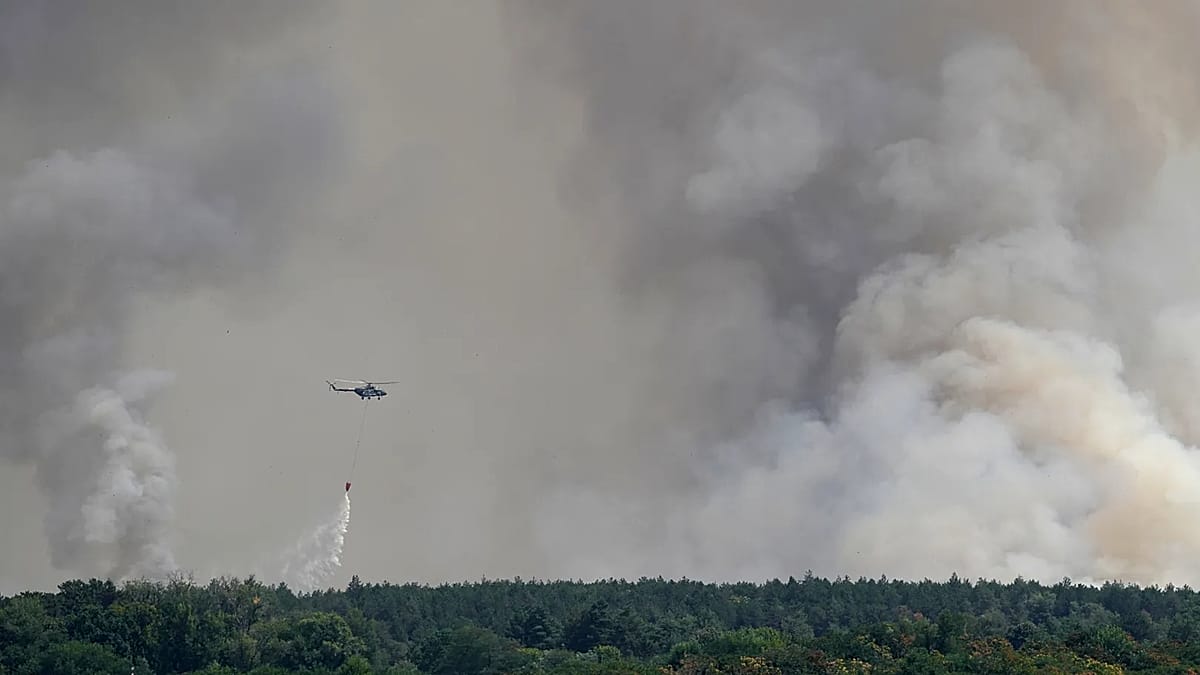
Firefighting crews across southeastern Europe are struggling to contain multiple wildfires as a prolonged heatwave pushes temperatures to 40°C. In Serbia, the most acute outbreaks are concentrated in the northeast and central regions, where dry terrain and strong winds have turned routine summer fires into major emergencies.
In the Deliblato Sands special natural reserve, about 50 kilometres east of Belgrade, ground teams and helicopters have been deployed against a blaze that has already scorched at least 700 hectares. The reserve, known for its steppe-like landscape and rare species, is particularly vulnerable to fire in these conditions. Local authorities have not yet given a containment estimate.
Near the town of Kraljevo, several fires have forced residents of nearby villages to evacuate. Locals say more than 150 acres of young pine forest have been destroyed in just a couple of days. “The damage is huge. It's a young pine wood forest, these pines were planted during the '80s,” one resident told The Associated Press. The loss is not only ecological but also economic, as the forest was managed for timber and local recreation.
On Thursday, another major fire swept through the Ibar valley in central Serbia. Water-bombing aircraft were called in to support crews working on rough terrain, with the priority being to protect villages at the valley's edge. The Serbian interior ministry has warned that the risk of new ignitions remains high, and that most fires are likely caused by human activity, whether accidental or deliberate.
Danube at record lows
The heatwave is also taking a heavy toll on the continent's rivers. The Danube, Europe's second-longest river, has fallen to record-low water levels in several stretches, particularly near the Djerdap II dam on the Romanian-Serbian border. Satellite images show exposed banks and stranded boats, a stark contrast to the river's usual summer flow.
In Hungary, the low water forced the temporary shutdown of the Paks nuclear power plant, the country's only nuclear facility, because it relies on Danube water for cooling. The plant's operator said the measure was precautionary and that power supply would be maintained through other sources. Still, the episode underscores how vulnerable energy systems are to climate extremes.
Serbia has also had to cut hydroelectric generation. Its two largest plants are now running at just 20 and 30 percent of capacity, respectively, according to the state power company. This has raised concerns about electricity imports and price spikes, especially as air conditioning demand soars across the region.
The situation is part of a broader pattern. Europe is the world's fastest-warming continent, with temperatures rising at roughly twice the global average, according to the European State of the Climate 2025 report. The report, published by the EU's Copernicus programme, highlights that heatwaves are becoming more frequent, longer, and more intense, with cascading effects on ecosystems, infrastructure, and public health.
Italy and France under pressure
In Italy, all major cities are under the highest heat alert as the heatwave persists. In the northern region of Emilia-Romagna, a wildfire broke out in a remote area near Vedriano, and firefighting efforts have been underway since Thursday afternoon. The terrain is difficult to access, and crews are using both ground teams and aircraft to prevent the fire from reaching populated areas.
In southern France, the large wildfire in the Var region that started on July 20 has stopped spreading, but firefighters remain on high alert. The blaze has burned more than 60 square kilometres, making it the largest in the region in decades. “It's a fire that can last over long periods of time. In the mornings, for example, it’s about setting up because fire risks with winds and rising heat increase in the afternoon,” said Chief Sergeant Anthony from the Marseille Naval Fire Battalion.
The repeated fires across southern Europe have raised questions about preparedness and prevention. As EU wildfire tools come under strain, experts argue that more investment in landscape management, early warning systems, and community-based prevention is needed. Some regions are experimenting with regenerative farming as a shield against wildfires, while others are looking at using European bison to reduce forest fuel.
For now, the immediate priority is containment. In Serbia, authorities have banned open fires in forests and are urging citizens to report any smoke immediately. The heatwave is expected to continue for at least another week, and with no significant rainfall in the forecast, the risk of new fires remains extreme.