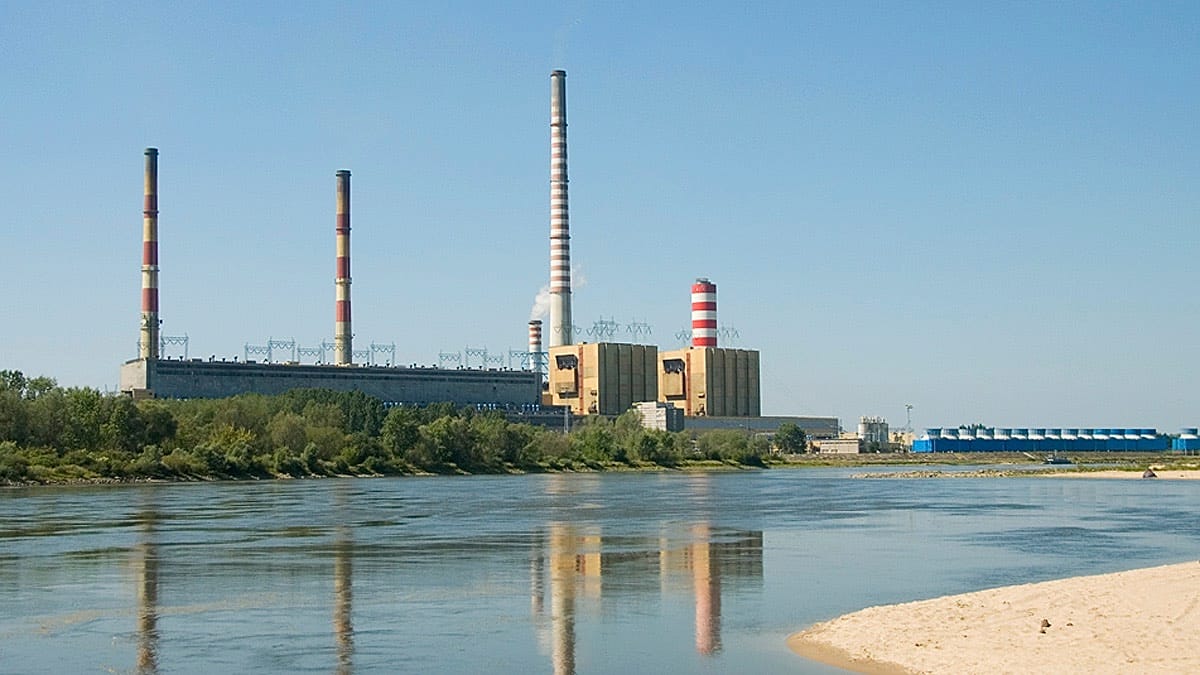
Poland's reliance on coal is proving increasingly costly as Europe's severe drought disrupts power generation. Earlier this month, utility Enea was forced to reduce output at its Kozienice and Połaniec coal plants after water levels in the Vistula River fell too low to support cooling systems. The move removed 1.3 gigawatts from the national grid—enough to power over a million homes—representing roughly two percent of Poland's electricity capacity.
River flow near the Kozienice plant dropped to just 135 cubic meters per second on 5 August, while the facility's cooling system requires 80–100 cubic meters per second—more than half of the remaining flow. This is not an isolated incident; similar thermal plants across Poland face the same vulnerability as droughts become more frequent and intense.
A paradox of the climate crisis
“This is the paradox of the climate crisis: power plants driving climate change are increasingly becoming its victims,” said Paweł Pomian, vice-president of the Polish environmental group EKO-UNIA. “As the Vistula River dries up, an energy system built around large thermal power plants loses its resilience. Kozienice isn’t unique. There are many plants with similar cooling systems across Poland and there will be more if the government continues to expand fossil gas.”
Pomian argues that the drought should serve as a wake-up call for Poland and the rest of Europe to accelerate the transition to solar and wind power, which require minimal water to generate electricity. Yet despite rapid solar growth—Poland added more than 20 GW of solar capacity between 2020 and 2025—the country still relies on coal for 51 percent of its electricity, according to energy think tank Ember. Wind and solar together account for just 25 percent of the mix, five percentage points below the EU average.
Poland has set a target of 51 percent renewable electricity generation and 64 GW of renewable capacity by 2030, but its coal addiction is proving difficult to break. Meanwhile, Enea is proceeding with plans to build a 1.3 GW gas-fired plant at the Kozienice site, despite evidence that the existing facility is killing millions of fish larvae, including six protected species. Experts warn that a new gas plant would continue to strain the Vistula's ecosystem through high cooling water demand.
“Coal plants are paying the price for the problems they created,” said Kasia Szeniawska, a campaigner at Beyond Fossil Fuels. “As heatwaves and droughts become more severe, it has exposed the weakness of fossil fuel-based energy systems. While most EU countries cut down their coal use, Poland is not only failing a timely phase-out, it’s also proposing new gas plants that will only aggravate environmental issues.”
Drought hits renewables too
The same dry conditions that crippled Poland's coal plants have also affected hydropower across the continent. According to energy intelligence firm Montel, inflows to reservoirs and run-of-river plants in Austria and Switzerland were nearly 50 percent below average in July. Austria's hydro production was only 51 percent of normal levels, while Switzerland saw 48 percent, Germany 63 percent, and France 68 percent.
These shortfalls can push countries back toward polluting sources, as seen last year when a 12 percent drop in EU hydropower contributed to an eight percent rise in gas generation. However, solar and wind often compensate: the same weather conditions that reduced hydro output boosted solar generation across Europe.
The situation in Poland echoes record lows on the Rhine and emergency energy talks over the Danube, as Europe's waterways shrink under climate stress. The record low in hydropower is a stark reminder that no energy source is immune to climate impacts.
For Poland, the choice is clear: continue investing in water-hungry thermal plants that are increasingly unreliable, or pivot to renewables that thrive in sunny, windy conditions. The drought has laid bare the fragility of fossil fuels, and the cost of inaction is rising with each dry summer.