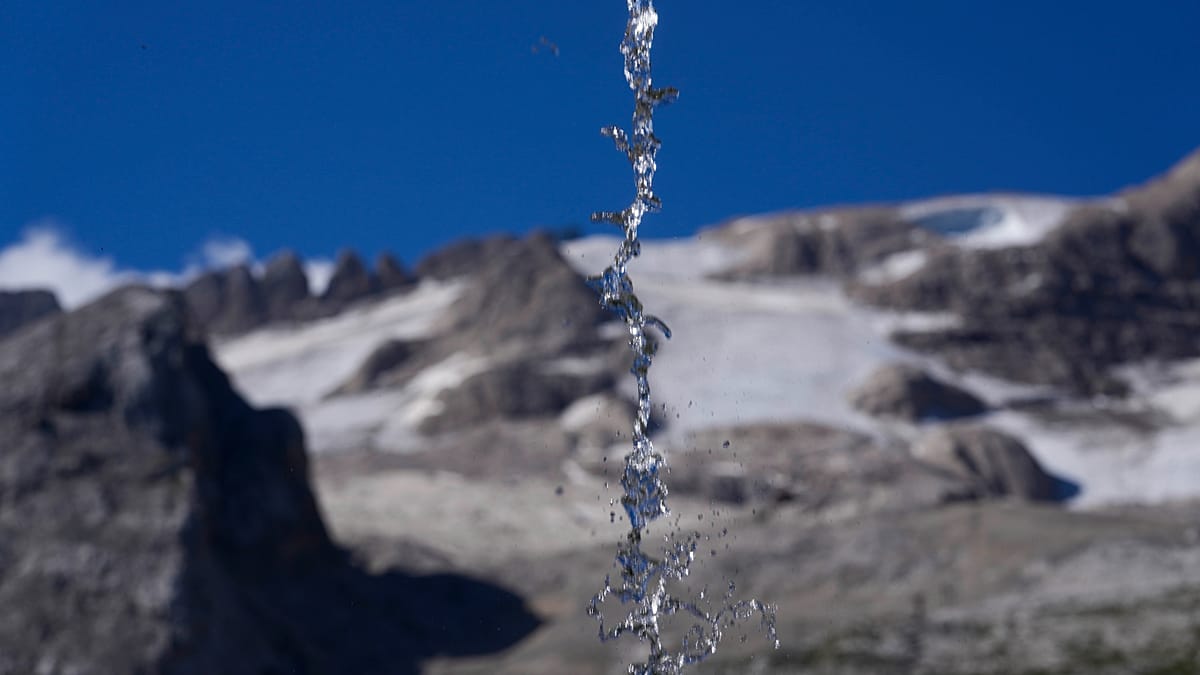
Europe's prolonged summer drought has pushed hydropower generation in the Alpine region to near-record lows, raising concerns about the continent's reliance on fossil fuels as a backup. Following successive heatwaves and scarce rainfall, much of the continent is parched, increasing wildfire risks that have forced evacuations in France, Spain, Greece, and Türkiye, and threatening harvests worth billions of euros.
According to the Combined Drought Indicator (CDI), alert conditions persisted in mid-July across parts of Ukraine, Belarus, and Poland, emerged in northeastern Iberia, and worsened in southern England, northern Italy, and central Europe—from France and southern Germany to Hungary and Romania, also affecting Switzerland, Austria, Czechia, Slovakia, and Serbia.
The dry spell has also disrupted Europe's clean energy mix. Record-low water levels on the Danube have forced Hungary to shut down its Paks nuclear plant—which supplies nearly half of the country's electricity—for the first time in almost fifty years. The emergency energy talks now being weighed by EU officials underscore the severity of the situation.
Hydropower output plummets
Data from energy intelligence firm Montel shows that inflows to reservoirs and run-of-river plants in Austria and Switzerland were nearly 50 percent below average in July. Austrian hydro production was just 51 percent of normal levels (compared to the last 15 years), while Switzerland managed only 48 percent. Germany and France also suffered, with output at 63 and 68 percent of normal, respectively.
Hydropower remains the EU's second-largest renewable electricity source, providing 28 percent of the bloc's power in the first quarter of 2026—more than solar (17.3 percent), combustible renewables (9.4 percent), and geothermal (0.4 percent). But the current shortfall is stark. "We are simply missing one-third of the water volume that our hydropower plants would normally process," says Michael Strugl, CEO of Austria's leading energy company Verbund.
Montel's senior hydrology analyst Eylert warns that Alpine countries may see no improvement until September, as forecasts point to several more weeks of hot, dry weather.
Gas as the fallback
Countries heavily dependent on hydropower, such as Portugal and Austria, are particularly vulnerable. When hydro output drops, utilities often turn to polluting fossil fuels. EU gas generation rose by eight percent last year compared to 2024, according to energy think-tank Ember, largely due to a 12 percent drop in annual hydro production caused by weather conditions.
However, the same weather boosted solar generation, which grew by more than 20 percent in 2025—its best year ever. This highlights the need for countries to diversify their renewable mix to withstand climate-driven extremes. Hydropower also complements inflexible renewables like wind and solar, acting as on-demand batteries that can be ramped up when demand peaks.
To avoid wasting clean energy due to grid constraints, experts advocate "hybridisation"—combining wind, solar, and storage behind a single grid connection. "By adding wind or solar at the same connection point as a hydropower plant, developers can get online faster and operators can use grid infrastructure more efficiently—on average doubling utilisation—while staying within export limits," says Elisabeth Cremona, energy infrastructures lead at Ember.
A recent Ember report found that across Austria, Bulgaria, France, Italy, Portugal, Romania, and Spain—the EU's major hydropower markets—hybridisation could integrate 18 percent of the new renewables expected by 2030 without requiring additional grid capacity. As the Rhine hits record lows and other waterways suffer, the urgency of such measures grows.
While gas remains a short-term stopgap, the long-term answer lies in accelerating the transition to a more resilient, diversified renewable energy system—one that can weather the increasingly erratic climate.