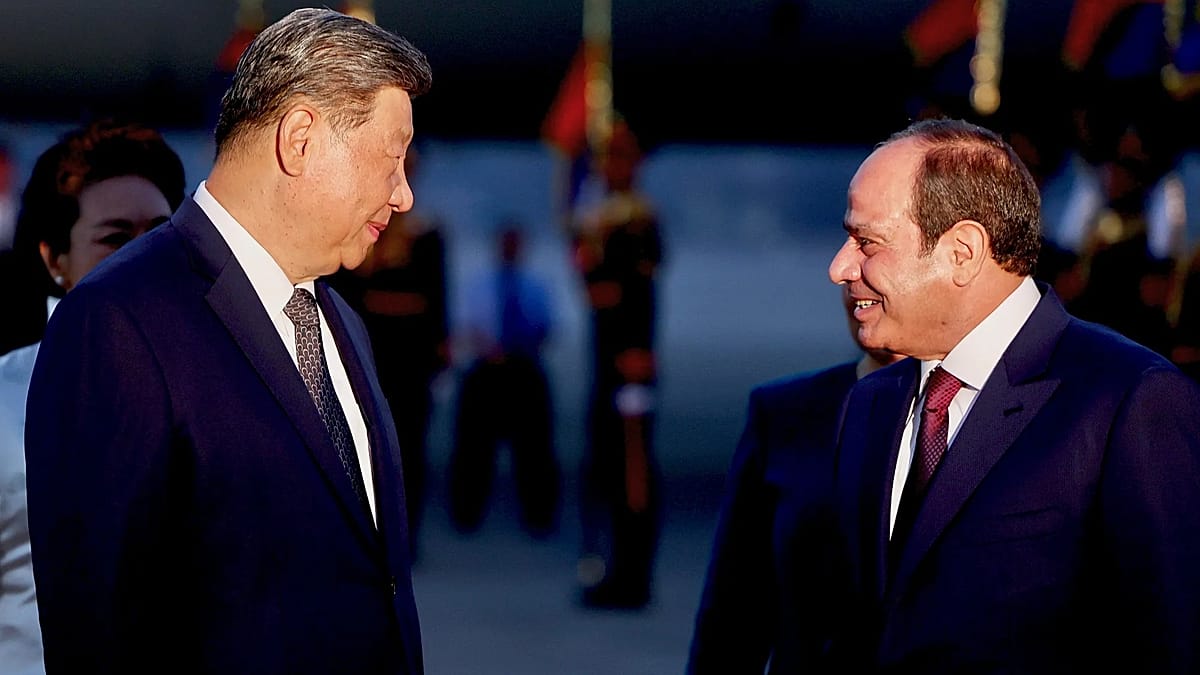
Chinese President Xi Jinping arrived in Cairo on Tuesday for his first visit since 2016, as Egypt and China celebrate seven decades of diplomatic relations. The trip underscores a relationship that has evolved from infrastructure and trade into a broader strategic partnership encompassing technology, defence, and regional diplomacy.
Since Xi's last visit, Chinese megaprojects have reshaped Egypt's urban landscape. The central business district of the New Administrative Capital, built by China State Construction Engineering Corporation, now features 20 skyscrapers, including the 385.8-metre Iconic Tower, the tallest building in Africa. A light rail system with Chinese involvement connects Cairo's eastern outskirts to new urban centres, and the China-Egypt TEDA industrial zone near the Suez Canal hosts more than 200 companies, creating over 10,000 direct jobs and attracting investments exceeding $4.7 billion (€4.05bn), according to Chinese figures.
The scope of cooperation is widening. Artificial intelligence, advanced manufacturing, and technology transfer are increasingly central to the economic agenda, while Chinese and Egyptian air forces have conducted their second joint exercise, named Eagles of Civilisation, running from mid-August into early September at Egyptian air bases. The drills include air combat tactics, air superiority operations, combat search and rescue, and joint force deployment.
Trade grows, but imbalances persist
Bilateral trade reached $11.3 billion (€9.75bn) in the first half of 2026, up 21.5% year-on-year, according to Egypt's Central Agency for Public Mobilisation and Statistics. Egyptian exports to China nearly tripled to $840.8 million (€725.4m), driven by fuel, mineral oil, fruit, vegetables, and cotton. However, imports from China hit $10.4 billion (€8.97bn), with machinery and electrical equipment alone accounting for $4.1 billion (€3.5bn), followed by vehicles, iron, steel, plastics, and chemicals.
Egypt seeks to rebalance this trade relationship by attracting Chinese investment in local manufacturing and technology transfer. A five-year programme (2024-2028) prioritises local production in electric vehicles, electronics, solar panels, chemicals, and modern agricultural technology, with AI listed as a key area. President Abdel Fattah el-Sisi said ahead of the visit that Egypt wants Chinese investment in EVs, battery storage, renewable energy, and shipbuilding, while expanding cooperation in telecommunications, AI, and space sciences.
The military dimension is becoming more visible. The joint air force exercises, first held only last year, signal a deliberate diversification of Egypt's defence partnerships. The United States remains Cairo's longstanding security partner, providing large-scale military assistance and supplying a significant portion of Egypt's equipment. Washington has not publicly commented on the Chinese drills, though the Pentagon has previously expressed concerns about Chinese military engagement with US partners in the Middle East and Africa.
Egypt's balancing act extends to its membership in BRICS, the New Development Bank, and the Shanghai Cooperation Organisation, alongside continued reliance on Western economic and security support. This multi-vector approach reflects Cairo's ambition to maximise its strategic options in a shifting global order.
For China, Egypt offers a market of over 100 million people, a strategic position on the Suez Canal, and political influence across the Arab world and Africa. Xi described Egypt as an important link between the two regions and called for deeper China-Arab and China-Africa cooperation through Cairo. The two governments share similar positions on several regional issues, including support for a Palestinian state, while Egypt maintains its One China policy.
Egypt was the first Arab and African country to establish diplomatic relations with the People's Republic of China in 1956. El-Sisi has visited China eight times since taking office in 2014, most recently in May 2024.
The deepening China-Egypt partnership has implications for Europe, which watches Beijing's growing influence in the Mediterranean and Africa with concern. The EU has been seeking to reduce its dependence on China in critical sectors, as highlighted by recent trade tensions and the push for concrete results from Beijing. Europe's interest in the region is also strategic, given its reliance on Suez Canal shipping lanes and its own defence partnerships in North Africa.
As China's footprint in Egypt expands, European policymakers will need to weigh the risks and opportunities. The EU's focus on breaking China's grip on critical minerals and its efforts to cut reliance on Chinese supply chains reflect a broader trend. The next phase of China-Egypt relations will be crucial, not only for the region but also for Europe's strategic posture.