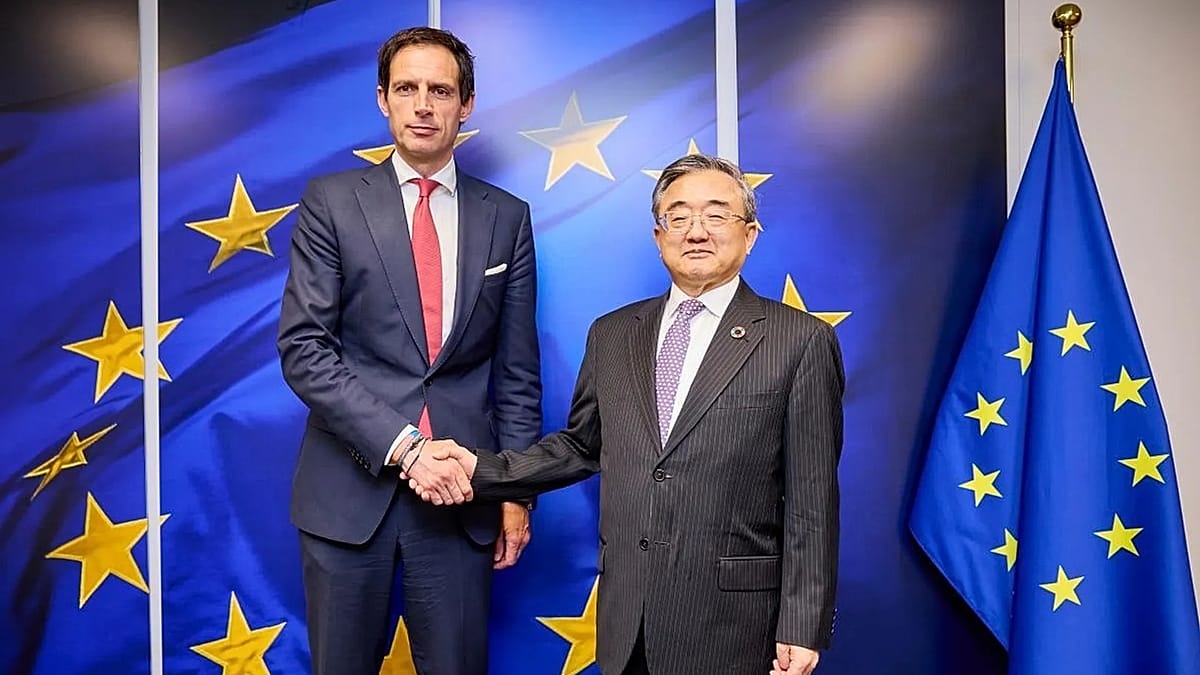
Europe must be prepared to pay more in the short term to reduce its reliance on China for clean-energy technologies, according to EU Climate Action Commissioner Wopke Hoekstra. In an interview with Euronews, the Dutch commissioner warned that postponing action would only deepen the bloc's strategic vulnerability and make it more costly to address later.
Hoekstra acknowledged that the EU should have confronted its dependence on Chinese manufacturing years ago. "We should have done this five to ten years ago," he said, adding that further delay would bring greater disruption and higher costs. "But it will be much cheaper and much more to our advantage to do it now than be wishy-washy and wait another five to 10 years."
A new dependency in the making
The EU is racing to deploy solar, wind, batteries, and other clean technologies to meet its 2050 climate neutrality goal. Yet Hoekstra cautioned that leaning too heavily on Chinese suppliers for electric vehicles, batteries, solar panels, and energy storage risks replacing one strategic dependency with another—echoing Europe's former reliance on Russian energy.
"This will stay with us for years to come, because the dependencies in many domains have simply become too large," he said, describing the situation as a "dangerous and uncomfortable" vulnerability for both Europe's climate ambitions and its economic security.
Chinese companies already dominate key parts of Europe's battery supply chain. According to Wood Mackenzie, they account for more than 80% of the bloc's residential battery energy storage market and nearly 88% of lithium-ion battery imports. The EU's dependence on China for critical raw materials is equally deep-rooted.
The issue has climbed the EU's political agenda as the rapid expansion of wind and solar power outpaces the development of storage infrastructure. EU energy ministers recently discussed the bloc's reliance on Chinese-made storage during a meeting under the Cyprus EU Presidency.
Trade tensions and strategic concerns
The broader trade relationship is also under strain. The EU's trade deficit with China reached a record €1 billion a day in 2025, prompting European leaders to call for a rebalancing of what they describe as "unsustainable" economic relations.
"Dialogue with China remains necessary. But it must produce results. And when dialogue is not enough, we must be ready to make full use of our instruments," Commission President Ursula von der Leyen said on 27 August.
Brussels has already taken measures to protect the European market, targeting Chinese companies over issues including illegal products, state subsidies, and foreign investment. Beijing has threatened retaliation.
Hoekstra pointed to Europe's solar industry as a warning of what can happen when domestic production loses out to heavily subsidised Chinese imports. But he went further, raising concerns about alleged Chinese interference and security risks involving critical infrastructure in Europe.
"Kill switches are being included in windmills. Espionage happens at a very high degree on European soil. Intellectual property theft in our most advanced companies happens on a weekly basis and on and on and on—that is something no government and the EU can simply allow," he said.
These comments come as Brussels seeks tangible progress in its economic relationship with Beijing. Technical talks between the EU and China are expected to advance in October, with EU Trade Commissioner Maroš Šefčovič expected to travel to China.
For Hoekstra, the goal is not to end trade with China but to ensure that Europe is no longer vulnerable to a single external supplier for technologies critical to its energy transition. As he has argued elsewhere, climate resilience and EU security are two sides of the same coin. The commissioner has also urged the EU to invest in climate prevention and confront China on trade, while his recent accusations of unfair trade practices underscore the mounting friction.