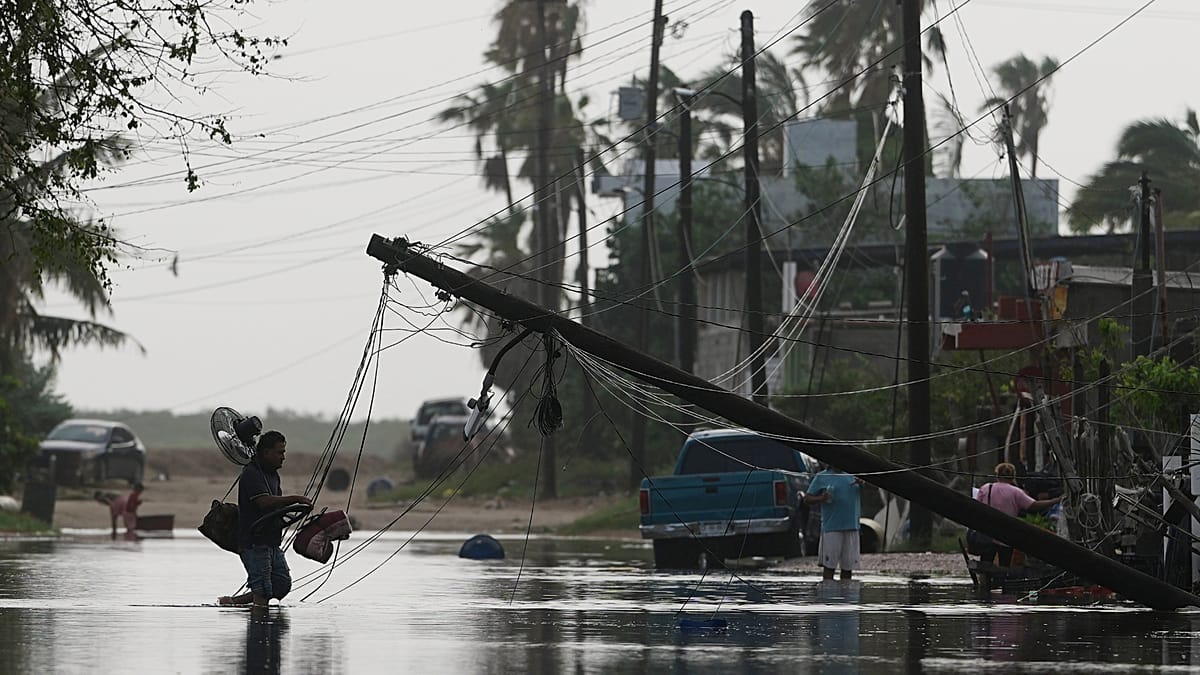
When Hurricane Polo tore through the eastern Pacific last month, it became the longest-lasting Category 5 storm on record for that basin. Now, a new analysis shows that while El Niño gave it a significant boost, climate change played an even larger role in its ferocity.
The study, published on 14 October by scientists from World Weather Attribution and Climate Central, found that global warming—driven by the burning of coal, oil, and gas—added nearly 10 kilometres per hour to Polo's peak winds. El Niño, the natural warming of parts of the Pacific, contributed about 8 kilometres per hour, according to co-author Friederike Otto, a climate scientist who coordinates the international research team.
“El Niño and climate change both made this hurricane stronger than it would have otherwise been, but the effect of climate change is even bigger than the one of El Niño,” Otto said. “El Niño comes and goes, but climate change only gets worse. That means that now every hurricane that will occur in the East Pacific has at least this climate change signal making it stronger. And as long as we keep burning fossil fuels, that will only get bigger.”
Warm waters and shifting odds
The researchers focused on the warm ocean surface that fuels hurricanes. They found that sea surface temperatures in Polo's path reached 31.2°C, about 2°C above normal. Climate change made such conditions 23 times more likely, while El Niño made them 14 times more likely.
This year, with a strong El Niño, the eastern Pacific has seen record-breaking storm activity. Polo spent two and a half days at Category 5 strength, the longest ever recorded in that region. The storm eventually weakened before hitting a sparsely populated part of Mexico's Baja California peninsula, but its rapid intensification—from a tropical storm to a top-tier hurricane in about 24 hours—has drawn scientific attention.
Kristina Dahl, vice president for science at Climate Central, said the study underscores the dominant role of climate change. “It’s a powerful reminder that even though El Niño right now is shifting hazards around the globe and changing where it’s flooding and getting dry, the really dominant signal behind all of this remains climate change,” she said.
How El Niño and climate change interact
El Niño's influence on hurricanes varies by region. In the Atlantic, it tends to increase wind shear that can tear storms apart. In the eastern Pacific, however, it reduces that shear, acting like a green light for storm development. Climate change then acts like a driver flooring the accelerator, said Daniel Gilford, a Climate Central scientist and co-author of the study.
University at Albany atmospheric scientist Brian Tang, who was not involved in the research, said he was initially surprised that climate change outweighed El Niño, given how strong this El Niño is. “But from a long-term standpoint, perhaps the result isn’t as surprising as it might seem,” he added.
Some outside scientists, including Jeff Masters of Yale Climate Connections, Michael Mann of the University of Pennsylvania, and Carl Schreck of North Carolina State University, argue the study may actually underestimate climate change's contribution. Masters pointed to Gilford's own 2024 research that found climate change added about 30 kilometres per hour to Atlantic hurricanes between 2019 and 2023.
The study used the scientifically accepted method of comparing the real world with a hypothetical one that hasn't warmed by 1.4°C since pre-industrial times. While the rapid analysis has not yet been peer-reviewed, the two research teams used slightly different techniques and reached the same conclusion, increasing confidence in the results.
For Europeans, the findings carry a broader warning. As El Niño's Pacific heat can disturb Europe's polar vortex, the effects of a warming planet are not confined to distant oceans. The study's authors stress that every additional bit of wind speed can dramatically increase the damage a hurricane causes, and that the trend will only worsen as long as fossil fuel emissions continue.
With COP31 in Antalya highlighting the gaps in climate finance, the message from scientists is clear: the window to act is narrowing. As Otto put it, “El Niño comes and goes, but climate change only gets worse.”