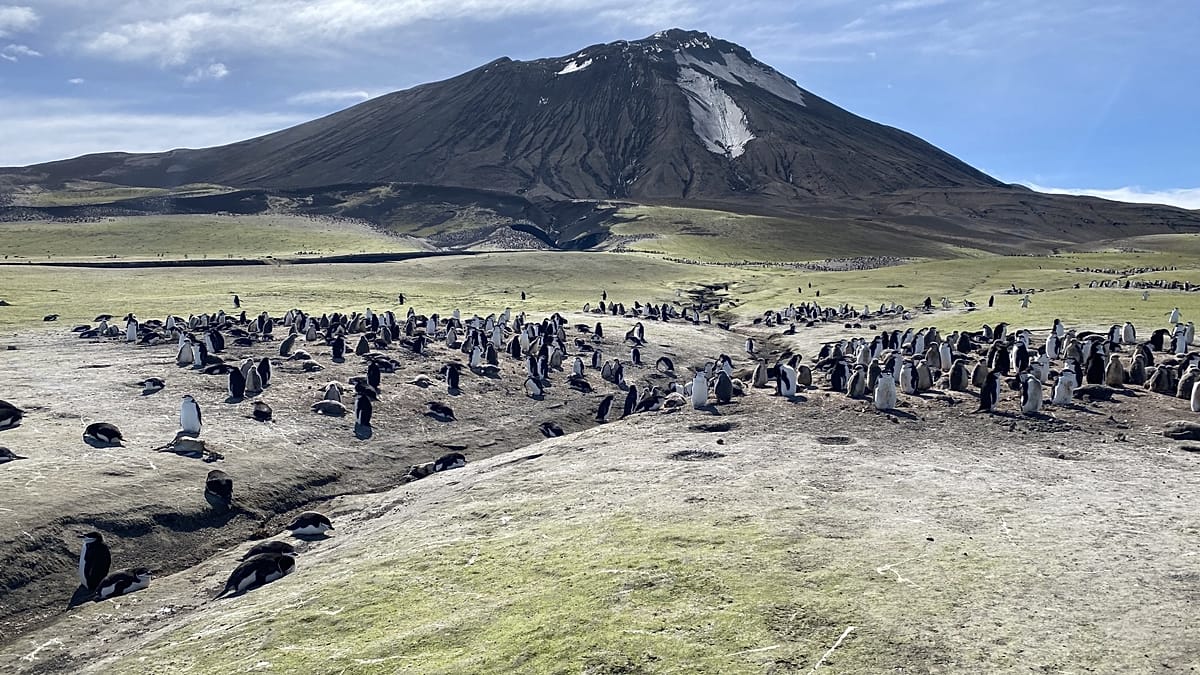
Zavodovski Island, a remote volcanic outpost in the South Sandwich Islands, has lost its title as the world's largest penguin colony. New research from the British Antarctic Survey (BAS) reveals a dramatic drop in chinstrap penguin numbers, a decline scientists attribute to human-driven climate change rather than the island's volcanic activity.
The island, roughly twice the size of Gibraltar and located about 2,000 kilometres from the nearest permanent human settlement, is one of the most inhospitable places on Earth for fieldwork. Researchers spent over two weeks crossing stormy seas to reach its rugged cliffs, where they used drones, aerial photography, and satellite tracking to survey the penguin population.
A 63% collapse in nesting pairs
Comparing aerial surveys with satellite records, the BAS team found a 63% decrease in occupied chinstrap nests from 2011 to 2025. This loss—more than half a million birds—represents over a quarter of the island's penguins, which are almost entirely chinstrap and macaroni species. The island now cedes its record to Cape Adare in the Ross Sea.
For years, Zavodovski appeared to buck the trend of chinstrap declines seen elsewhere in Antarctica. Now it holds the unfortunate distinction of having the highest rate of chinstrap population decline globally.
Professor Norman Ratcliffe, a penguin ecologist who led the study, described the situation as “a worrying decline for chinstrap penguins, which have specialist diets and specific ocean temperature preferences.” Chinstraps prefer to forage in cooler waters northwest of the island, where Antarctic krill—their primary prey—are typically abundant.
“The problem is, with waters warming, the krill have moved southwards into the Weddell Sea,” Ratcliffe explained. “Sea-ice cover to the south and a lack of suitable islands for nesting prevents chinstraps from following the food.”
Macaroni penguins adapt, chinstraps don't
In contrast, macaroni penguins on the island have increased by 28% between 2011 and 2016, and their numbers have remained stable since. The difference lies in their diet. Macaroni penguins are generalists, able to switch to fish and crustaceans when krill become scarce. Tracking data showed them foraging predominantly in warmer waters northeast of the island, where they supplemented their diets with these alternatives.
“Our data shows that the cold-adapted Antarctic chinstrap species are no longer thriving beside their sub-Antarctic neighbours,” Ratcliffe added. “It’s the biggest change in community composition ever observed at a single location in Antarctica, which provides further evidence of how rapid warming in the Antarctic is impacting unique and sensitive ecosystems.”
The researchers ruled out other explanations, such as competition for nesting space or krill fisheries, noting that breeding habitat remains abundant and that krill harvesting is banned in the surrounding Marine Protected Area (MPA). However, they acknowledged that fishing in connected currents could still affect food availability.
Climate change reaches the most remote corners
The South Sandwich Islands host about 30% of the world's chinstrap penguins. Combined with declines elsewhere in Antarctica, these losses could push the species into the 'Endangered' category on the IUCN Red List. Earlier this year, Emperor penguins were declared endangered due to sea ice loss.
Dr Peter Fretwell, a BAS remote-sensing specialist, said the study is yet another example of a “warming climate impacting even the most remote parts” of the planet. “The South Sandwich Islands are far from any humans, home to almost a third of the world’s chinstrap penguins—but not even they can escape the impacts of climate change.”
The findings echo broader concerns about planetary boundaries being breached, as climate change destabilises ecosystems far from human activity. The loss of chinstrap penguins could disrupt marine food webs across the Southern Ocean, with implications that extend beyond the Antarctic.
As the world warms, even the most isolated species are feeling the heat. The fate of Zavodovski's penguins serves as a stark reminder that no corner of the planet is immune to the consequences of our changing climate.