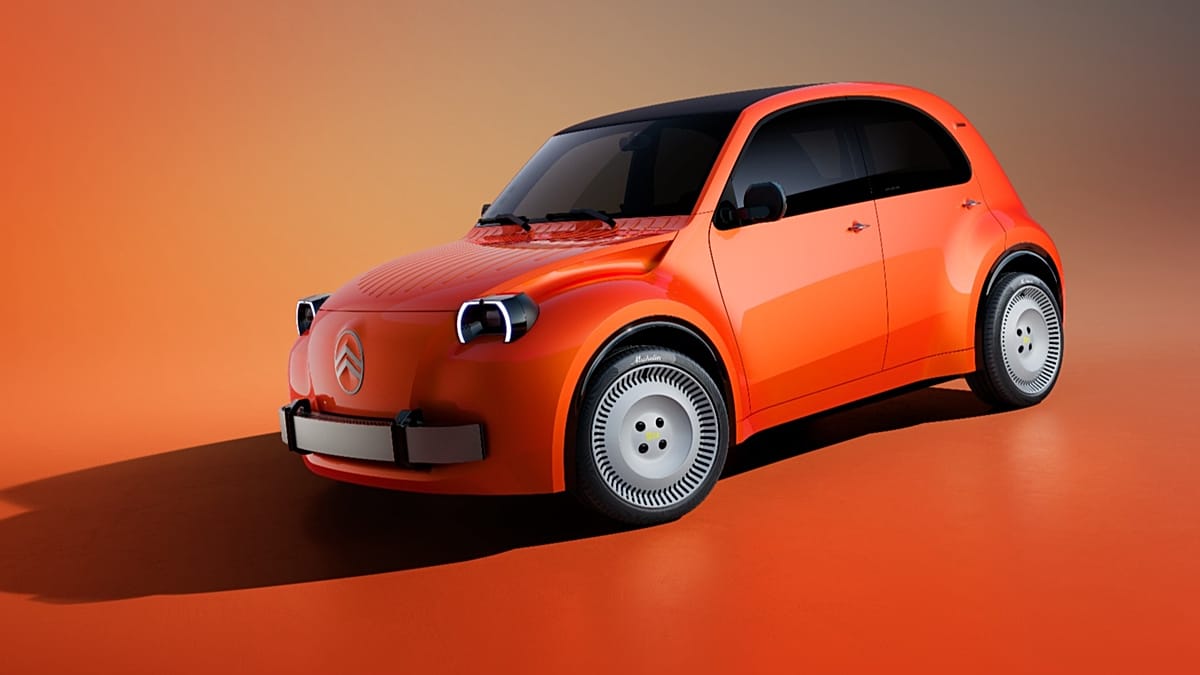
Almost four decades after the last 2CV rolled off the line, Citroën has brought its most famous model back — this time with a battery instead of a flat-twin engine. The all-electric concept made its debut at the Paris Motor Show, which runs at the Porte de Versailles from 13 to 18 October, and it is among the most closely watched unveilings of the event.
The new car keeps the visual signatures of its ancestor: the V-shaped bonnet, the upright windscreen and the round headlights that made the original recognisable at a glance. Underneath, however, it is a thoroughly modern city car, built by Stellantis around a small battery and a target weight of under one tonne.
A familiar shape, a new powertrain
The original 2CV was produced from 1948 to 1990, with more than five million units built across all variants. It became a symbol of France's post-war expansion and of the first mass holiday getaways, prized less for comfort or speed than for being cheap, rugged and endlessly adaptable.
Citroën's chief executive, Xavier Chardon, framed the revival in those terms at the unveiling. "The 2CV became an icon not because of what it had, but because of what it allowed people to do," he said. "And today that spirit is back."
The company is pitching the car at roughly €15,000, a figure that would place it among the cheapest electric vehicles on the European market. To hold costs down, Stellantis has opted for a modest battery sized for everyday journeys rather than long-distance touring — a trade-off that mirrors the original's deliberately limited performance.
The concept is not yet a production car. Citroën expects the electric 2CV to reach showrooms at the end of 2028, timed to the 80th anniversary of the original's launch, and has said a small van derivative is under consideration. That would echo the 2CV Fourgonnette, long a fixture of French farms and small businesses.
France's EV market shifts toward smaller cars
The timing reflects a broader change in French demand. Battery-electric vehicles reached a record 42% of new registrations in September, according to figures cited around the show, driven in part by smaller models and by the state-backed social leasing scheme, which accounted for roughly 9,500 registrations over the past month.
Purchase incentives in France have made affordable electric cars politically attractive as well as commercially viable, at a moment when European manufacturers are under pressure from Chinese brands. Those competitors are expected to have a substantial presence in Paris, and the show has become a stage for the continent's response — a theme we examined in our coverage of how Chinese brands are challenging Europe's automakers.
Renault's Dacia has already moved into the low-cost electric segment with the Spring, and Volkswagen is preparing smaller, cheaper entries in its ID line. The 2CV concept fits that pattern: a European answer to the question of how to sell electric mobility to buyers who cannot or will not spend €30,000 or more.
Whether Citroën can deliver the car at the promised price is another matter. Small batteries, lightweight platforms and European labour costs pull in different directions, and the gap between a concept unveiled in October and a production vehicle in 2028 leaves room for the numbers to move. The company has not yet confirmed which plants would build it or where the battery cells would come from.
What is clear is that the 2CV's return is being positioned as more than nostalgia. Citroën is using one of the most recognisable names in European motoring to argue that the electric transition can be simple, affordable and popular — the same pitch that sold five million cars to French households after the war. For a continent trying to keep its car industry competitive while cutting emissions, that argument will be tested in showrooms, not at motor shows.