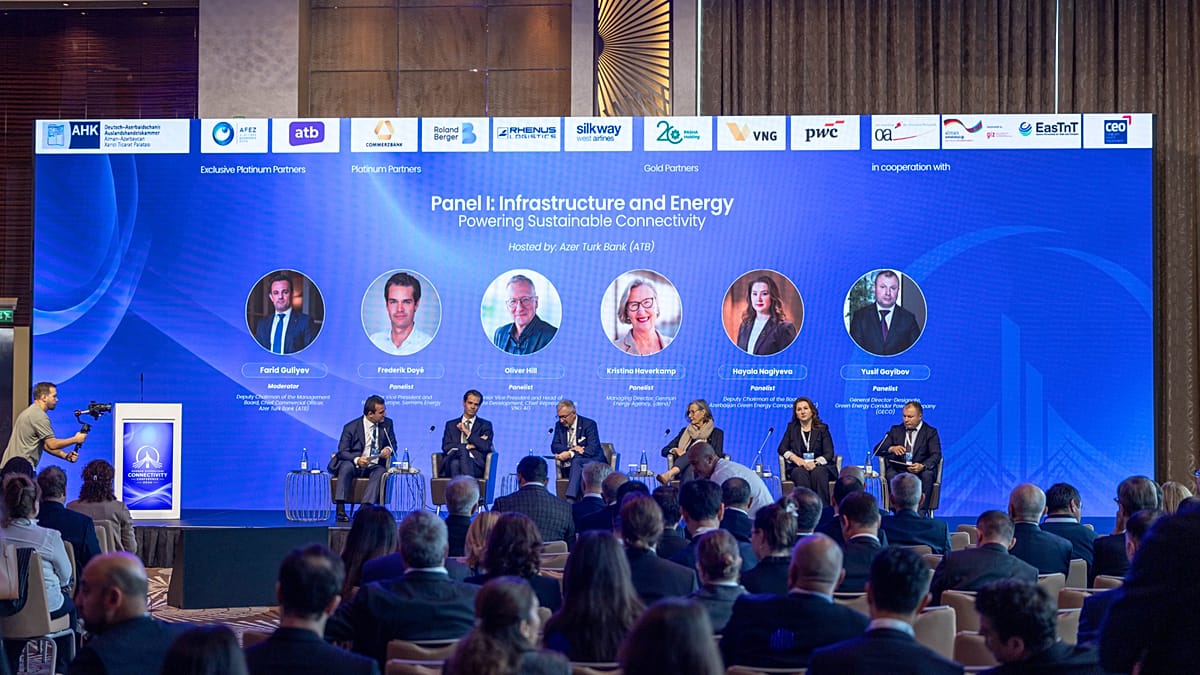
German energy and infrastructure companies are stepping up their engagement in Azerbaijan, with plans spanning both conventional gas and renewable power. The moves come as Europe seeks to diversify away from Russian fossil fuels and strengthen transport links across the Caucasus and Central Asia.
At the German-Azerbaijani Connectivity Conference 2026, hosted by the German-Azerbaijani Chamber of Commerce (AHK Azerbaijan) in Baku, corporate leaders outlined investment intentions ranging from wind and solar projects to digitalising the Middle Corridor. The event drew more than 250 participants, including over 35 guests from Germany and senior Azerbaijani policymakers.
A second pillar of bilateral ties
Nargis Wieck, Executive Director of AHK Azerbaijan, stressed the need to move beyond trade volumes and towards concrete joint ventures. "One of the key questions is how to deepen our economic cooperation through concrete projects," she told Euronews. The chamber's role, she added, involves "helping German companies become part of Azerbaijan's economic ecosystem, and Azerbaijani companies integrate more closely into German and European value chains."
German Ambassador Dirk Lölke noted that regional connectivity could become the "second pillar" of bilateral economic relations, alongside energy cooperation, following President Ilham Aliyev's recent visit to Berlin.
Renewables and grid modernisation
Siemens Energy said it was ready to supply technology and expertise for Azerbaijan's renewable energy sector and the planned Caspian-Black Sea-Europe Green Energy Corridor. Frederik Doye, Senior Vice President for Europe at Siemens Energy, highlighted Azerbaijan's offshore wind potential as a key link between Europe, the South Caucasus, and Central Asia.
Azerbaijan aims to develop 8 GW of wind and solar capacity by 2032, according to Deputy Energy Minister Elnur Soltanov. He outlined priorities including "renewable energy, energy connectivity, energy efficiency and the broader energy transition." Soltanov added: "Our goal is to connect this potential to European markets through several complementary routes – the Caspian-Black Sea-Europe Green Energy Corridor, the Central Asia-Azerbaijan Corridor, and westward links to Türkiye and Europe via Georgia and Nakhchivan."
Beyond generation, German firms are eyeing grid modernisation, battery storage systems, and electric vehicle charging infrastructure. Julia Egel, Head of Stakeholder Engagement at AHK Azerbaijan, noted that German companies are well placed to support Azerbaijan's target of raising renewables to 30% of installed capacity by 2030. She also announced an upcoming trade mission of German energy firms, with business-to-business meetings and potential German pavilions at next year's Baku Energy Week.
Gas supplies and local manufacturing
Alongside renewables, German gas importer VNG AG expressed interest in a long-term supply agreement with SOCAR, Azerbaijan's state oil company, lasting 15 to 20 years. The firm aims to boost current import volumes to stabilise European markets in the short term before transitioning to decarbonised systems. VNG also wants to cooperate with SOCAR on biomethane, renewable hydrogen, and other decarbonised fuels.
German wind turbine manufacturer Enercon is exploring local production in Azerbaijan using German financing and technology. Tayfun Bayraktar, a company representative, said: "We are currently exploring investment opportunities in Azerbaijan and how we, as a wind turbine manufacturer, can become active here." While no formal proposal has been made, successful talks could lead to a manufacturing facility with export potential. Bayraktar noted that a single 7 MW turbine costs around €7–8 million, so the scale of investment would depend on demand.
Logistics and digital infrastructure
The conference also focused on logistics and digital infrastructure. Azerbaijan expects transit cargo to reach 30 million tonnes by 2030, and German businesses are positioning themselves to support that growth. Deputy Economy Minister Samad Bashirli presented the Alat Free Economic Zone as a platform for German manufacturers to set up export-oriented production, citing the country's stable macroeconomic environment.
These developments come as Europe seeks to reduce its energy dependence on Russia, a theme that has gained urgency amid recent geopolitical tensions. The German-Azerbaijani partnership reflects a broader trend of European engagement with the South Caucasus, which also has implications for energy security across the continent. As Germany and other EU members push for diversification, Azerbaijan's role as a transit hub and energy supplier is likely to grow.



