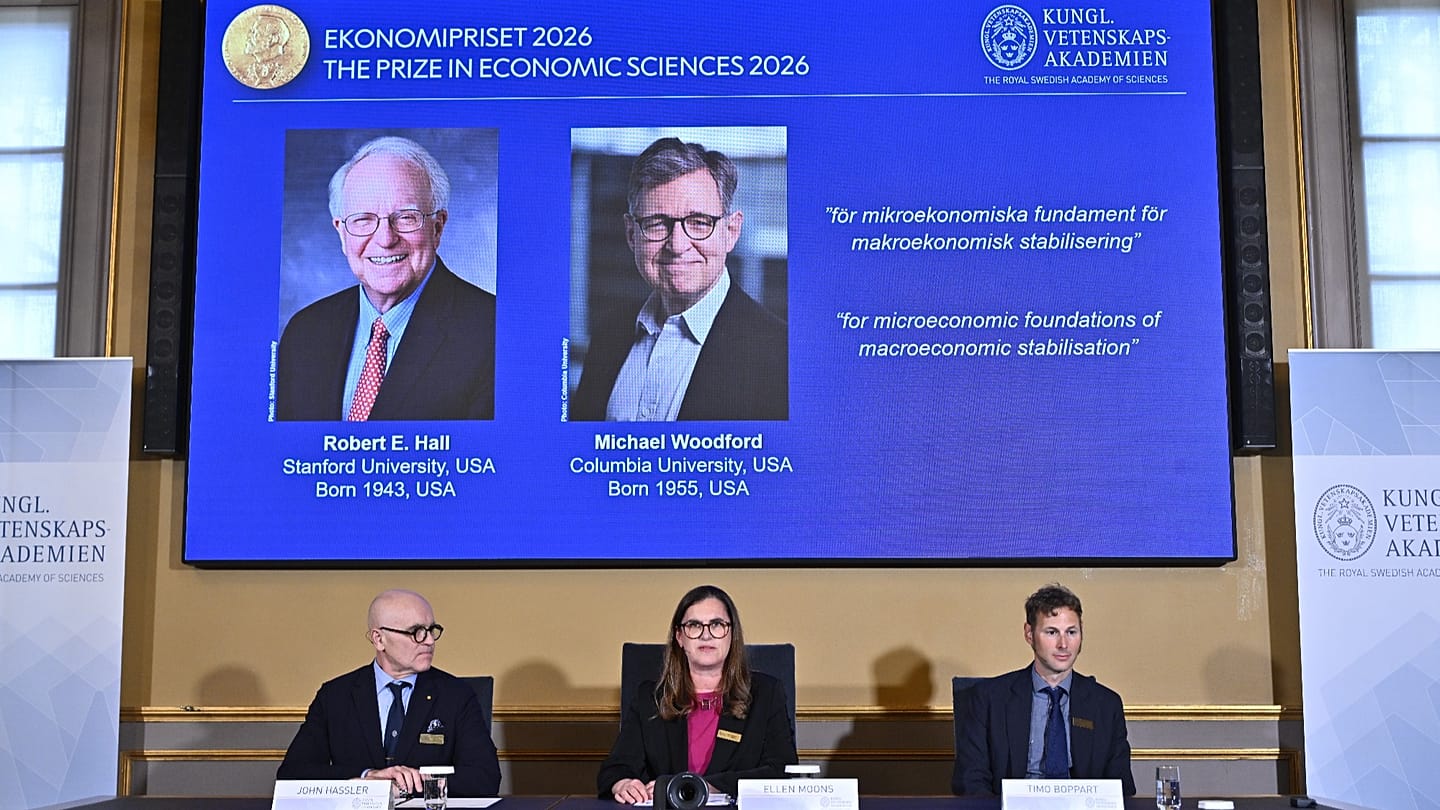
The Royal Swedish Academy of Sciences has awarded the 2026 Nobel Prize in Economic Sciences to Jonas Hall of Stanford University and Michael Woodford of Columbia University. The two American economists were recognised for their development of models that explain how economies can be stabilised in the face of shocks, a framework that has become central to modern monetary and fiscal policy.
The academy, meeting in Stockholm, praised the laureates for providing "a coherent theoretical foundation for the design of stabilisation policy". Their work, built on the so-called New Keynesian paradigm, has helped policymakers understand the trade-offs between inflation and unemployment, and how expectations shape economic outcomes.
From theory to practice
Hall and Woodford's contributions, developed largely in the 1990s and 2000s, have had a profound influence on central banks across Europe. The European Central Bank in Frankfurt, the Bank of England in London, and the Sveriges Riksbank in Stockholm have all incorporated their insights into their policy frameworks. Their models are now standard tools in the forecasting and policy analysis departments of these institutions.
Woodford's 2003 book, Interest and Prices, is widely regarded as a foundational text for the modern practice of inflation targeting. Hall's work on consumption and fiscal policy has been equally influential, particularly in understanding how government spending can cushion economic downturns.
The prize, formally known as the Sveriges Riksbank Prize in Economic Sciences in Memory of Alfred Nobel, is the only Nobel award not among the original five created in the will of the Swedish scientist, who died in 1896. It was established in 1968 by Sweden's central bank and has been awarded since 1969.
This year's announcement comes amid a broader Nobel season that has seen recognition for work in other fields. Earlier this week, French and Japanese chemists won the chemistry prize for their research on mirror-image molecules, while a Belgian physicist was honoured for transforming Antarctic ice into a neutrino telescope. The peace prize, awarded to South African human rights lawyer Navi Pillay, has drawn attention for its political implications, with criticism from former US President Donald Trump.
The economics prize is often seen as the most policy-relevant of the Nobels, and this year's choice reflects a renewed focus on how economies can be stabilised in an era of overlapping crises. From the pandemic-induced recession to the inflation surge triggered by Russia's war in Ukraine, European policymakers have repeatedly turned to the frameworks developed by Hall and Woodford.
In Brussels, officials at the European Commission have used these models to assess the impact of the EU's recovery fund, the €800 billion programme designed to rebuild economies after COVID-19. In Berlin, the German Council of Economic Experts has cited their work in its analyses of fiscal rules and debt sustainability.
The laureates will share the prize sum of 11 million Swedish kronor (approximately €950,000). The formal award ceremony will take place in Stockholm on 10 December, the anniversary of Alfred Nobel's death.
Hall, speaking from Stanford, said he was "deeply honoured" and expressed hope that the recognition would draw attention to the importance of evidence-based economic policy. Woodford, in a statement from New York, emphasised the need for "humility" in economic modelling, noting that "the real world is always more complex than our models"—a reminder that even Nobel-winning frameworks have their limits.
For Europe, where economic governance remains a delicate balancing act between national sovereignty and collective action, the work of Hall and Woodford offers a reminder of the value of rigorous analysis. As the continent navigates the twin challenges of digital transformation and climate transition, their models will likely continue to inform the decisions made in the corridors of power from Paris to Warsaw.



