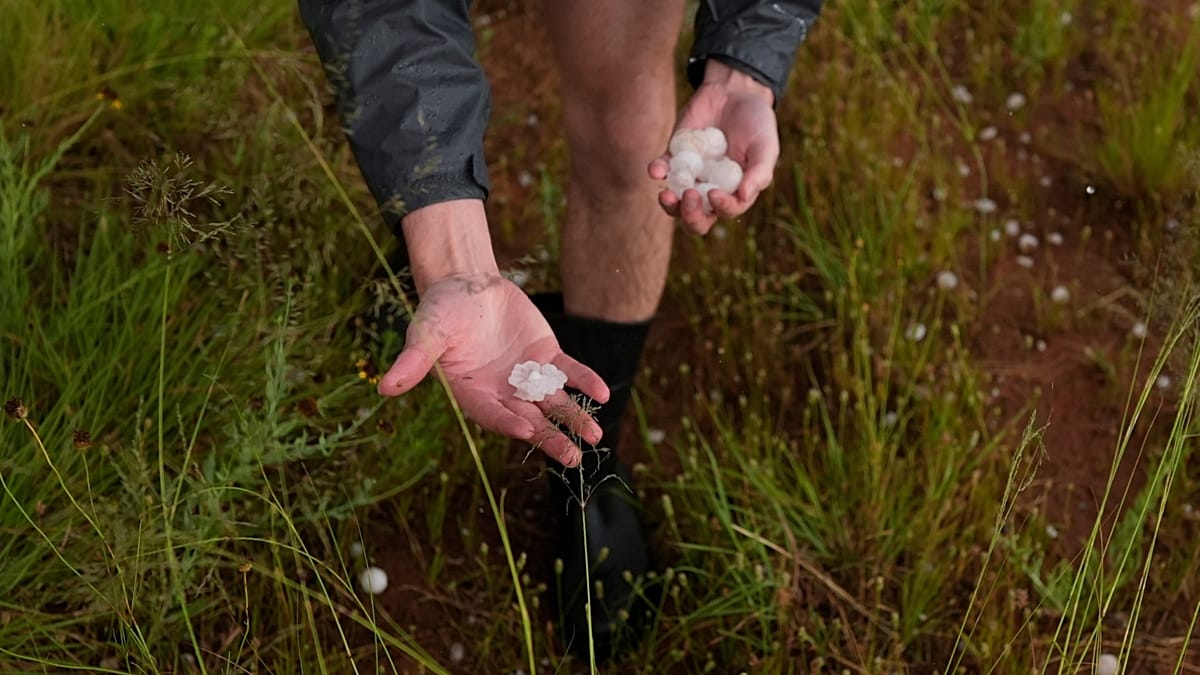
Hailstorms are among the most destructive weather phenomena in Europe, and new research suggests climate change will make them significantly worse. A study published this week in Nature projects that hailstones larger than a marble will increase by 38 to 47 per cent by the end of the century, depending on global emissions levels. Storms producing smaller hail, meanwhile, are expected to decline by 4 to 8 per cent.
The findings underscore a growing threat to European infrastructure, from solar farms in Spain to vehicle fleets in Germany. Hail already causes roughly €68 billion in damage globally each year, according to John Allen, a meteorology professor at Central Michigan University and co-author of the study. In Europe, hailstorms have surged by 267 per cent over the past five years, according to insurer Chaucer, rising from 3,217 storms in 2019/2020. A 2026 study in Science Direct warned that the 2022 and 2023 hail seasons each caused record losses exceeding €5 billion.
Why Hail Is Getting Bigger
Warmer air holds more moisture, which fuels stronger updrafts in thunderstorms. These updrafts keep hailstones aloft longer, allowing them to grow larger before falling. “What happens is there’s more water vapour in a warmer atmosphere and that increases the available energy to the atmosphere,” Allen explains. “And that leads to more thunderstorms with updrafts capable of producing hail.”
Andreas Prein, a climate scientist at ETH Zurich, notes that while small hail can devastate crops, stones reaching around five centimetres in diameter pose a serious risk to vehicles, roofs, solar panels, and other infrastructure. The heavier the hailstone, the faster it falls, amplifying the force of impact. Solar farms, which are expanding rapidly across Europe, are particularly vulnerable. Operators are often required to prove their panels can tilt to a 70-degree angle to protect against cracking, but retrofitting existing installations with remote-tilting capabilities remains a “significant challenge,” according to Chaucer.
Allen points out that a single hole in a roof can be patched, but multiple large stones typically necessitate a full replacement—a costly prospect for homeowners and businesses alike.
Europe’s Growing Exposure
While much hail research has focused on the United States, which experiences the most hail globally, experts warn that Europe, Canada, and Argentina are likely to see the largest increases in large hail due to climate change. “It’s not just a US problem,” Allen says. “Yes, we do see large losses here, but the global hail losses seem to be something that is really spiralling in recent years.”
A 2025 study from Newcastle University and the UK’s Met Office found that climate change is “supercharging” Europe’s biggest hailstones. Under a high-emissions scenario where Europe fails to cut greenhouse gases, severe hail may become less common overall, but when it does occur, the stones could be regionally much larger. This pattern mirrors findings from the Nature study, which examined hail above and below 30 millimetres in diameter—roughly the size of a marble or a US 50-cent coin.
The researchers modelled three emissions scenarios. In a moderately optimistic path, large hail increases by 38 per cent. In a more pessimistic scenario, where temperatures rise nearly 1°C higher, the increase jumps to 47 per cent. “This is a meaningful climate signal,” says Walker Ashley, a meteorology professor at Northern Illinois University. But he cautions that disaster losses are not driven solely by the hazard. “Climate change may be increasing the potential for larger, more damaging hail in some regions, but the future loss signal will also depend heavily on where people build, what they build, how resilient those structures are, and how land use changes.”
As Europe’s population and infrastructure expand into hail-prone areas, the continent faces a growing challenge. The findings come amid broader climate pressures, including record heat events and shifting disease patterns, as highlighted in recent reports on France’s record May heat and the risk of chikungunya becoming endemic in Europe. Meanwhile, countries like Germany risk missing their 2030 climate goals, underscoring the urgency of adaptation.
Allen stresses that current building standards rarely account for hail resilience. “We’ve seen record hailstones in recent years. I find this extremely concerning because we’re not really building our environment to be resilient to hail. We don’t include this in our design standards, for example, for built homes in the US or indeed internationally.” For Europe, the message is clear: as the climate warms, the hailstones falling from the sky will only get bigger—and more expensive.