Driving a motorhome along Croatia's Adriatic coast is a way to experience the country at the pace of its landscapes. Over 25 days, a route from Rovinj in the north to Dubrovnik in the south reveals a coastline of striking contrasts: Roman cities, Venetian hill towns, pebble beaches, forested islands and roads that cling to cliffs above some of Europe's most dramatic seascapes.
But travelling Croatia on four wheels comes with its own set of challenges. The coastal highway is narrow and winding in places, and parking a motorhome is not a matter of pulling over anywhere. Campsites and designated areas are sometimes a long walk from historic centres, and in peak season they can charge steep rates. July and August are the most difficult months; spring, early summer and autumn offer a more relaxed experience.
Istria: Croatia's Italian-flavoured peninsula
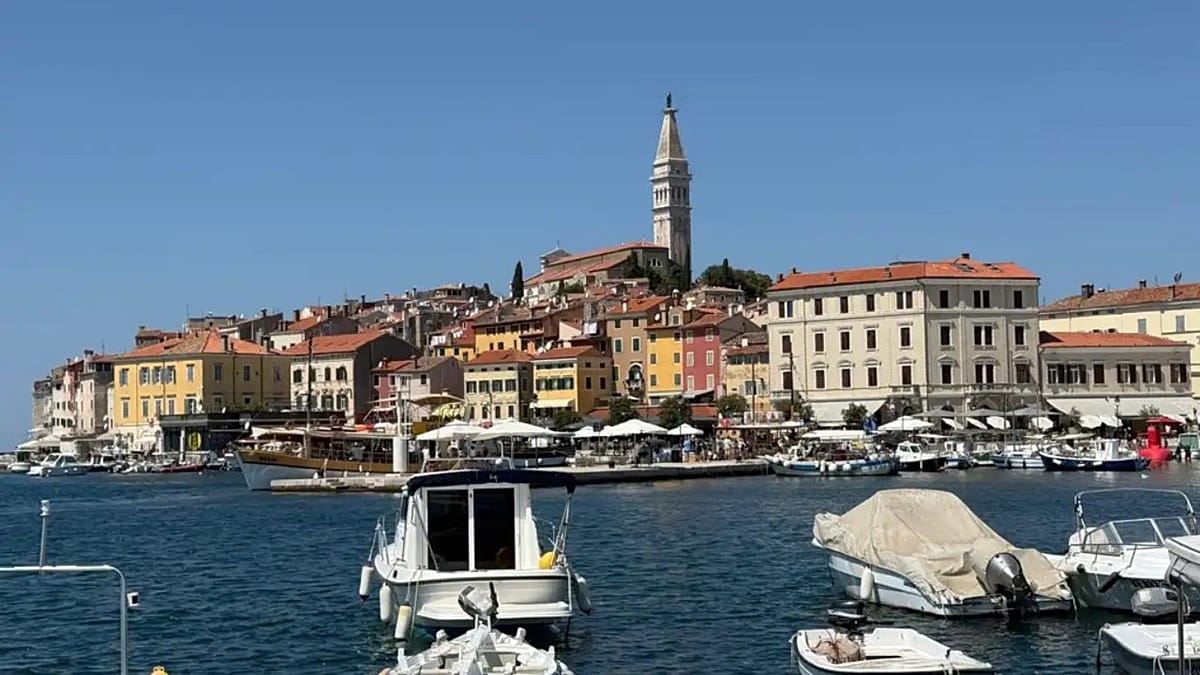
The journey begins in Rovinj, one of Istria's most picturesque towns. Its old quarter, a tangle of cobbled lanes, sits on what was once an island, crowned by the church of St Euphemia. Colourful facades, a busy harbour and small offshore islets make it one of the most recognisable spots on the Croatian Adriatic.
Further south, Pula combines clear water with a remarkable Roman heritage. The Pula Arena, built in the first century AD, is among the six largest surviving Roman amphitheatres in the world; today it hosts concerts and festivals, blending antiquity with contemporary culture. A walk through the city also takes in the Arch of the Sergii, the Gate of Hercules and the Kaštel, a 17th-century Venetian fortress with sweeping views over the harbour.
Istria is a world apart from the rest of the coast. The heart-shaped peninsula, shared between Croatia, Slovenia and Italy, retains a strong Italian influence. Its green hills, vineyards, olive groves and medieval hilltop towns have earned it the nickname 'the Tuscany of the Adriatic'. Inland, places like Motovun command the views, but a lack of suitable motorhome facilities meant we had to leave them off our itinerary.
From Opatija's elegance to Plitvice's lakes
After covering much of Istria, we reached Opatija, a resort that feels very different from the rest of the coast. Grand villas, historic hotels and manicured gardens recall the Austro-Hungarian era, when the town was a favourite retreat for aristocrats drawn by its spas and mild climate. The Lungomare, a seafront promenade of about ten kilometres, winds past villas, coves and clear water; the best way to enjoy it is to stroll slowly and stop for a swim. It is worth continuing to Volosko, a charming old fishing village.
From Opatija, the coastal road runs beneath the Velebit mountains, one of the most spectacular stretches of the trip. We chose the motorway to reach Nin, near Zadar, where the scenery changes again. Nin's compact historic centre sits on a tiny island surrounded by lagoons. The 9th-century Church of the Holy Cross, traditionally called the smallest cathedral in the world, is a key landmark. The town is also known for its sandy beaches, therapeutic mud and salt pans.
In Zadar, motorhome parking is scarce, but the visit is worth the effort. The seafront holds two of the city's main attractions: the Sea Organ, which uses pipes beneath the stone steps to turn wave motion into sound, and the Greeting to the Sun, a circle of solar panels that lights up at dusk. Zadar's sunsets are famous; Alfred Hitchcock is said to have called them the most beautiful in the world, a claim that has become part of local lore.
From Zadar we left the Adriatic behind for a day to visit Plitvice Lakes National Park. Its 16 terraced lakes, linked by rivers and waterfalls, form one of Croatia's most breathtaking natural landscapes. A UNESCO World Heritage Site, the park is explored along footpaths and wooden boardwalks, with electric boats on some routes. The great waterfall, Veliki Slap, drops about 78 metres, the highest in Croatia. Swimming is forbidden, despite the tempting turquoise water.
Šibenik, Trogir and the heart of Dalmatia
Back on the coast, Šibenik is a city of white stone, alleyways and small squares. Its cathedral, St James's, is a World Heritage Site built entirely of stone, with an unusual frieze of 71 sculpted human heads, each one different. About 50 kilometres further on lies Trogir, a small island town that feels like Dalmatia in miniature; the best approach is to get lost in its narrow streets.
Split, the region's urban heart, grew up around the vast palace of the Emperor Diocletian, built more than 1,700 years ago. Its ancient walls, passageways and chambers now form the core of a lively city. For those planning a similar trip, it is worth noting that Slovenia's compact landscapes offer a natural extension to a Croatian itinerary, while Montenegro's coast lies just south of Dubrovnik for those who want to continue. And for travellers who prefer not to drive, overland coach journeys are making a comeback across Europe.
The route from Rovinj to Dubrovnik is not just a drive; it is a journey through layers of history, from Roman engineering to Venetian elegance, from Austro-Hungarian leisure to the natural wonders of the Dinaric Alps. With careful planning and a willingness to adapt, a motorhome offers the freedom to discover Croatia at your own pace.