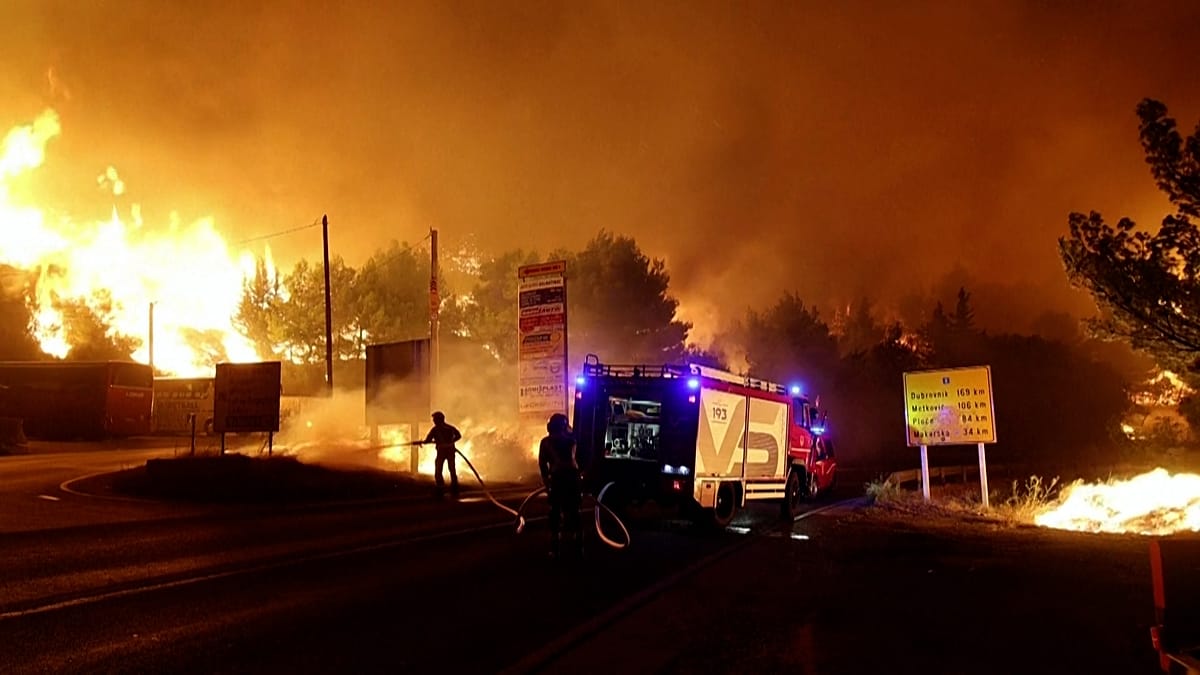
A fast-moving wildfire along Croatia's Adriatic coast forced the evacuation of roughly 1,000 residents and holidaymakers on Thursday, as flames consumed vegetation and encroached on homes in the village of Lokva Rogoznica, about 40 kilometres southeast of Split.
Local authorities said the fire broke out in the afternoon and spread rapidly under dry, windy conditions, a pattern that has become increasingly familiar across southern Europe in recent summers. Emergency services deployed water-dropping aircraft and ground crews to protect the village, which sits on a narrow strip between the sea and the Biokovo mountain range.
Tourists and residents moved to safety
Evacuees were moved to nearby beaches and to the town of Makarska, where temporary shelter was arranged. No injuries have been reported, but several houses and outbuildings sustained damage. The Croatian Civil Protection Directorate said the operation was ongoing through the evening, with firefighters working to contain the fire before winds strengthened again.
Lokva Rogoznica is a popular summer destination, and the evacuation included a significant number of foreign tourists. Local hoteliers and campsite operators helped shuttle guests to safety, while some residents stayed behind to defend their properties with hoses and buckets, a common sight in Mediterranean fire zones.
The blaze is one of several that have hit the Balkans and the wider Mediterranean this month. In neighbouring Portugal, more than 2,000 personnel are battling wildfires as a heatwave persists, and Spain and France have seen large areas burn, including 17,000 hectares in Aragon alone.
Climate scientists point to rising temperatures and prolonged droughts as key factors intensifying the fire season across Europe. The European Forest Fire Information System (EFFIS) has recorded above-average fire danger for much of the Adriatic coast this summer, and Croatia has already faced several major blazes in Dalmatia and Istria.
Local officials in Split-Dalmatia County said the priority was protecting human life, and they praised the coordination between national firefighting units, local volunteers, and the Croatian Navy, which provided amphibious support. The fire's cause is under investigation, though early indications suggest it may have been sparked by human activity, either accidental or deliberate.
For residents like Marija Kovačević, who has lived in Lokva Rogoznica for over 30 years, the fire brought back memories of the devastating 2017 season. “We thought we were prepared, but the wind changed so quickly. The smoke was everywhere, and we had to leave everything,” she told local media.
The evacuation order was lifted for some areas early Friday, but authorities warned that the fire was not fully contained. Aerial surveillance continued to monitor hotspots, and residents were advised to remain vigilant. The Croatian Meteorological Service forecast moderate winds and slightly cooler temperatures over the weekend, which could aid firefighting efforts.
Across Europe, the frequency of such evacuations is prompting calls for better prevention and cross-border cooperation. The EU's Civil Protection Mechanism has been activated several times this summer, and mass evacuations have become a recurring feature of the continent's summer months. In Belgium, crews recently battled the largest wildfire on record in the High Fens, while Germany evacuated a border town as flames approached.
For now, the immediate concern in Croatia is to prevent the fire from spreading further into the Biokovo nature park, a biodiversity hotspot. Firefighters are using bulldozers to create firebreaks, and water-bombing planes are making repeated sorties. The local tourism board has set up an information hotline for visitors, and hotels in Makarska have offered discounted rates for evacuees.
As climate change continues to lengthen the fire season, experts argue that Mediterranean countries must invest more in forest management, early warning systems, and community preparedness. The scenes in Lokva Rogoznica are a stark reminder that even well-equipped regions can be overwhelmed by the sheer speed and intensity of modern wildfires.