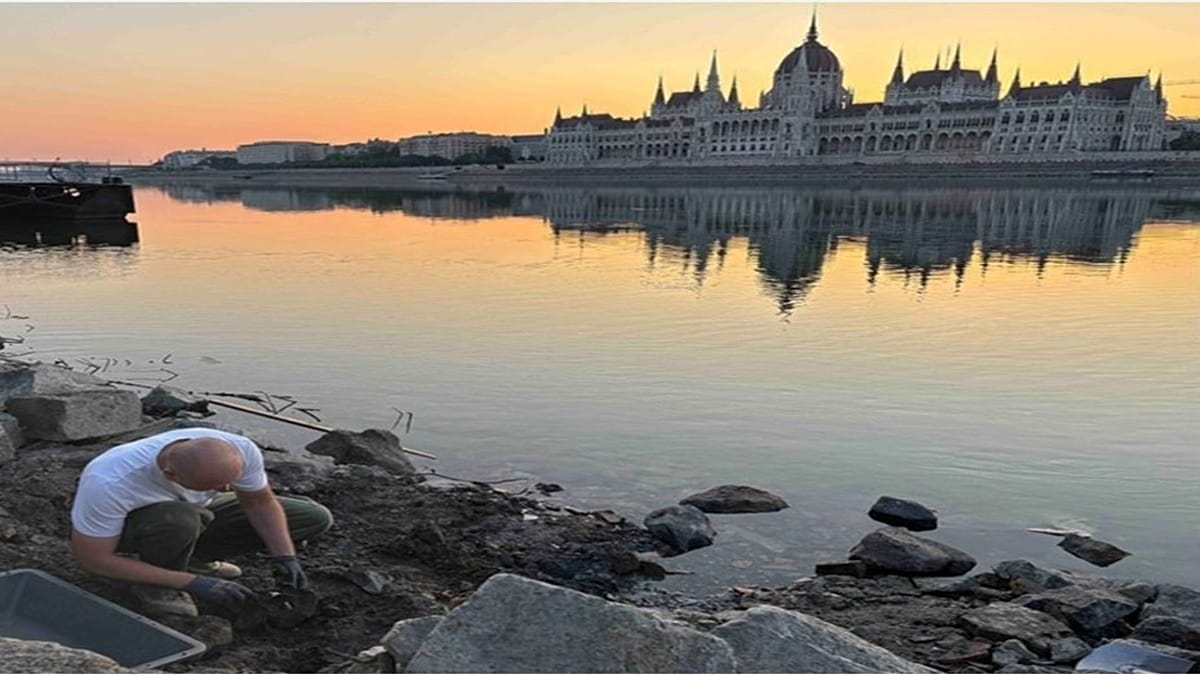
For more than eight decades, the muddy bed of the Danube kept its secret. But this summer's extreme drought, which has dramatically lowered the river's water levels across Central Europe, has brought a forgotten wartime tragedy back to the surface in Budapest.
In early August, workers at the Hungarian Institute and Museum of Military History discovered a remarkably well-preserved DKW NZ 350-1 motorcycle on the Buda bank of the river. Beneath or beside the vehicle, they found human remains – the bones of two German soldiers who had lain there since the final years of the Second World War.
Gábor Kohlrusz, an exhumation specialist for the German War Graves Commission (Volksbund Deutsche Kriegsgräberfürsorge), carefully recovered the skeletons from the exposed riverbed. Kohlrusz has spent years in Hungary locating and documenting German war dead, often working with local historians to piece together the fates of soldiers who were never officially accounted for.
Intact identity discs point to unresolved fates
Alongside the bones, two German identity discs were found in near-perfect condition. In the Wehrmacht, these discs were split in two when a soldier died: one half remained with the body, the other was sent to the military information office in Berlin so that the death could be registered and the family notified. The fact that both discs recovered from the Danube are still intact strongly suggests that the families of these two men never received official confirmation of their deaths – they were likely listed as missing in action, their loved ones left waiting in vain.
The discovery also yielded a wedding ring and a Kuban shield, a decoration awarded to German soldiers who served in the Kuban bridgehead on the Eastern Front in 1943. If the shield can be attributed to one of the dead, it would indicate that he had already seen combat in the Soviet Union years before his death in Budapest.
One of the identity discs belonged to a regular Wehrmacht soldier; the other to a member of the Waffen-SS. The Waffen-SS was a multi-ethnic force that at its peak numbered around 900,000 men, including committed Nazis, foreign volunteers, and – especially late in the war – conscripts and minors. The presence of a Waffen-SS soldier among the dead adds a layer of historical complexity to an already poignant find.
Arne Schrader, head of the War Graves Service and International Relations at the Volksbund, cautioned that identification is a painstaking process. The names on the discs may be traced relatively quickly, but confirming that the discs belong to the recovered bodies requires a detailed anthropological examination.
Experts will study the bones for clues about age and stature. The length of leg bones can indicate height; the condition of the sacrum, the epiphyses (growth plates) on long bones, and the presence of wisdom teeth can help estimate age at death. Dental fillings made of amalgam, for example, suggest the deceased likely came from Western Europe, where such materials were more common.
Once the anthropological data is compiled, it will be compared with military records, missing persons reports, and the Volksbund's own online database, which contains around 5.4 million entries. Any provisional identification would then need to be officially confirmed by Germany's Federal Archives.
The site where the remains were found lies in an area of accumulated harbour silt mixed with gas oil – conditions that appear to have preserved both the motorcycle and the identity discs exceptionally well. The motorcycle is now being cleaned and restored in the hangar of the Museum of Military History in Budapest, while the bones have been taken for further analysis.
This discovery is part of a broader phenomenon: as the Danube's water level has dropped to record lows, the river has revealed a range of wartime relics and even unlikely party venues on its exposed banks. The find has also drawn attention to the river's role as a silent witness to history, and to the ongoing work of organisations like the Volksbund to give names back to the fallen.
For now, the two soldiers remain anonymous, their stories still buried in the mud of time. But thanks to the meticulous work of historians and forensic experts, there is a real chance that their families – or at least the historical record – will finally learn what happened to them.