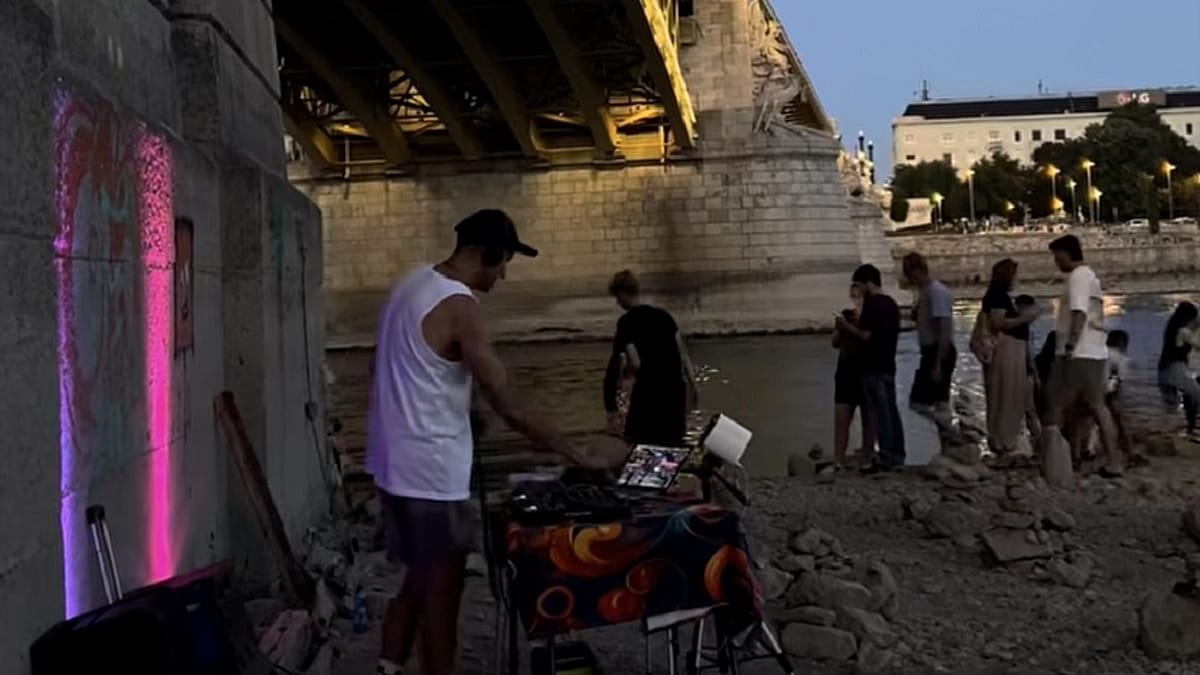
In Budapest, the Danube has receded so far that the riverbed beneath Margaret Bridge is now dry enough to host a party. A video posted by photographer Zsanett Zsebők on Facebook shows a Saturday night gathering on the exposed sand and stone, drawing hundreds of comments. Some call it a spontaneous celebration of summer; others describe it as a disturbing sign of ecological distress.
The so-called Ínség-szikla (Famine Rock), which emerges near Liberty Bridge when water levels drop, has become a familiar sight. But the dry stretch under Margaret Bridge, towards Margaret Island, is now accessible on foot—a development that was unthinkable just a few years ago. In 2018, the area first became walkable without getting wet; since then, it has reappeared more often, stayed dry longer, and expanded in size.
A river in disorder
László Wild, the heritage architect who oversaw the recent renovation of Margaret Bridge, told local media that the Danube's bed along Budapest is in a state of "incredible disorder." The receding waters have exposed not only sandbanks but also relics of the past: metal rubbish bins from the pre-war era, and even remnants of scaffolding used during the bridge's construction in the 1870s by Ernest Goüin's team.
As the dry area grows, more people are crossing from Margaret Island to explore the new terrain. From there, the city's panorama—especially at dusk, when the lights of the Parliament and the bridges begin to glow—offers a fresh perspective. What began as a curiosity has now turned into a social scene.
The party in the riverbed evokes a familiar metaphor: the band playing on the Titanic as the ship sank. Some guests, it is said, even joked about fetching ice from the iceberg for their cocktails. The Danube's retreat inspires a similar duality—anxiety about the future, and a desire to seize the moment.
This is not an isolated phenomenon. Across central Europe, the Danube has hit record lows, stranding boats and exposing sandbanks in Serbia. In Hungary, the low water has threatened the Paks nuclear plant, which relies on river water for cooling. The situation has forced emergency energy measures across the region.
For some, the exposed riverbed is a playground; for others, it is a warning. The debate reflects a broader European conversation about climate adaptation and the future of the continent's waterways. As the Danube continues to shrink, Budapest's party may be a fleeting diversion, but the underlying issue is anything but temporary.