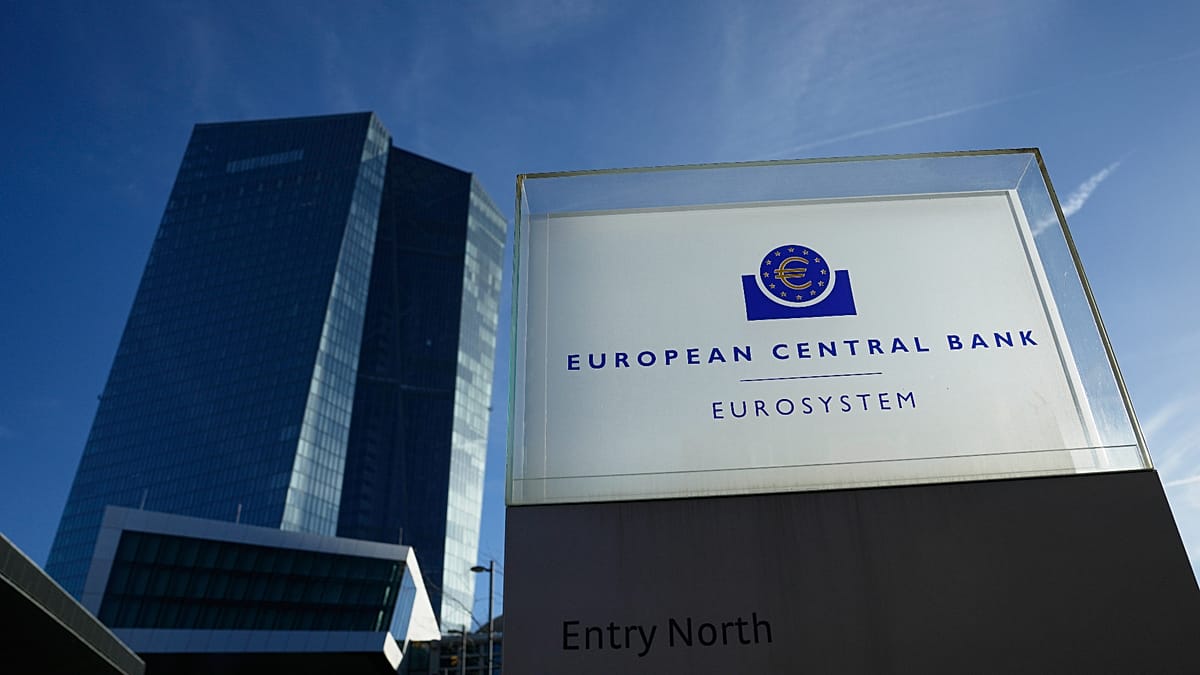
The European Central Bank (ECB) has drawn a direct comparison between the current artificial intelligence boom and the dotcom bubble of the early 2000s, warning that a wave of large stock market listings and heavy borrowing by tech giants could leave markets exposed to a sudden sell-off.
In its biannual Financial Stability Review, published on Wednesday, the ECB said risks to the eurozone's financial stability "remain elevated, given persistent geoeconomic uncertainty and growing exposure to AI." The warning was echoed by ECB Vice-President Boris Vujčić, who had already sounded the alarm on Monday.
The report comes just a day after the European Commission said the EU economy had weathered the energy shock from the Iran conflict better than expected. While the ECB agrees with that assessment, it cautions that the very optimism driving the AI sector has itself become a source of risk.
Echoes of the dotcom era
Share prices in the AI sector rest on "extraordinarily strong earnings expectations" that may prove difficult to meet, the report said. It also warned that cheaper AI models could undercut today's market leaders, a scenario that would trigger a repricing of tech stocks.
With AI spending now exceeding the cash that tech companies generate, US giants are borrowing at a record pace—and increasingly in euros. This leaves European investors more exposed to a potential downturn. The ECB estimates that big tech firms had more than $4 trillion (€3.63 trillion) in off-balance-sheet commitments by the end of the second quarter of 2026, while chipmakers often finance the customers who buy their products.
The central bank stopped short of calling the AI boom a bubble, but it noted that the rapid shift to debt financing invites comparisons with both the dotcom and subprime mortgage bubbles of the early 2000s.
Meanwhile, the amount raised by US IPOs is on track to beat its dotcom-era high relative to the size of the economy. The ECB's staff estimate that US IPOs will raise around $212 billion (€192 billion) this year, up from about $44 billion (€40 billion) in 2025. SpaceX's record IPO in June led the way, and Anthropic, the maker of the Claude AI models, is expected to set its IPO price on Wednesday and begin trading on the Nasdaq on Thursday.
Large listings can shift "unquantified risk" to less informed buyers, including retail investors, the ECB warned. This dynamic is reminiscent of the late-1990s, when a flood of new listings preceded a sharp market correction.
Government debt under strain
Beyond the tech sector, the ECB also highlighted vulnerabilities in government debt markets. Shaky public finances in major advanced economies could trigger a global repricing of government debt, the report said. Long-term borrowing costs have reached their highest levels in more than two decades in several countries, and many eurozone governments are now paying the most to borrow since the 2012 debt crisis.
Eurozone governments are issuing the most debt since the pandemic, driven mainly by Germany's defence and infrastructure spending. With the ECB no longer buying government bonds under its stimulus programmes, a larger share of this debt is going to foreign investors and hedge funds, which tend to be more flighty in a crisis and could amplify any sell-off.
France stands out, with investors demanding a higher premium to cover political risk ahead of the 2027 elections. Its 10-year borrowing costs topped 5% in October for the first time since 2002 and now stand at 4.85%.
On Tuesday, the Commission forecast that EU public debt would rise from 82.6% of GDP last year to 85.6% in 2028, with interest payments swallowing 2.4% of economic output by then. "Fiscal consolidation is overdue," the ECB stated bluntly.
Banks resilient, but non-banks vulnerable
On the positive side, the report noted that banks are in good shape to absorb shocks, with profitability at its highest in a decade and non-performing loans at a record low of 2.2% of total loans in September. However, vulnerabilities are greater at some non-bank financial institutions, such as investment funds and hedge funds, where safeguards are less developed.
US tech and AI-related firms now make up between 16% and 26% of eurozone non-banks' equity investments. The ECB pointed to the near-collapse in July of Situational Awareness, a US hedge fund whose assets under management shrank from around $45 billion (€40.9 billion) to $10 billion (€9 billion) after its leveraged AI bets went wrong.
Such stress could spread to banks, which get almost a fifth of their funding from non-banks. The ECB called for stronger safeguards against leverage and liquidity risks in the sector, while urging authorities to keep banks' capital buffers in place.
Higher energy prices could also leave households and companies struggling with repayments, and bad loans can take years to build up after an energy shock, the ECB warned.
The report lands as governments close in on a deal over the ECB's leadership. Germany's finance ministry said on Tuesday it was seeking the chief economist job for Princeton University professor Markus Brunnermeier, with Berlin reportedly backing former Bank of Spain governor Pablo Hernández de Cos to replace Christine Lagarde as president in exchange. The outcome of these negotiations will shape the ECB's policy direction for years to come.