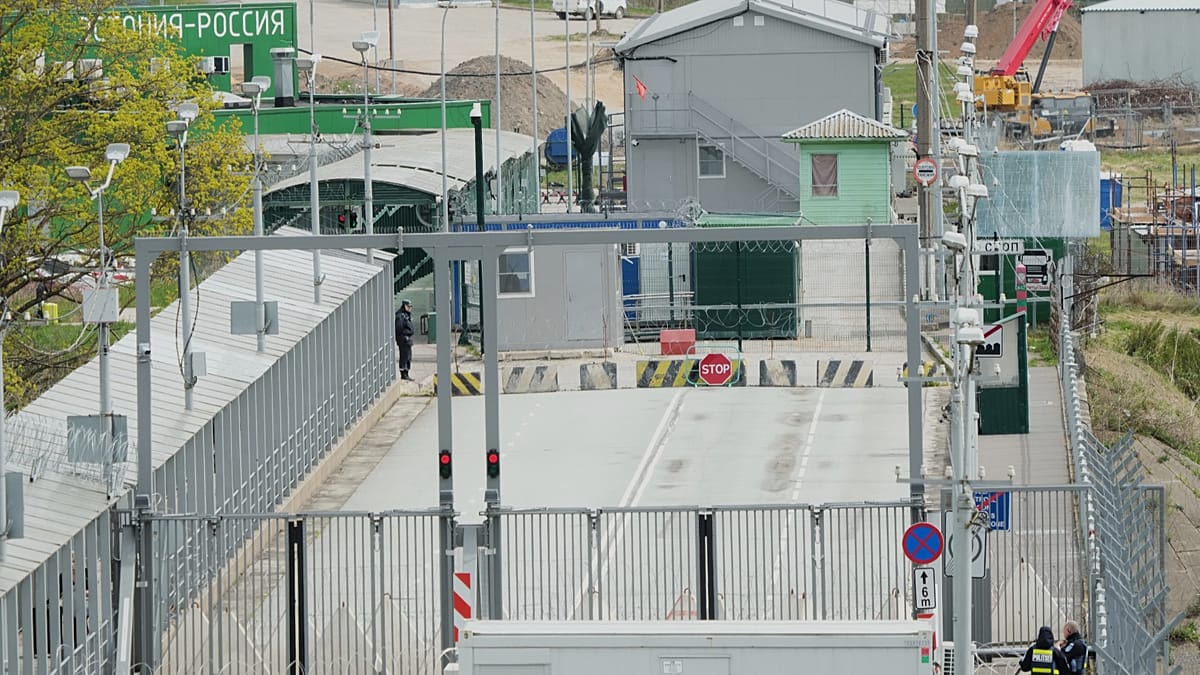
Estonia announced on Sunday that it will shut all border crossing points with Russia starting December 1, following the disruption of what officials described as a Russian military intelligence–ordered arson attempt on a drone manufacturer. The decision marks a sharp escalation in the Baltic state's confrontation with Moscow, which Tallinn views as part of a wider pattern of hostile acts linked to Russia's war in Ukraine.
Foreign Minister Margus Tsahkna wrote on X that there was "clear evidence" that the GRU had directed the attack, and that "Estonia will close all Estonian-Russian border crossing points as of 1 December." He added that "Russia must understand that hostile actions against Estonia come with consequences. Attempts to intimidate, destabilise, or undermine our security will not go unanswered."
Prime Minister Kristen Michal earlier reported that the sabotage attempt occurred on Saturday night at Threod Systems, a defence company based in Viimsi, just north of Tallinn. "Extensive damage was averted thanks to heightened security measures and a swift reaction by law enforcement. The attackers have been detained," he said on X.
Chief prosecutor Astrid Asi told journalists that eight individuals, all residents of Latvia, had been arrested in connection with the incident. The foiled attack follows a similar attempted arson in August against Milrem Robotics, another Estonian defence subcontractor, in which Latvian nationals were also detained.
Broader hybrid campaign
Michal framed the incident as "part of Russia's broader hybrid war against Europe, with the aim of decreasing support to Ukraine and pressure on Russia." He insisted that "we will not be intimidated." The prime minister's remarks echo concerns voiced by other European leaders about a surge in sabotage, cyberattacks, and disinformation across the continent since the full-scale invasion of Ukraine in 2022.
Tsahkna said he had informed his Finnish, Latvian, and Lithuanian counterparts of the decision. The move effectively severs the last remaining overland links between Russia and the European Union that were still operational after Moscow's invasion. Estonia currently has three crossing points—Narva in the north, and Luhamaa and Koidula in the south—that allow both pedestrian and vehicle traffic. Russia had already suspended vehicle traffic through Narva in February 2024, though pedestrians were still permitted to cross.
Moscow responded with scepticism. Russian foreign ministry spokeswoman Maria Zakharova told the TASS news agency that Russia would "verify all this to see if it's true." She added that if the plans were real, they would be seen as "yet another bout of aggressive and unbridled Russophobia."
The closure is likely to have significant practical implications for the small number of travellers and goods that still move between the two countries. It also raises the stakes in the broader standoff between NATO's eastern flank and Russia, which has been accused of orchestrating a series of incidents across Europe, from shadow fleet operations in the Mediterranean to drone strikes near Romania's coast.
Estonia, a member of both the EU and NATO, has been one of the most vocal advocates for a hard line against Moscow. The border closure, while a domestic decision, is likely to be discussed at the EU level, as it affects the bloc's external border. The European Commission did not immediately comment.
For now, the immediate security threat appears contained, but the political fallout is only beginning. As Tsahkna put it, the message to Moscow is clear: hostile actions will not go unanswered.