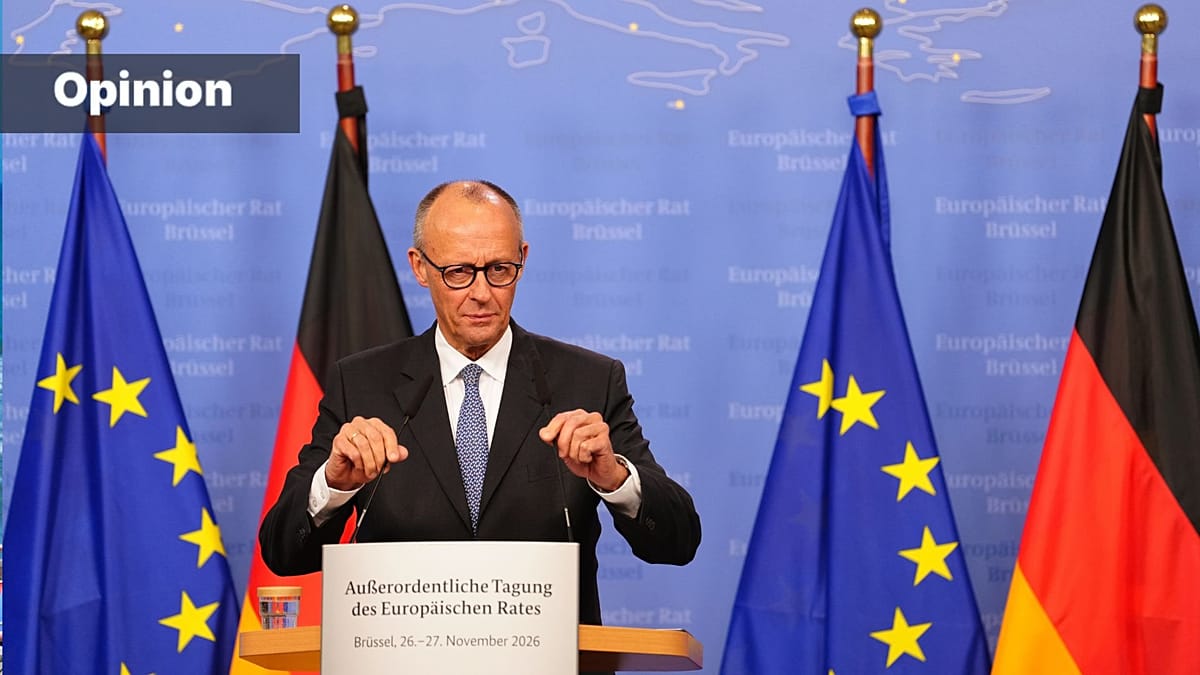
The special Brussels summit on the European Union's next long-term budget ended without a deal on 17 December, as heads of state and government failed to reconcile sharply divergent national priorities. The proposed financial framework for 2028-2034, which would shape how the bloc spends nearly €2 trillion, has become the latest battleground over Europe's strategic direction.
Council President António Costa trimmed the European Commission's draft from just under €2 trillion to around €1.78 trillion, but Germany and other net contributors still balk at the figure. More telling than the overall size, however, is where Costa proposes to cut. Compared with the Commission's blueprint, he removes roughly €95.5 billion from competitiveness, prosperity and security—a 16% reduction—and about €54 billion from agriculture, cohesion and related areas, a 5% cut. Defence industry, security and space would suffer an almost 30% reduction.
Costa's draft does allocate more to defence and competitiveness than the current budget, but the new strategic priorities are still being trimmed disproportionately. This has exposed a fundamental clash over what Europe should finance jointly in an era of renewed geopolitical rivalry.
The logic of national interests
Germany and other net contributors want to cap their payments and steer the budget toward competitiveness and security. Poland and other cohesion countries defend funding for their regions. France insists on an ambitious budget while protecting its farmers, and Italy remains sceptical of new European levies. Each position is understandable from a national perspective, but the interaction creates a structural problem.
The EU's financial framework requires unanimity in the Council and the consent of the European Parliament. Every government can make its approval conditional on safeguarding its own interests. This favours spending with clearly attributable benefits to individual member states. A French president can tell farmers which subsidies he secured in Brussels; a Polish prime minister can point to new roads and modernised regions. But which leader can claim a joint European air defence system as a national victory?
Joint European tasks do have political advocates, but their benefits are harder to map onto the national balance sheet that underpins every budget negotiation: how much did we pay in, and how much do we get back?
Agriculture or defence? A budget for a new world
About 60% of the current EU budget goes to agriculture and cohesion. Both serve core integration purposes—food security, economic development and reducing regional disparities. Yet Europe now faces challenges that barely existed when this structure was created. Russia threatens the continent's security order, China has built significant technological and industrial capacity in strategic sectors, and the United States pursues its own economic and security interests, which do not always align with Europe's.
The conditions that underpinned European prosperity for decades are changing fundamentally. Addressing this requires more than higher national defence spending. It calls for joint defence research, industrial production capacity, secure supply chains, cross-border energy networks, military mobility and European expertise in key technologies.
In 2024, Mario Draghi laid out the scale of the challenge: closing the innovation gap with the US and China, combining decarbonisation with competitiveness, and reducing strategic dependencies. He estimated the additional private and public investment needed at €750 to €800 billion per year. The EU budget cannot and should not finance that alone, but it can mobilise national and private investment and enable joint projects where individual member states lack the necessary scale.
The substance is shrinking
The European budget should be shaped by its tasks—what member states can achieve better, more efficiently or more cheaply together than alone. Agriculture and less developed regions still need reliability, but their shares should, with appropriate transition periods, gradually yet clearly decline to create room for joint investment in the future.
Anyone who thinks Europe can simply carry on as before is living off a substance that is steadily shrinking. A Europe that wants to become more sovereign and independent must get ahead of events. That requires honesty on the revenue side. Costa's draft sets aside €158 billion solely for repaying EU debt taken on during the pandemic—money unavailable for other tasks.
Costa therefore proposes new European own resources, including levies on digital services provided by large companies, tobacco and non-recycled electronic waste. Those who reject additional own resources must explain whether they prefer higher national contributions or corresponding cuts. And those who demand more European tasks must say how they should be funded.
The contribution rebates also belong in this context. They reflect a budget logic that measures success by national returns. As long as that calculation dominates, funding joint tasks will remain structurally difficult.
The deadlock in Brussels is not merely about numbers. It is about whether Europe can adapt its budget to a new world. The failure to bridge the divide leaves the bloc's strategic ambitions in limbo. With Ukraine aid hanging in the balance and farmers protesting in Brussels, the pressure is mounting. Leaders will try again before the end of the year, but the fundamental question remains: how much is Europe willing to spend on its future?



