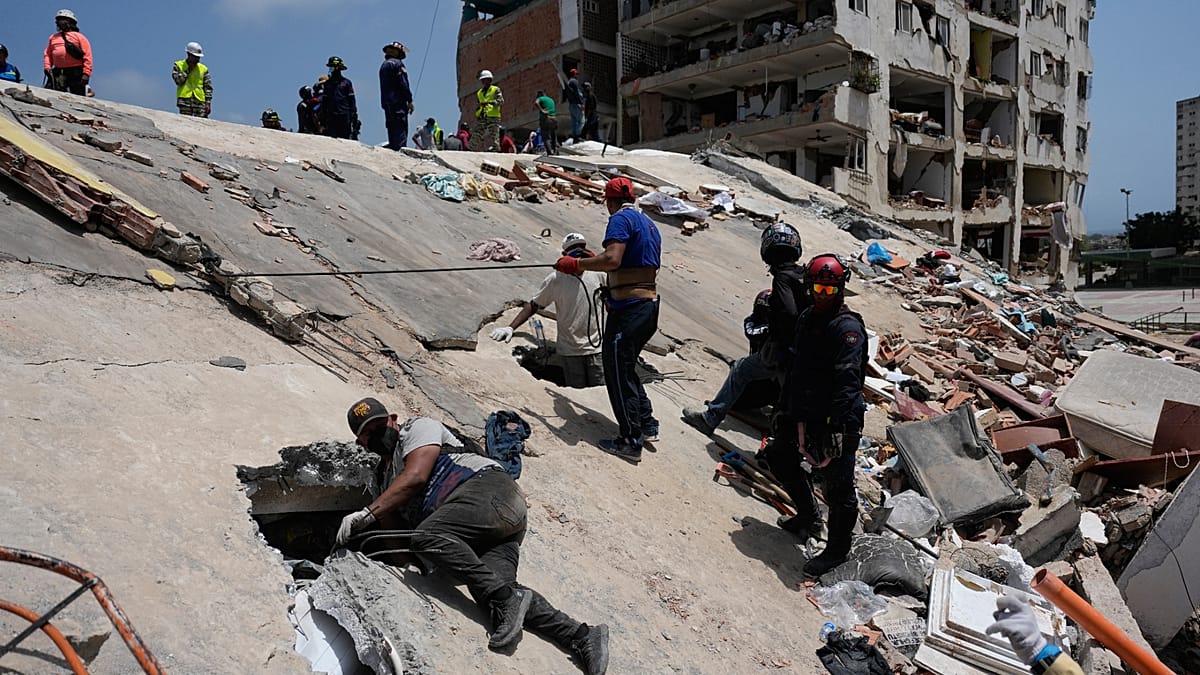
Rescue workers from across the European Union are continuing to search for survivors after two powerful earthquakes struck Venezuela earlier this week, killing at least 920 people and injuring 3,360. The back-to-back tremors, of magnitudes 7.2 and 7.5, caused widespread destruction, damaging at least 383 buildings, 13 hospitals, 25 shopping centres, and 1,002 other structures. Tens of thousands of people remain unaccounted for, according to local authorities.
European Response
The European Commission’s Civil Protection and Humanitarian Aid Operations department has mobilised more than 520 emergency responders from eight EU member states: the Czech Republic, France, Germany, Italy, the Netherlands, Portugal, Spain, and Luxembourg. Teams have been deployed to some of the hardest-hit areas, coordinating with Venezuelan authorities to locate and extract survivors trapped under rubble.
Spain has sent 59 military personnel from its Military Emergency Unit, along with two army engineers and eight canine units. The team, part of the 2nd Emergency Intervention Battalion, uses specially trained search dogs, cameras, and geophones to detect signs of life. An additional 40 personnel and four dogs from Madrid’s Emergency and Rapid Response team have landed in Venezuela and are heading to the capital, Caracas.
The Netherlands has dispatched 64 specialists and eight search dogs from its Urban Search and Rescue team, departing from Eindhoven Air Base. Switzerland, though not an EU member, has contributed 80 specialists, eight search dogs, and 18 tons of equipment. “Upon arrival, the teams will coordinate with local authorities to search for, clear, and rescue earthquake victims buried under the rubble,” the Swiss foreign ministry said.
Italy is deploying air force assets alongside personnel from the Crisis Unit of the ministry of foreign affairs, the ministry of defense, the fire brigade, and the civil protection department. The Italian defence ministry announced on Saturday that its first military aircraft had landed in Venezuela carrying search and rescue teams, with a second aircraft ready to transport additional specialists.
France is sending a detachment from the 4th and 7th Civil Security Training and Intervention Regiments, according to the Directorate-General for Civil Protection and Crisis Management. The team includes rescue and rubble-clearance specialists, medical teams, and canine units.
International Support
The United States has also joined the effort. The US Department of State confirmed that search and rescue teams from California and Virginia, supported by US military personnel, have been deployed. These teams include doctors, engineers, firefighters, and search dogs. US Southern Command has provided transport aircraft, Chinook helicopters, and the USS Billings combat ship to support operations in Caracas.
The scale of the disaster underscores the importance of international cooperation in crisis response. As European teams continue their work, the focus remains on locating survivors amid the rubble. The situation remains fluid, with aftershocks and logistical challenges complicating efforts. For context on how environmental factors can influence human behaviour in crises, see our report on how extreme heat alters brain chemistry and fuels aggression across Europe.
Meanwhile, the economic toll of such disasters often reverberates globally. For a look at how investment patterns shift in the wake of crises, read about the Tashkent Investment Forum. As rescue operations continue, the EU’s rapid mobilisation highlights its capacity to project humanitarian aid beyond its borders, a role that remains central to its foreign policy identity.