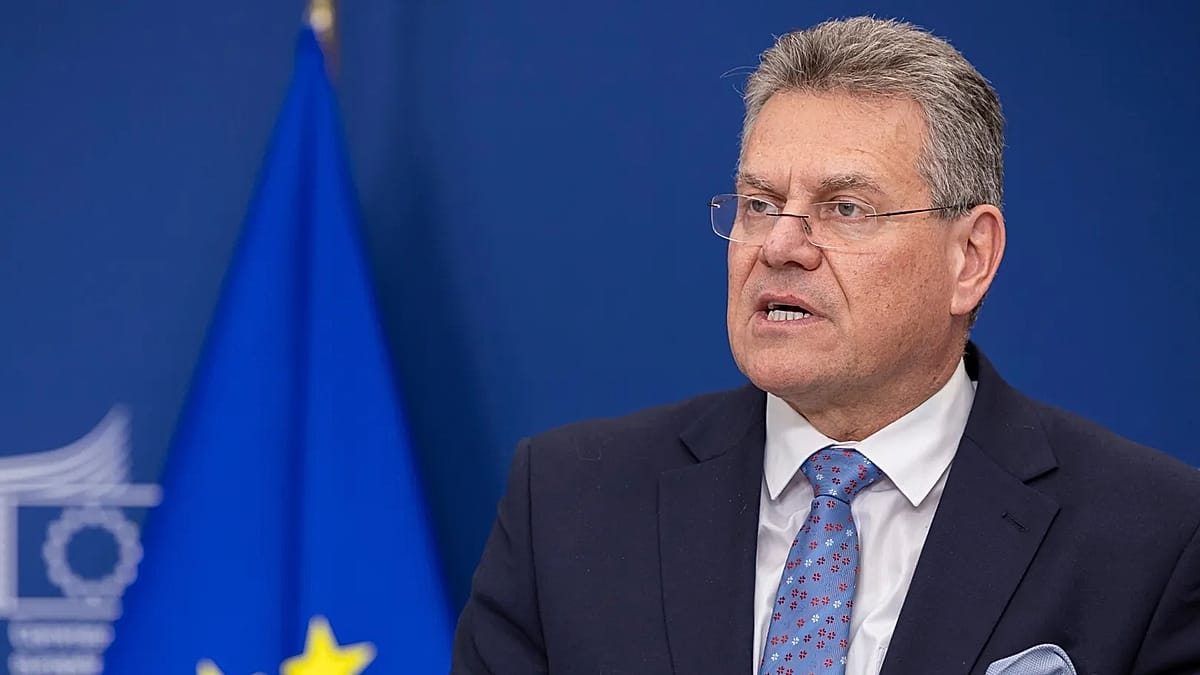
The European Commission confirmed on Wednesday that EU trade commissioner Maroš Šefčovič will hold talks with Chinese trade envoy Li Chenggang on the sidelines of an OECD ministerial meeting in Paris. The encounter comes at a moment of heightened friction between Brussels and Beijing, as the EU moves to counter what it sees as unfair Chinese trade practices.
The meeting follows the Commission's recent unveiling of the Industrial Accelerator Act and the Cybersecurity Act, both of which could restrict Chinese companies' access to the European market. Beijing has responded with threats of retaliation, raising fears of a full-blown trade war between the two economic giants.
Record Trade Deficit and Overcapacity Concerns
At the heart of the dispute is a record-high trade deficit of €359.9 billion with China, which the Commission describes as unsustainable. European officials argue that Chinese state subsidies and overcapacity in sectors such as steel, solar panels, and electric vehicles are flooding the EU market, undercutting domestic producers.
“The current state of the trade and investment relationship is not sustainable,” the Commission said in a statement after a recent meeting of EU commissioners dedicated to China strategy. An EU official told Euronews that a majority of commissioners agreed to strengthen the bloc's trade defence tools. Proposals are expected to be presented to EU leaders at their summit on 18 June.
Divisions Among Member States
EU member states remain split over how to handle China. A non-paper signed by France, Italy, Spain, the Netherlands, and Lithuania calls for faster use of tariffs and quotas on imports that threaten European industrial sectors, with China as the primary target. The aim is to restore a level playing field against what many in Europe describe as unfair Chinese trade practices.
Germany, however, has taken a more cautious approach. Berlin is keen to preserve access to the Chinese market for its companies, even as it faces a deep trade deficit with Beijing. This divergence reflects broader tensions within the EU between those advocating for a tougher stance and those prioritizing economic engagement.
The EU has also been working to reduce its reliance on Chinese technology and supply chains. Earlier this year, the bloc unveiled a tech sovereignty plan aimed at challenging US and Chinese dominance in critical sectors. Additionally, the Commission has proposed supply chain caps to limit dependence on Chinese imports.
China's role in enabling Russia's war in Ukraine has also strained relations. The EU's sanctions envoy recently described China as a “very big problem” for enforcement of Russia measures, as Beijing continues to provide economic support to Moscow.
The outcome of Thursday's meeting in Paris will be closely watched, as both sides seek to manage tensions without triggering a damaging trade war. For now, the EU appears determined to push back against Chinese practices, even as it navigates internal disagreements over the best path forward.