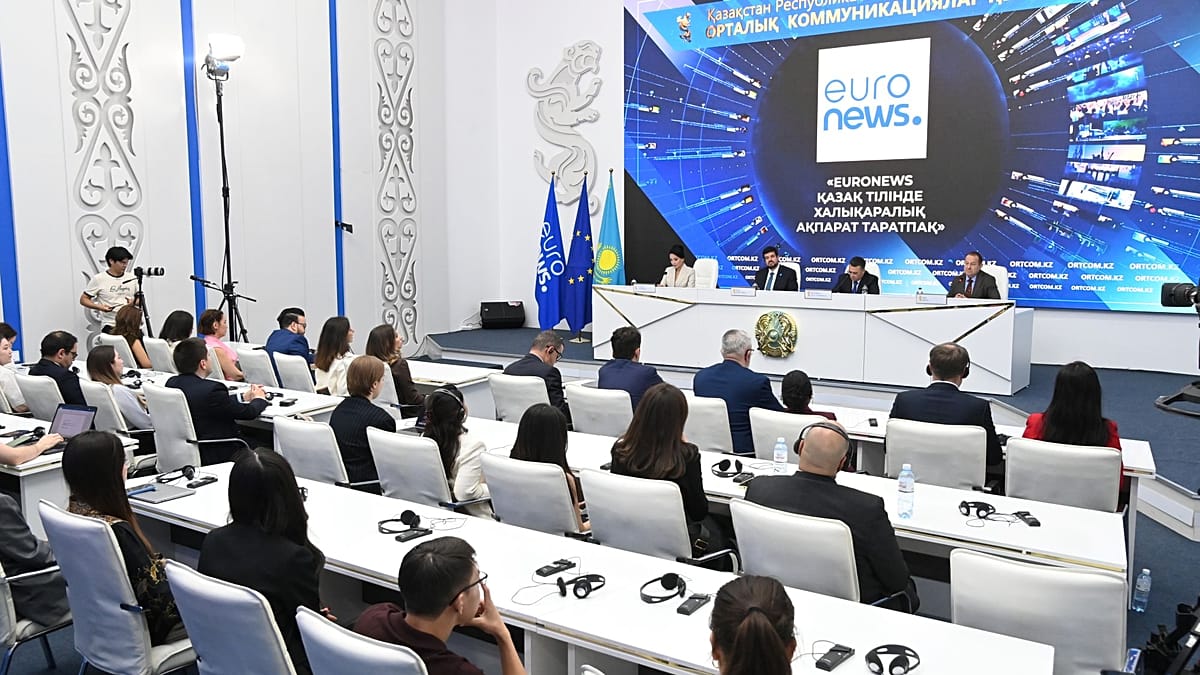
Euronews has taken a significant step in its Central Asian expansion by launching a Kazakh-language broadcast service from Astana. The new channel, which began operations this week, becomes the network's 20th linguistic offering and the first to feature a Central Asian language. It is part of a broader strategy to deepen coverage of a region whose geopolitical and economic importance has grown markedly in recent years.
The launch follows a partnership agreement signed two years ago between Euronews and Kazakhstan, and the subsequent establishment of an editorial hub in Astana and an office in Almaty. These facilities, described by the network as a global media first for the country, will produce Kazakh-language content for television and digital platforms, including YouTube.
A Bridge Between Europe and Central Asia
Speaking at a launch event in Astana on Tuesday, Euronews chairman Pedro Vargas David emphasised the strategic rationale. “As a main Eurasian language and thus a European language, Kazakh will have an important space inside our Euronews family,” he said. Vargas David stressed that the new service is not a local media outlet but an international news channel broadcasting in Kazakh, with a distinct value proposition: to offer audiences the full facts of global events while contributing to well-informed societies.
Kazakhstan’s First Vice Minister of Culture and Information, Kanat Iskakov, described the launch as “a historic event, a milestone for Kazakhstan and a media service that we had to have.” He noted that Euronews previously broadcast in Russian in Kazakhstan, adding: “Now we will broadcast Euronews in Kazakh.” Iskakov said the service “will convey impetus and development for the Kazakh language in general” and “will sincerely serve our nation, conveying news and everything that is happening in the world, now in the Kazakh language.”
The move is expected to elevate the global status of the Kazakh language while giving residents access to Euronews’ trademark international content, built on editorial values of independence, objectivity, accuracy, and fairness.
Expanding Regional Footprint
Euronews began its Central Asian expansion in 2024, opening its first office in Astana in December of that year, which also serves as a regional editorial hub. Bureaus in Tashkent and Baku followed shortly after. The network’s team of journalists in Astana and Almaty is now expanding to produce daily coverage of Kazakhstan and Central Asia, as well as current affairs programmes such as Modern Nomads, East-West Connect, and Voices of Central Asia, which are broadcast worldwide in Euronews’ major language services.
This week, the Astana bureau is also hosting Euronews’ first Asian bureaus editorial seminar, bringing together teams from Qatar, UAE, Azerbaijan, Uzbekistan, and Kazakhstan to align editorial strategy across the continent.
The launch comes amid broader European interest in Central Asia. The European Bank for Reconstruction and Development recently lent €255 million to boost Kazakhstan’s mineral processing capacity, while the country has also deployed AI in schools to bridge the urban-rural education gap. Euronews’ new service adds a media dimension to these ties, offering a platform for European perspectives on regional developments.
With its 20th language service now live, Euronews continues to position itself as a global news network with a distinct European editorial identity, connecting audiences across continents through factual, independent journalism.