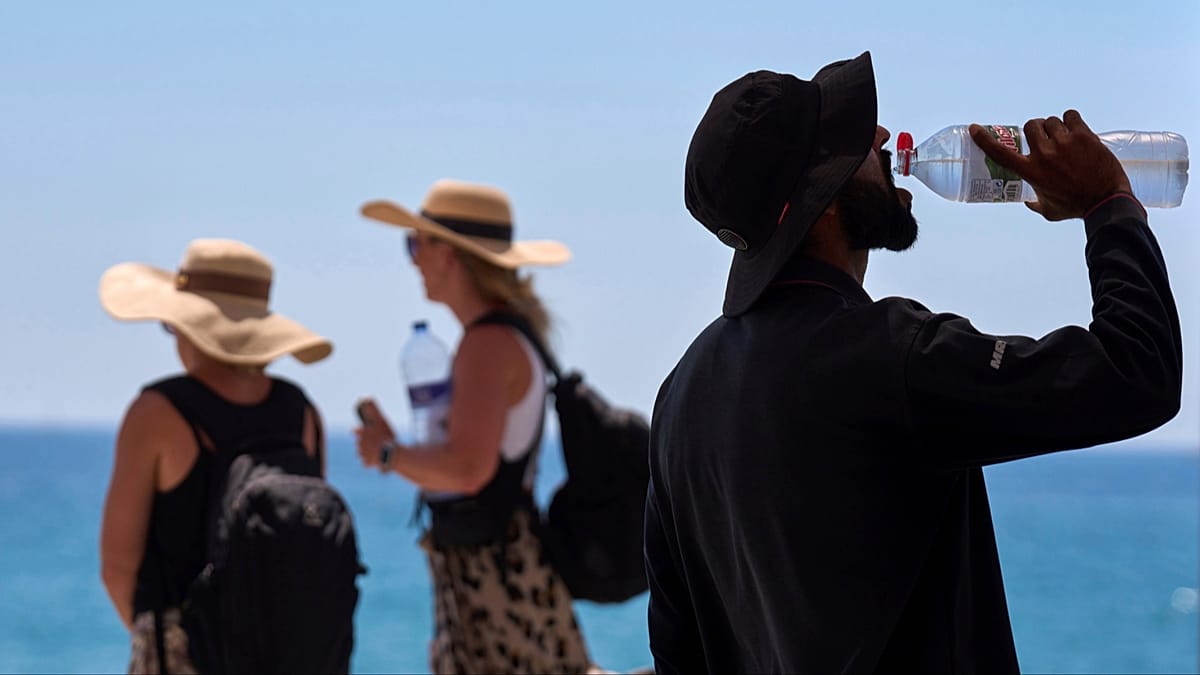
Just weeks after a deadly heatwave swept across the continent, a new surge of extreme temperatures is building over southern Europe. Spain's meteorological agency AEMET has issued yellow warnings for much of the country due to a “notable rise” in temperatures, with an orange alert for rainfall and storms in the northeast. Forecasters expect Seville, Zaragoza, and Córdoba to see highs pushing towards 40°C into next week, accompanied by so-called tropical nights where the mercury does not fall below 20°C over a 24-hour period.
France, which recorded multiple fatalities during last month's unprecedented heat, is preparing for projected highs of 39°C in the southwest and the Bordeaux region. In Portugal, meteorologist Maria João Frada of the Portuguese Institute for Sea and Atmosphere (IPMA) told local media that temperatures will rise from Saturday onward and are likely to remain very high next week. “We are already talking about temperatures of around 35 to 40°C by the start of next week,” Frada said, noting that the 40°C mark will be more confined to inland regions such as the Douro Valley, the Tagus Valley, and the interior of the Alentejo, while the western coast could see 35°C.
Atmospheric Blocking Event, Not a Passing Warm Spell
Italy's meteorologists warn that hot air from subtropical latitudes over inland North Africa will draw across the country next week, bringing blistering temperatures to the south, with Florence potentially reaching 40°C. Even typically cooler nations are warming up: early predictions from weather forecasters at wfy24.com indicate that the interior Danube plains of Bulgaria and Romania are pushing toward 38°C, while Budapest could climb into the 36–37°C range as a ridge extends over the Carpathian Basin.
“This isn't just another hot week; it has the structural fingerprints of an atmospheric blocking event, not a passing warm spell,” Ionna Vergini, founder of wfy24, told Euronews Earth. Vergini describes the spike as a “textbook demonstration of the ‘new normal’,” as heat-trapping gases continue to warm the planet.
Europe's Structural Gap in Heat Preparedness
Vergini argues that the heatwave reveals a widening structural gap in Europe's preparedness. “Southern Europe has developed a behavioural tolerance to extreme heat: shifted routines, siestas, shutters, etc, but that's a behavioural adaptation, not a biological one, and it doesn't protect the physical infrastructure,” she said. Electrical grids, even in hotter regions, struggle with surges in air conditioning use, while many public transport systems were built on thermal thresholds designed for the late 20th century, making them vulnerable to intense heat.
Last week, the northwestern Italian city of Turin experienced large-scale blackouts as the May heatwave strained the local electricity network. France's commuter rail and tram-train network Transilien has already urged passengers to check schedules before heading to stations due to potential heat-related disruptions.
The Hidden Dangers of Tropical Nights
The incoming heatwave is also expected to bring an increase in tropical nights across much of the Mediterranean. This phenomenon is already affecting public services: some schools are considering changing exam times to help students who are not sleeping well because of high nighttime temperatures.
“Sustained nighttime heat is arguably a greater public health threat than the daytime peak,” explained Vergini. “When lows fail to drop below 20°C and in the worst cases stay above 25°C, what some call 'super-tropical nights', the body is denied its vital recovery window, and the cardiovascular system stays under constant strain to cool the core. Excess mortality during heatwaves correlates much more heavily with consecutive high nighttime minimums than with a single hot afternoon.”
As the continent braces for another week of extreme heat, the focus is shifting from mere temperature records to the less visible but equally dangerous effects of sustained warmth after dark. For more on how Europe is adapting to climate extremes, read about Portugal's new autonomous vehicle testing rules and Europe's hidden natural wonders.