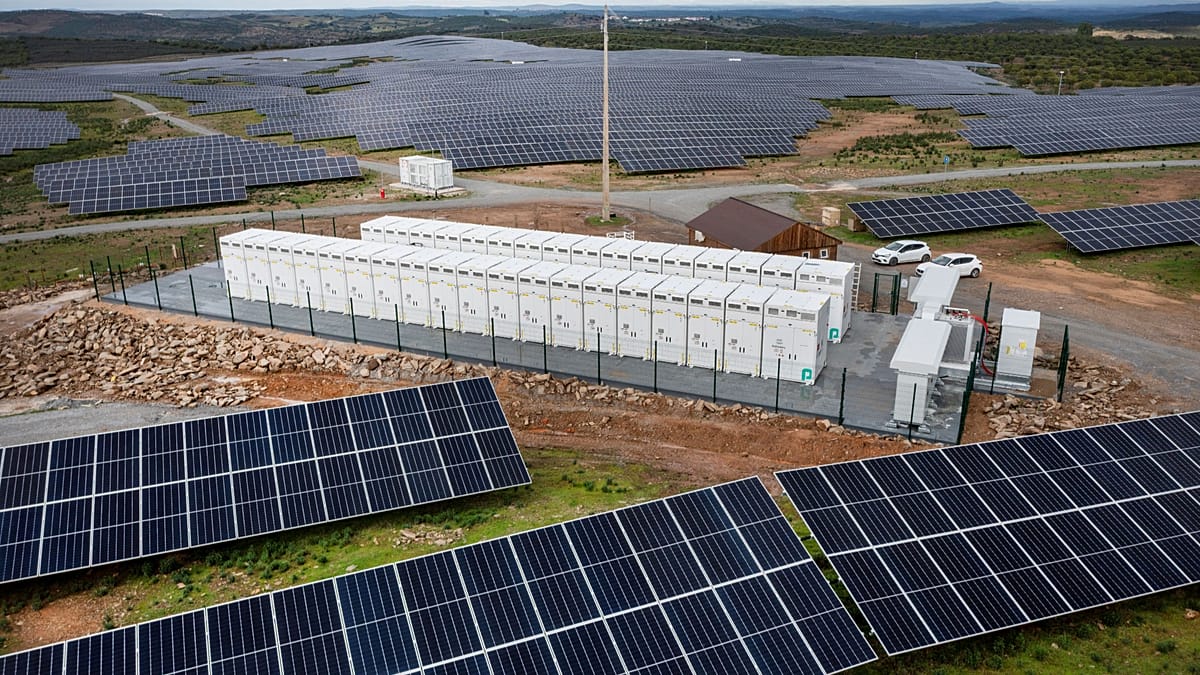
Batteries are essential for storing electricity from intermittent sources like solar and wind, enabling a stable and efficient power grid. As European countries race to decarbonise, their battery capacities vary dramatically, with some nations already far ahead and others planning massive expansions.
According to Ember's European and Türkiye Electricity Review 2026, Germany currently holds the top spot for operational battery capacity with 2.8 gigawatts (GW). Italy follows at 2 GW, while a second tier of countries—Ireland (0.92 GW), Sweden (0.75 GW), Bulgaria (0.56 GW), and France (0.52 GW)—sits between 0.5 GW and 1 GW. Romania (0.49 GW), Belgium (0.47 GW), Finland (0.39 GW), the Netherlands (0.39 GW), and Turkey (0.21 GW) round out the list below half a gigawatt.
Turkey's Ambitious Pipeline
When project pipelines—including projects under construction, permitted, or announced—are considered, the rankings shift dramatically. Turkey emerges as the most ambitious country in Europe, with a pipeline of 32.8 GW, more than three times that of its nearest rivals: Germany (10.5 GW), Poland (10.4 GW), and Italy (10.2 GW).
Ufuk Alparslan, Ember's regional lead and author of the Türkiye Electricity Review 2026, explained the driving force: "[In Turkey] the policy's key success came when the regulator opened up unlimited grid capacity for storage-integrated wind and solar projects, which led to a flood of investor interest."
If these plans materialise, Turkey would lead Europe with a total battery capacity of 32.97 GW, followed by Germany (13.26 GW), Italy (12.15 GW), and Poland (10.42 GW)—each roughly a third of Turkey's projected total. Romania, Spain, the Netherlands, and Belgium would also see significant, though more modest, improvements.
Falling Costs and Policy Drivers
Dr. Beatrice Petrovich, senior energy analyst at Ember and author of the European Electricity Review 2026, highlighted that falling battery prices are a key catalyst. "Grid-scale battery costs dropped to a record low in 2025, a 45% drop from 2024, continuing a trend of roughly 20% annual cost reductions over the past decade. As battery economics improve, projects are increasingly profitable without subsidies," she said.
Petrovich stressed that while technology and economics are now largely in place, the scale of battery fleets ultimately depends on policy choices. "Stable policy frameworks unlock battery potential because they mean predictable revenue streams which allow project developers to attract capital," she noted. Several EU countries, including Bulgaria, Italy, and Spain, already demonstrate how policies can accelerate deployment. Conversely, Germany illustrates how uncertainty can slow progress: "Proposed preferential treatment for gas in backup power tenders and uncertainty over changes to grid fee risk undermining investor confidence," Petrovich added.
The trend is part of a broader shift where renewables with battery storage now rival fossil fuels on cost, making storage a commercially viable investment across the continent.
France Lags Behind
France would more than double its capacity to 1.12 GW, yet that would still leave it near the bottom of the rankings among 16 countries. The country's heavy reliance on nuclear energy—which accounted for 69% of its electricity production in 2025, compared to the EU average of 12%—helps explain its limited battery ambitions. Nuclear power provides baseload electricity, reducing the immediate need for large-scale storage.
Can Turkey's Pipeline Be Built?
Alparslan cautioned that a project's pre-license only guarantees grid capacity, not that it will come online. "Investors are eager to complete these projects. The [Turkish] government's decision on timeline extensions will determine how much of the planned capacity is realized," he said. He warned that if projects fail to materialise after extensions, they could block new wind and solar installations by occupying available grid capacity.
As of late 2025, Turkey's total installed wind and solar capacity reached 40 GW, meaning its 33 GW battery pipeline corresponds to 83% of that existing capacity. The country's ambitions are part of a broader solar and battery boom positioning it as Europe's renewable leader.
The race for battery storage is reshaping Europe's energy landscape, with policy decisions and cost trends determining which countries will lead the transition to a flexible, low-carbon grid.