As Türkiye prepares to host the COP31 climate conference in November, it is quietly reshaping its energy landscape. The country now boasts one of the world's largest solar installations and Europe's most ambitious battery storage pipeline, positioning itself as a renewable energy pioneer for the continent.
A recent report by the energy think tank Ember reveals that Türkiye has built a battery storage pipeline surpassing any European Union member state. Since 2022, Ankara has required all new wind and solar projects to include equivalent battery capacity. This mandate triggered a staggering 221 gigawatts (GW) of applications within months, with 33 GW already approved. By comparison, the EU's top storage markets—Germany and Italy—sit at 12–13 GW. Türkiye's pipeline now equals 83 percent of its current wind and solar capacity.
“By mandating storage with renewables, Türkiye hasn't just increased its targets; it has created a massive investment signal that outstrips its European peers,” said Ufuk Alparslan, the report's author. “If delivered, Türkiye’s battery pipeline will be the backbone of a new, clean regional energy hub.”
A Sci-Fi Solar Facility
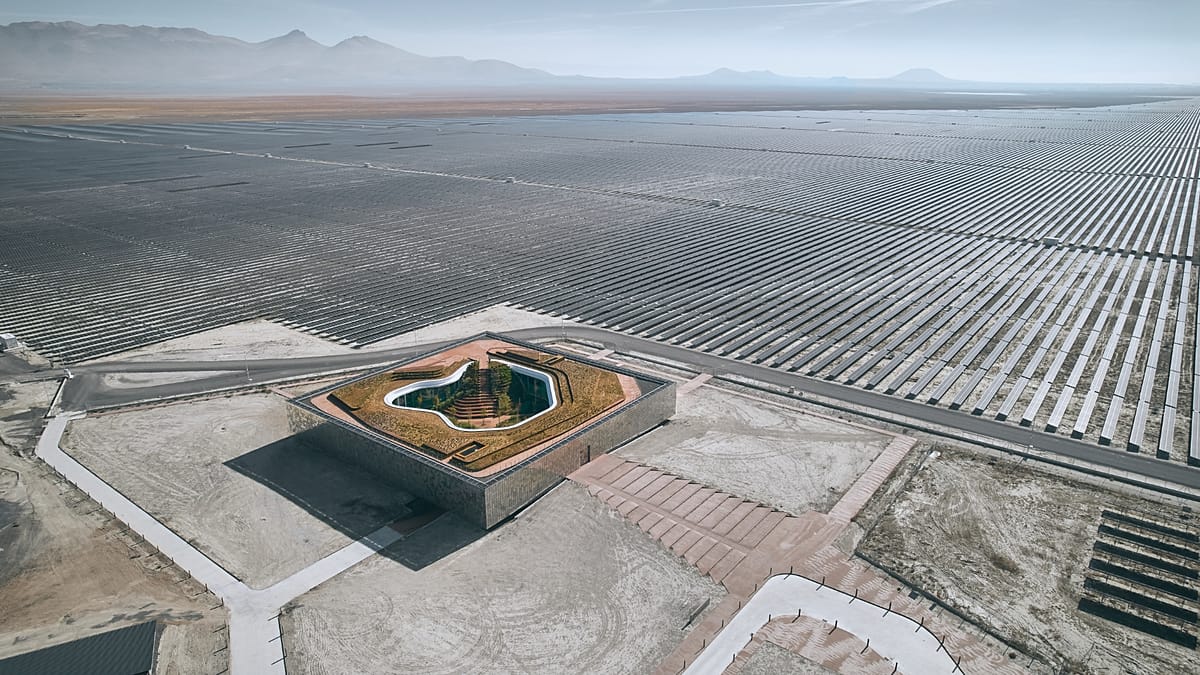
The centerpiece of Türkiye's renewable push is the Kalyon Karapınar Solar Power Plant (SPP) in the central Anatolian province of Konya. Spanning roughly 20 million square metres—equivalent to 2,600 football fields—the facility houses around 3.5 million solar panels. It has been generating electricity since 2023, producing nearly three billion kilowatt-hours annually, enough to power a city of two million people.
The plant's Central Control Building, designed by Bilgin Architects, has drawn international attention. Its exterior is clad in reflective silver panels, while inside a lush courtyard oasis opens to the sky. Images of the structure have impressed online users, with one Reddit commenter suggesting it could feature in a new James Bond film and another calling it a “masterpiece.”
Wind and solar now account for a combined 22 percent of Türkiye's electricity generation, making it the undisputed leader among 16 countries in the Middle East, Caucasus, and Central Asia. It is the only nation in that broader region where wind and solar have surpassed a 20 percent share. This progress aligns with broader European efforts to accelerate renewables, as seen in the EU's accelerated push for renewables and nuclear energy following the Strait of Hormuz closure.
Coal Dependency Remains
Despite these gains, Türkiye still trails many European peers. It ranks 15th in Europe for wind generation and 16th for total renewables. To meet its 2035 target of 120 GW of solar and wind capacity, the country will need to triple its current capacity—a formidable challenge.
Coal remains Türkiye's primary power source at 34 percent, with two-thirds of that generation relying on imports. While no new coal plants have been commissioned in the last three years, a 2025 purchase guarantee for domestic coal risks driving up coal generation in 2026, according to Ember. Production growth has slowed but has yet to peak.
“Türkiye has a unique opportunity to turn its regional leadership in renewables into a global advantage,” Alparslan said. “By accelerating its storage projects and modernising its grid, Türkiye can finally break its coal dependency. Ahead of COP31, the country is proving it has the potential to move from the 'middle of the pack' in Europe to a pioneer for the entire region.”
The country's investments in renewables also resonate beyond its borders. For instance, Central Asian leaders recently signed a landmark environmental pact, pledging €2 billion for a green transition, underscoring the regional momentum. Meanwhile, Spain, France, and Portugal are racing to expand renewables amid the ongoing energy crisis, highlighting the competitive landscape Türkiye now leads.