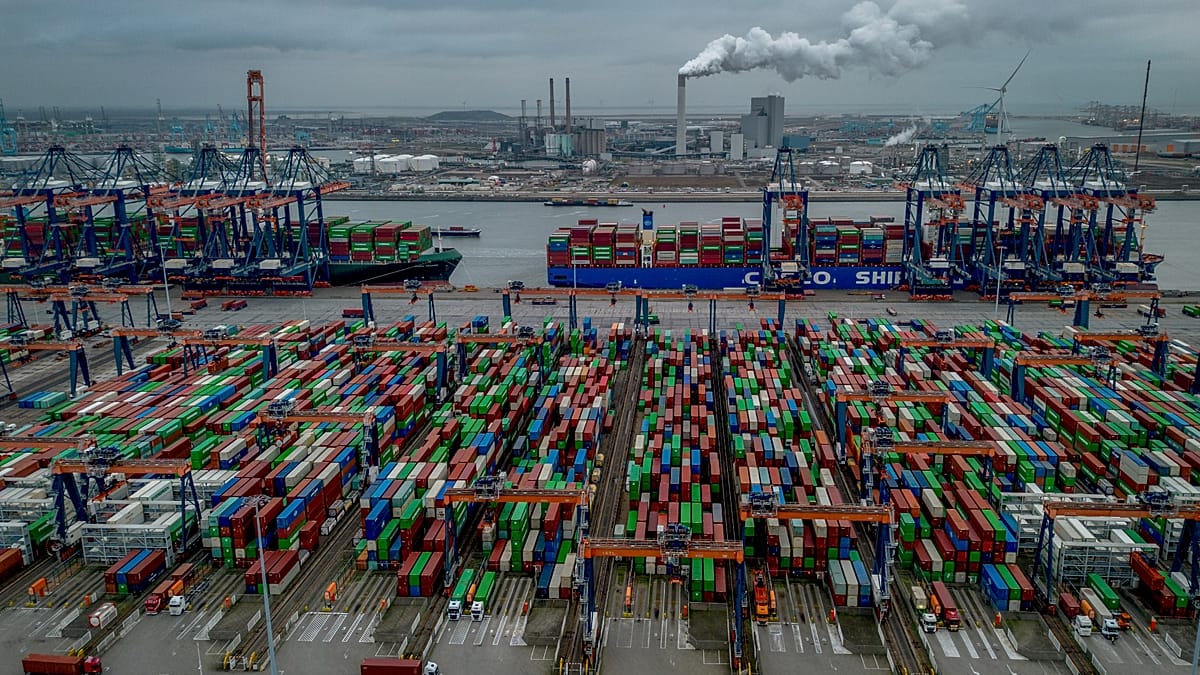
Maritime shipping remains the backbone of European trade, moving everything from food and fuel to manufactured goods. In 2024, EU ports handled roughly 3.4 billion tonnes of cargo, about 26% of the global total of 13 billion tonnes. Nearly 90% of the bloc's external freight travels by sea, according to the EU Blue Economy Observatory.
But the picture is not uniform. A handful of port cities dominate, and the balance of power is shifting as non-EU countries like Turkey and Norway play an increasingly large role.
Rotterdam and Antwerp-Bruges: the EU's heavyweights
Rotterdam in the Netherlands remains the EU's busiest port by a wide margin, handling 397.3 million tonnes of goods in 2024, according to Eurostat. Belgium's Antwerp-Bruges follows with 243.7 million tonnes. These two ports together account for more than a fifth of all EU maritime cargo.
Hamburg, Germany's largest port, comes third with 97 million tonnes — a significant drop from the top two. The gap between the leaders and the rest is stark, but competition is tight among the next tier.
Spain's Algeciras ranks fourth with 81.5 million tonnes, followed by Amsterdam at 78.8 million tonnes. France's HAROPA (Le Havre and Rouen) handles 76.6 million tonnes, while Poland's Gdańsk is close behind at 71 million tonnes. Marseille, another French port, moves 66 million tonnes, and Valencia in Spain adds 64.5 million tonnes.
Romania's Constanța, the EU's largest Black Sea port, also makes the top ten with 57.6 million tonnes — a reminder that the bloc's eastern maritime routes remain vital, especially given recent disruptions in the region.
Beyond the top ten: a diverse field
From positions 11 to 20, cargo volumes range from 55.5 million tonnes at Barcelona to 36.8 million tonnes at Dunkerque. Italy's busiest port, Trieste, handles 53.5 million tonnes, followed by Genoa at 47.4 million tonnes. Portugal's Sines moves 44.1 million tonnes, while Greece's Piraeus — a key gateway for the eastern Mediterranean — handles 43.7 million tonnes.
Germany's Bremerhaven adds 42.5 million tonnes, Sweden's Göteborg 38.5 million tonnes, and the Netherlands' Zeeland Seaports also features prominently. This spread shows that Europe's maritime economy is not concentrated in a single region; it stretches from the North Sea to the Black Sea and the Mediterranean.
Country rankings: the Netherlands leads, Turkey surges
When measured by total cargo handled in all ports, the Netherlands is the EU champion with 538.1 million tonnes. Italy follows with 488.6 million tonnes, narrowly ahead of Spain at 486 million tonnes. These three countries are far ahead of the rest: Belgium, in fourth place, handles 274.9 million tonnes, while Germany manages 273.9 million tonnes and France 269.8 million tonnes.
Greece, Sweden, and Poland each handle more than 100 million tonnes, underscoring the breadth of Europe's maritime infrastructure.
But the picture changes when EU candidate countries and EFTA members are included. Turkey ranks second overall with 524.7 million tonnes — just behind the Netherlands and ahead of every EU member state. Norway, with 212.1 million tonnes, sits eighth. This reflects the growing importance of non-EU ports in European supply chains, a trend that has been accelerated by recent geopolitical tensions, including the shipping disruptions in the Strait of Hormuz.
The European Commission has long emphasised that “maritime transport has been a catalyst for economic development and prosperity throughout its history” in Europe. That remains true today, but the geography of that prosperity is evolving. As Turkey and Norway expand their port capacities, and as EU ports like Gdańsk and Constanța gain prominence, the continent's maritime map is being redrawn.
For businesses and policymakers, these rankings are more than statistics. They indicate where infrastructure investment is needed, where trade routes are shifting, and which cities are best positioned to benefit from the next wave of global commerce. With the EU's external trade heavily dependent on sea routes, the health of its ports is a direct measure of its economic resilience.