The United States military said on Tuesday that it had carried out strikes against Islamic Revolutionary Guard Corps (IRGC) targets inside Iran, responding to what it described as recent attacks on commercial shipping in the Strait of Hormuz and on American service members deployed to the region.
In a statement posted on X, US Central Command (CENTCOM) said the strikes were a direct response to "recent attempted attacks by the IRGC against commercial shipping in the Strait of Hormuz and against American service members deployed to the region." The statement did not provide further details on the locations or the scope of the operation.
Iran's semi-official Fars news agency reported that explosions were heard in the areas of Bandar Abbas, Sirik, and Qeshm, and that local authorities had also reported strikes in the districts of Chabahar and Konarak. The reports could not be independently verified.
Renewed hostilities in a critical waterway
The latest US action marks a sharp escalation in a conflict that had simmered since late February, when Washington and Israel launched a first wave of strikes on Iranian territory. On Sunday, US forces carried out what they said were strikes on IRGC minelaying forces in the Strait of Hormuz, the first American military action in the waterway in a month.
The IRGC quickly confirmed that Larak Island had been hit and warned of a "retaliatory response." On Monday, the IRGC said its forces had attacked two US bases in Jordan and one in the United Arab Emirates. The UAE's Ministry of Defence later denied that its Al Menhad air base had been targeted.
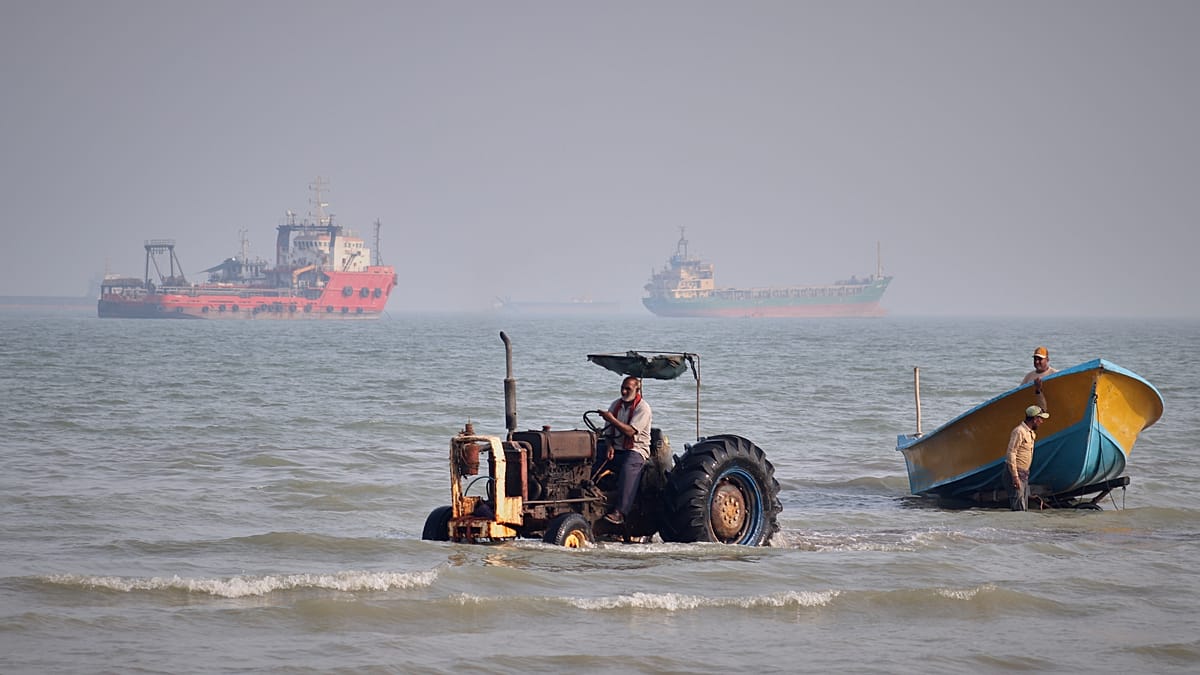
CENTCOM rejected Iran's characterisation of the Sunday strikes as an "act of aggression," insisting that US forces were responding to an "imminent threat in the Strait of Hormuz." The strait is a strategic chokepoint that normally carries around a quarter of the world's seaborne oil trade, making any disruption a matter of global concern.
"In essence, Iran created the threat and the U.S. military eliminated it to protect civilian mariners, commercial shipping, and the free flow of global commerce," CENTCOM said.
The escalation has immediate implications for European energy security and trade. The prolonged disruption to Hormuz shipping has already forced QatarEnergy to extend its force majeure on LNG deliveries into November, a move that will keep European gas markets under pressure as winter approaches.
European governments are watching the situation closely. The EU has been grappling with the knock-on effects of the crisis, including temporary fuel tax cuts approved for Spain to cushion the impact on consumers. Meanwhile, Qatar's prime minister visited Tehran in a bid to de-escalate tensions, but so far there is little sign of a breakthrough.
The renewed hostilities also come against a backdrop of broader instability. The Iranian strikes on US bases in Jordan have raised fears of a wider regional conflict, while the resurgence of Somali piracy and the ongoing Red Sea shipping disruption are compounding challenges for global supply chains.
For Europe, the stakes are high. The continent relies heavily on imported energy, and any sustained closure of the Strait of Hormuz would send shockwaves through European economies. EU leaders have called for restraint, but the cycle of attack and retaliation shows no sign of abating.
As the situation develops, European capitals will be weighing their options, from diplomatic pressure to contingency planning for further energy disruptions. The coming days will be critical in determining whether the conflict can be contained or whether it spirals into a broader regional war.