As Europe braces for hotter summers, cities from Paris to Berlin are racing to clean up centuries-old waterways, betting that a swimmable river is now essential urban infrastructure. This is not a nostalgic revival but a practical adaptation to a warming climate, where rivers and canals become tools for cooling, public health, and community life.
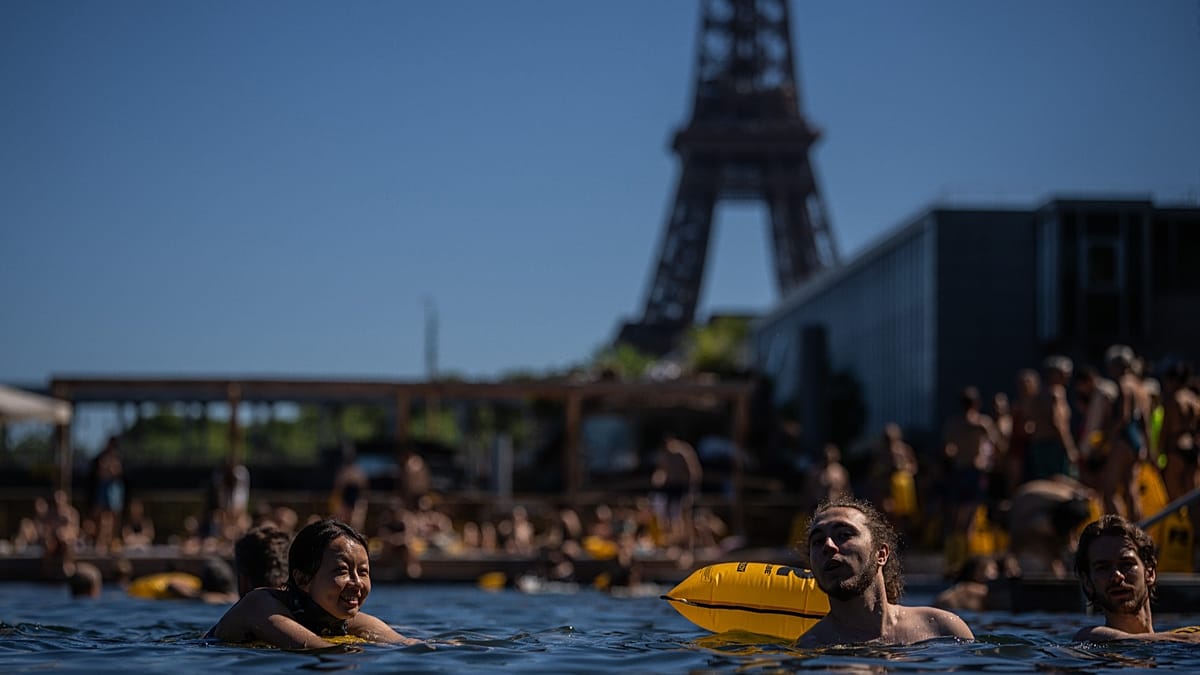
When Paris opened the Seine to public swimming last year, it was more than an Olympic spectacle. It signaled a broader shift: cities are reimagining their rivers not as engineering problems hidden behind concrete embankments but as public spaces worth restoring. Vassileios Latinos, head of resilience and climate adaptation at ICLEI Europe, a network of local governments focused on sustainability, notes that “European cities definitely are increasingly investing in the rivers and also the canals that are connecting the rivers, because they can provide multiple benefits at once.” From Copenhagen to Berlin, he says, cities are rediscovering waterways as tools for climate resilience, public health, and everyday urban life.
Water Quality Improves, but Urban Rivers Lag
The optimism is backed by data. According to Trine Christiansen, head of the freshwater and environment group at the European Environment Agency, 85 percent of Europe’s bathing sites were rated excellent in the most recent assessment, and 96 percent met minimum quality standards. These figures have steadily improved since the EU’s Bathing Water Directive was revised, with poor-quality sites falling from 2.4 percent to 1.5 percent. However, gaps remain for urban rivers. France, the Netherlands, and Estonia currently have some of the highest shares of poor-quality bathing waters in the EU, often linked to inland rivers rather than coasts. For a deeper look at the cleanest waters, see Europe's Cleanest Swimming Waters: Cyprus, Greece, Bulgaria, Austria Lead.
For Latinos, the motivation goes beyond nostalgia. “Having clean and integrated waterways and rivers within the city can be a powerful tool for helping cities to cope with more frequent and intense heat waves,” he says, pointing to the extreme heat that hit Europe recently. Rivers, canals, and surrounding green spaces “can create natural cooling, they can reduce the urban heat island effect… and provide accessible places where people can find relief during extreme temperatures.” He describes watching Paris’s riverside promenades, deliberately redesigned as pedestrian-friendly public space, become “basically packed” during a recent heatwave. In Berlin, the local government is “revitalising the waterways through green corridors and public access projects,” often working with NGOs and citizen groups.
The appeal is that river restoration delivers multiple benefits from a single investment: flood risk management, biodiversity gains, cooler streets, attractive public space, and a boost for local economies. It’s also a statement of intent. “It’s also like a way to show that the city basically cares about the urban environment,” Latinos adds.
The Hard Part: Cleaning the Water
None of this works without tackling water quality. Eline Boelee, an expert in water and health at the Dutch research institute Deltares, points to aging infrastructure as a core problem. Many European cities still rely on combined sewer systems that carry both rainwater and sewage. “The systems are built for an average, and when heavy rainfall comes, the capacity is sometimes surpassed and that water is flushed into surface water,” she explains. This poses risks including pathogens, antimicrobial-resistant bacteria, and chemical pollutants like PFAS.
Latinos frames the fix in structural terms. Making a river swimmable requires reducing pollution at its source, upgrading wastewater and stormwater systems, restoring the natural ecosystem, and building a proper monitoring system so cities and citizens know when water is genuinely safe. Coordination is the real bottleneck. “It’s not that when someone makes a decision, this can be done within months,” Latinos says. Rivers cross multiple jurisdictions and involve utilities, businesses, and local communities whose interests don’t always align, especially when restoration work means closing riverside businesses for months. “There is a need for coordinated action and strong leadership from the beginning,” he says, along with technical expertise and patched-together funding from diverse sources.
Done well, the payoff is significant. Latinos points to cities like Paris and Copenhagen as models of what “blue-green infrastructure” can achieve: cooler, healthier, more livable neighborhoods built around water. As Christiansen explains, with heatwaves becoming more frequent, “safe and well-managed river bathing waters are increasingly important for the quality of urban life, public health and water resilience.” Reclaiming urban rivers is becoming a practical response to a hotter, more unpredictable climate. For those seeking a different kind of urban water experience, Stockholm in Summer: Archipelago Sunsets, Fika, and Wild Swimming offers a Nordic perspective.