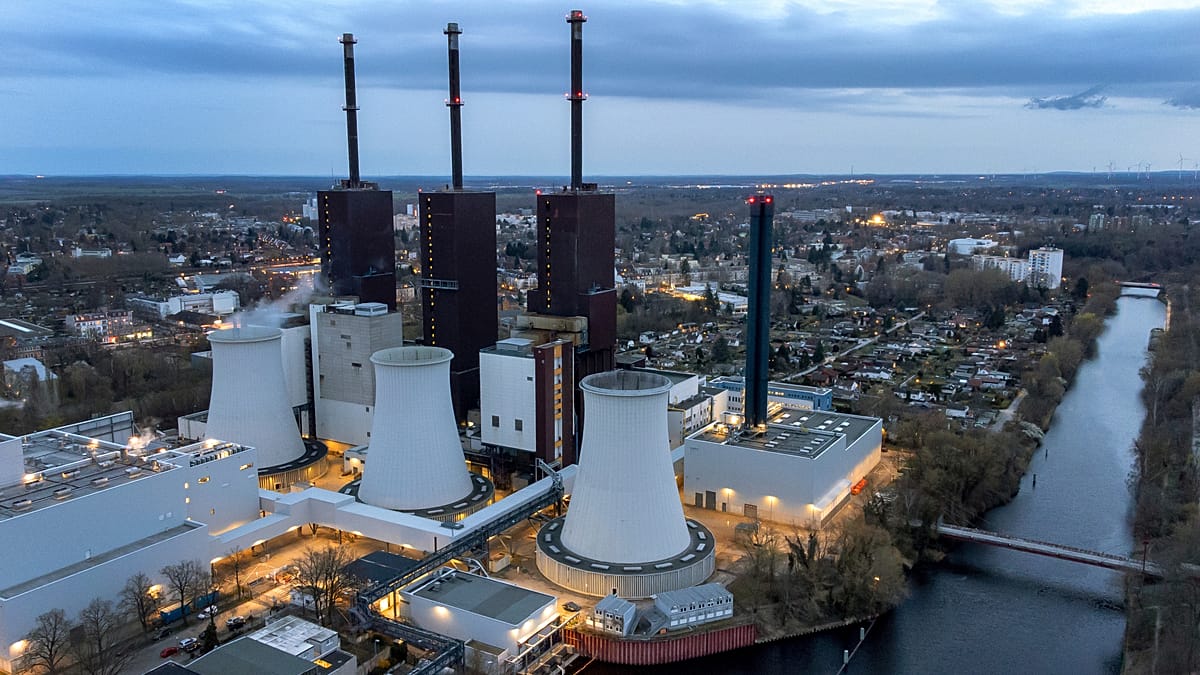
Europe’s response to the energy crisis triggered by the war on Iran is taking a troubling turn. Rather than accelerating the shift to renewables, governments across the European Union are planning to build almost 60 gigawatts of new gas-fired power plants, according to a report published on 15 June by the campaign group Beyond Fossil Fuels (BFF). The analysis warns that this expansion could lock the continent into fossil fuel dependence for decades, undermining climate goals and leaving households exposed to future price shocks.
The report, titled ‘Merchants of Crisis’, estimates that if all planned plants are built, they would burn roughly 28 billion cubic metres of gas annually — equivalent to about nine per cent of the EU’s projected gas imports, or the yearly consumption of 46.4 million households. This comes as natural gas prices in Europe have already risen by 60 per cent since the conflict began, and storage levels at the end of February 2026 stood at 46 billion cubic metres, down from 60 billion a year earlier.
Germany at the Forefront of Gas Expansion
Germany is singled out as a prominent example of this trend. The German government plans to add 12 GW of power plant capacity by 2031, of which 10 GW are designated as hydrogen-ready, gas-fired plants. While this is a reduction from earlier coalition plans to tender 20 GW by 2030, it still represents a significant addition to the country’s existing 31 GW of gas capacity. Berlin mandates that all new gas capacity must “decarbonise” by 2045, but leaves the door open for carbon capture and storage (CCS), a technology that critics, including the Institute for Energy Economics and Financial Analysis (IEEFA), argue is neither proven nor cost-efficient.
BFF contends that Germany’s Energy Minister, Katherina Reiche, brings a pro-gas-industry stance to her role, having spent a decade working with E.ON subsidiary Westenergie AG and VKU, a lobby group for municipal energy utilities. Since taking office, she has pushed for gas plant expansion, advocated for relaxing EU net-zero deadlines, and proposed cuts to solar and grid subsidies. The German Federal Ministry for Economic Affairs and Climate Action (BMWE) did not respond to a request for comment.
German households already face the highest energy bills in the EU, largely due to the country’s heavy reliance on imported gas — 95 per cent of its consumption comes from abroad. The report also highlights Poland and Romania, where state ownership of oil and gas companies influences energy policy. In Poland, the state is the majority owner of utilities PGE and ENEA, and the top shareholder in Orlen and Tauron. In Romania, gas producer Romgaz is 70 per cent state-owned, and the state holds a 20.7 per cent stake in OMV Petrom. These two companies are co-developing the €4 billion Neptun Deep Black Sea gas project, set to double Romania’s gas production from 2027. Romania’s Mintia gas-fired thermal power plant, slated to become the largest in the EU, is expected to start operations this year, despite EU grid body ENTSO-E finding much of its planned capacity would not be economically viable by 2035.
Flexible Power and the Clean Alternative
The report argues that a “powerful alliance of politicians and energy companies” is using the language of energy security to justify maintaining the status quo. By mandating that 10 GW of new capacity “must be able to generate electricity continuously over a longer period of time,” Germany is effectively favouring gas-fired plants, which currently provide flexible, dispatchable power to balance the grid when wind and solar output fluctuate. However, campaigners and analysts warn this approach risks creating stranded assets. Battery storage and other clean flexibility solutions, they argue, are cheaper and more resilient.
“Clean flexibility is scaling fast,” says Dr. Beatrice Petrovich, senior energy analyst at think tank Ember. “Grid-scale battery costs hit a record low in 2025, continuing a decade-long trend, while installed capacity more than doubled in just two years — making batteries a cheaper alternative to new gas for short-term grid balancing that is also faster to build.” In Germany alone, battery capacity is expected to grow from 2.5 GW in 2025 to over 10 GW in the next few years. Combined with AI-enabled demand flexibility from a growing fleet of electric vehicles and heat pumps, this progress shows that policymakers should carefully assess the long-term economic and environmental costs of new gas infrastructure.
Juliet Phillips, energy campaigner at Beyond Fossil Fuels, puts it bluntly: “Building more gas plants will not protect people in Europe from future energy crises — it will deepen our dependence on volatile fossil fuel imports, while energy companies profit. The real solution is establishing a strategy to phase out fossil fuels while accelerating progress on renewables, storage, grids and clean flexibility.”
As Europe grapples with the immediate fallout of the war and rising energy costs, the choice between locking in fossil fuel infrastructure or investing in a cleaner, more resilient system has never been more stark. The report’s findings underscore the need for a fundamental rethink of energy security, one that prioritises long-term sustainability over short-term fixes.