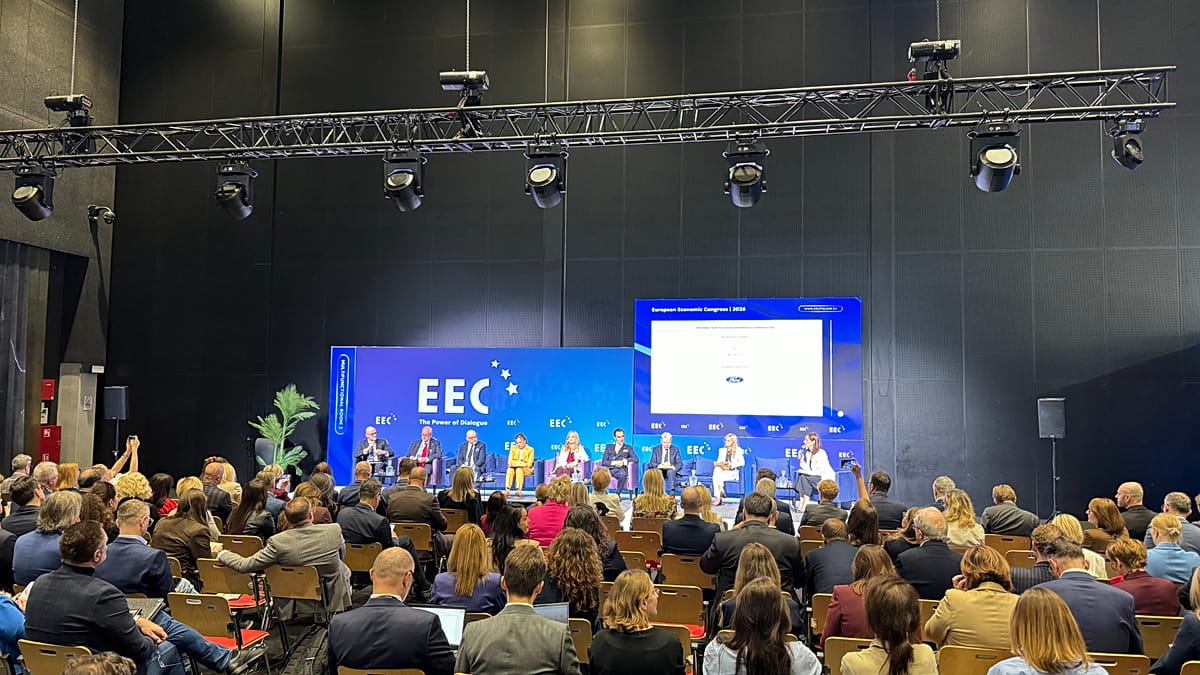
At the European Economic Congress 2026 in Katowice, a stark message emerged: Europe's critical raw materials crisis has a partial solution sitting in its waste streams, but the continent has been too slow to act. Dorota Włoch, CEO of Eneris Surowce, told delegates that recycling is no longer optional—it is essential for the energy transition.
Unlike plastics, metals can be recovered and reused indefinitely, making urban mining—the recovery of raw materials from existing products and waste—increasingly valuable, particularly for batteries. "From recycling, we recover metallic aluminium and so-called black mass, which is a concentrate of metals, mainly cobalt-nickel. These are some of the most valuable battery metals," Włoch explained. "Batteries are crucial today, not only in the automotive sector, but also in storing energy from renewable sources such as wind and solar."
Europe's 25-Year Lag
Włoch put the scale of the problem plainly. "Deposits are critical—any machine can be bought, but natural resources are not. They are non-transferable and non-renewable. If we use them, they simply disappear," she said. Europe's belated recognition of that reality has cost it dearly. "The regulation of critical raw materials came 25 years after other regions of the world had invested heavily in deposits. Europe was too passive. Today we are catching up, but the regulations are often so demanding that countries like Poland have difficulty implementing them."
This regulatory lag has left European nations scrambling to secure supply chains for metals like lithium, cobalt, and graphite—minerals essential for batteries and renewable energy storage. While Poland holds significant reserves of copper, coking coal, nickel, and silver, the minerals most needed for the energy transition exist only in limited quantities, forcing imports from outside the continent.
Who Benefits from Extraction?
Arkadiusz Kustra, dean of the faculty of civil engineering and resource management at AGH University of Science and Technology in Kraków, told a panel that awareness of the full supply chain—and who profits from it—is now essential. He pointed to Serbia as a case study. "Serbia has lithium deposits and is already in talks with Mercedes or Stellantis," he said. Belgrade is using that leverage to attract investment in battery factories and car plants, keeping more of the value chain at home. The goal, Kustra argued, should be regional supply chains that retain added value locally. "You can earn the least at the beginning and the most from the end customer," he noted.
The bigger obstacle is Chinese dominance. "Margins in critical raw materials largely go to the Chinese, who control more than 90% of processing and trading, even though they do not own most of the deposits," Kustra said. In the Democratic Republic of Congo—among the world's most resource-rich countries—Chinese entities control around 90% of deposits. This concentration of processing power leaves Europe vulnerable to price shocks and supply disruptions, a concern that has only grown amid global tensions.
The European Economic Congress, which has become Central Europe's premier business forum, highlighted the urgency of building domestic recycling capacity. As the EU Energy Chief Warns of Prolonged Price Hikes from Middle East Conflict, the need for self-sufficiency in critical materials becomes even more pressing. The congress also echoed calls from Katowice Economic Congress Opens with Call for European Self-Sufficiency, emphasizing that Europe must act now to avoid being locked out of the recycling market.
Without a concerted push to scale up urban mining and recycling infrastructure, Europe risks remaining dependent on external suppliers—and missing the economic and environmental benefits of a circular economy. The message from Katowice was clear: the window for action is narrowing, and the cost of delay is only rising.