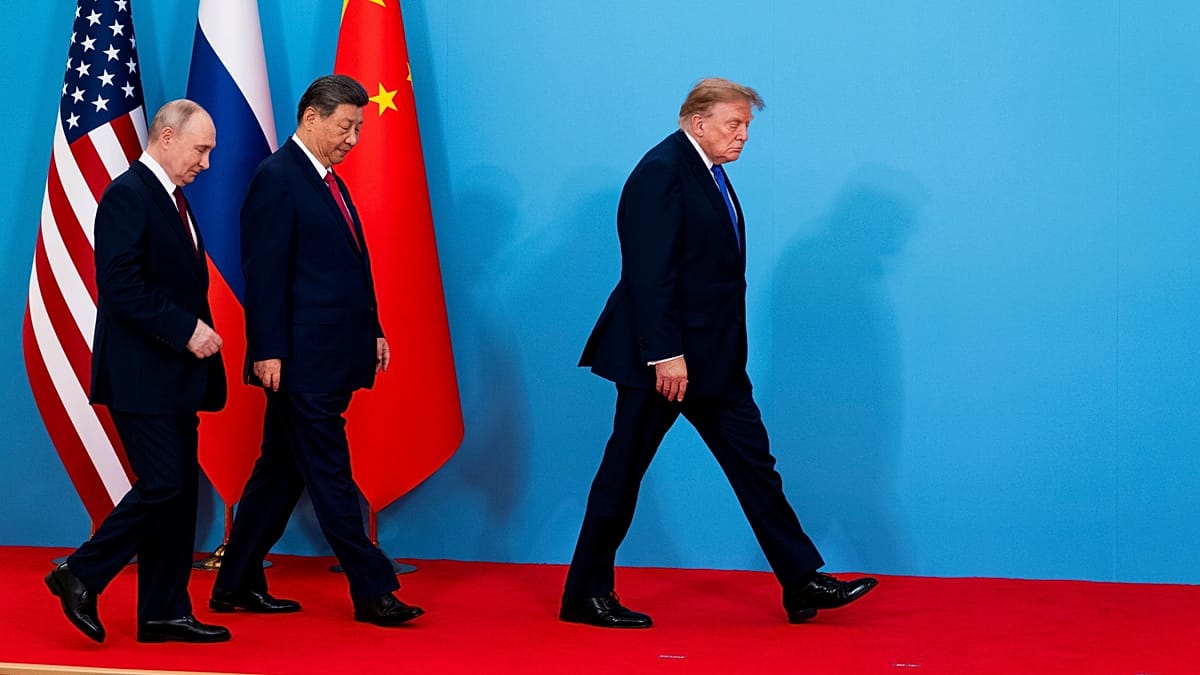
The buildup was grandiose, the setting meticulously staged, and the expectations almost impossibly high. When Donald Trump, Xi Jinping, and Vladimir Putin finally sat down together in Shenzhen, the world was told to brace for a new Yalta — a redrawing of spheres of influence that would define the 21st century. What actually unfolded was far less dramatic: an 80-minute meeting, a vaguely worded declaration on nuclear peace, and a photo opportunity that may have been the summit's only tangible product.
For Europeans, the letdown was almost a relief. Hours after the Shenzhen talks concluded, leaders from the so-called Coalition of the Willing gathered in Berlin, where the mood was less about alarm and more about quiet determination. German Chancellor Friedrich Merz and French President Emmanuel Macron both took pains to dismiss the notion that Europe's fate could be decided by others. "A Yalta-style format will not bring peace," Merz said. "At Yalta, Europe was divided up. It was parcelled up. And we won't allow anything like that to happen again."
A summit of optics, not substance
For Trump, the summit was largely about the image of three powerful men sharing a stage. He appeared to doze off at moments, and his main achievement seemed to be the media frenzy surrounding the encounter. The joint declaration against nuclear warfare was so generic that it could have been written by a committee of diplomats with no particular crisis in mind — as meaningful as a beauty pageant contestant's plea for world peace.
Putin, for his part, left Shenzhen with little to show. He was seated at a secondary table during the dinner, while Trump and Xi enjoyed a more intimate rapport. His attempts to steer the conversation toward Ukraine were conspicuously ignored; the conflict was absent from the ironically titled "Declaration toward Peace." The meeting allowed Putin to project an image of Russia as a global power on par with the US and China, but the reality is that Russia's economy is roughly the size of Italy's, and its war in Ukraine has dragged on for nearly five years without achieving its core objectives.
Xi Jinping, by contrast, emerged as the clear winner. As host, he controlled the stage and the narrative, speaking of nuclear weapons as "a sword of Damocles hanging over humanity" and urging major powers to "live in harmony." His broader message was unmistakable: China offers an alternative to the Western-led order, and it is ready to help shape it.
Europe's collective shrug
In Berlin, the response was a collective shrug — but a confident one. Macron insisted that the Shenzhen meeting lacked the legitimacy to redraw the global order. "Europeans have taken decisions. They have decided to determine their own fate," he said. "Europe is not a subject on a menu of discussions, but a series of powers who want to build their own future."
The contrast with previous years was stark. In 2025, Washington deliberately kept Europe out of peace talks, prompting hand-wringing about Europe's "missing seat" at the table. Now, US officials are actively pushing Moscow to engage directly with European counterparts — a shift that European diplomats privately interpret as Washington finally recognizing that no durable settlement is possible without European involvement.
The past month has seen a flurry of diplomatic activity: meetings in Miami, Oslo, Brussels, Abu Dhabi, and Berlin, where European, Ukrainian, and US officials have been building a framework for security guarantees and post-war recovery plans for Ukraine. This coordinated effort suggests that Europe is no longer waiting for permission to act.
Still, the underlying anxiety has not entirely disappeared. Europeans remain wary of Trump's unpredictability and his penchant for dramatic gestures. But the Shenzhen summit, for all its hype, may have inadvertently strengthened Europe's resolve. As one Brussels official put it, the episode was a reminder that Europe cannot rely on others to defend its interests — and that, in itself, is a form of progress.
The Berlin meeting was a clear signal that Europe intends to be a player, not a prize. And while the Yalta comparisons may persist, the continent's leaders are determined to write a different ending.