Europe's economic lifelines run beneath the sea. More than 95% of international digital traffic flows through submarine fibre-optic cables, and over 1.4 million kilometres of these cables carry an estimated €9.2 trillion in daily financial transactions. Meanwhile, roughly two-thirds of the world's oil and gas is extracted or transported at sea. For the EU, maritime transport handles 75.6% of imports and 73% of exports, totalling around €1.126 trillion in goods annually. A disruption at key chokepoints could trigger inflation and manufacturing shortages across the continent.
In response, the EU and its member states are shifting budgets towards maritime defence. According to the EU Blue Economy Observatory, the bloc spent nearly €118 billion on maritime defence over the past decade, with a sharp 23.6% increase in 2022 following Russia's invasion of Ukraine. That year, domestic maritime defence spending hit a record €11.6 billion. Submarines account for 27% of the EU's total production value, with the remainder split among surface ships, aircraft, and other warfare systems.
The shift marks a transition from a purely commercial 'blue' economy approach to a securitised maritime strategy. In 2023, the EU updated its European Union Maritime Security Strategy (EUMSS) to protect critical seabed infrastructure. It then locked in strategic defence priorities by launching dedicated European Defence Projects of Common Interest and implementing a Submarine Cable Security Toolbox to counter grey-zone threats and safeguard underwater networks.
Underwater domain awareness
Traditional naval patrols are no longer enough. "Underwater Domain Awareness is a critical activity to know what is happening below the surface, particularly around cables, pipelines and offshore energy infrastructure, prioritising those identified as critical for the security of the Union," said Jürgen Scraback, Head of the Maritime Domain Unit at the European Defence Agency. As threats increasingly come from low-cost drones, uncrewed underwater vehicles, and mine warfare, governments are investing in autonomous technologies and surveillance systems.
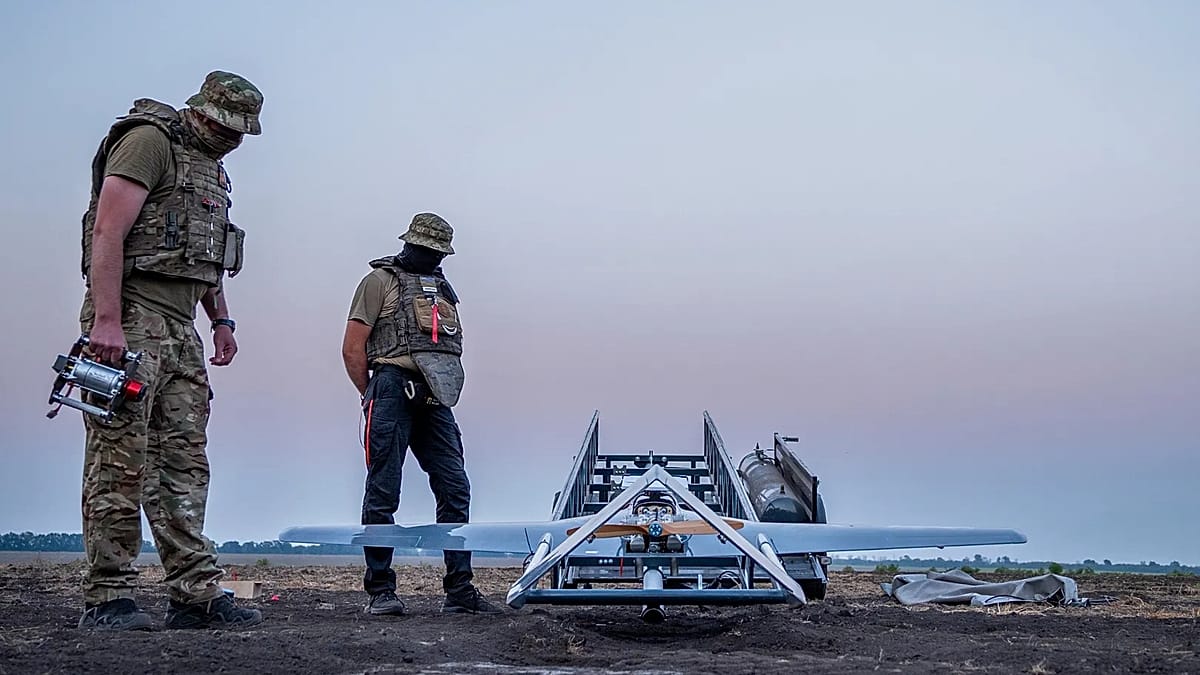
Between 2016 and 2025, the EU's annual production value of crewless vehicles—including aerial and submarine drones—increased by 132% to €847 million. Fixed-wing unmanned systems accounted for one third of that output, worth €277 million, while production of traditional unmanned submarine platforms fell by 23% over the same period. Fleet modernisation continues to focus on both conventional naval assets and autonomous platforms. Manned surface ships now account for 65% of EU maritime defence vehicle production value, serving as primary platforms for command, logistics, and force projection. Submarines represent another 27%, supported by new procurement programmes and investment in next-generation underwater weapons.
Autonomous surface vessels and unmanned underwater vehicles are becoming increasingly important for surveillance, reconnaissance, and infrastructure monitoring. European operators are deploying AI-enabled unmanned systems to monitor ports, offshore energy infrastructure, and submarine cables, detecting threats across large areas. For Scraback, "autonomous and unmanned systems combined with AI-enabled data fusion are among the technologies likely to have the greatest impact. They can provide persistent surveillance over large areas without requiring expensive crewed platforms to remain almost permanently deployed."
Strategic shift and funding
The 2014 Maritime Security Strategy guides Europe's maritime approach, protecting citizens, the economy, infrastructure, and borders. The updated strategy, according to Chris Kremidas-Courtney, senior advisor at the European Policy Centre and associate fellow at the Geneva Centre for Security Policy, "calls for a greater emphasis on the hard power aspects of maritime defence and security, where the EU had previously faced challenges in establishing a role and identity." It identifies "the protection of critical infrastructure in the maritime domain as a key priority."
The Industrial Maritime Strategy, adopted in March 2026, backs this shift. It boosts Europe's naval production through a new EU Industrial Maritime Value Chain Alliance and reinforces naval, underwater, and dual-use capabilities, including a dual-use ferry construction programme. By July, Europe allocated €325 million to five European Defence Projects of Common Interest, including one maritime and seabed defence project. Since February, a new Counter-Drone Action Plan has shifted production towards unmanned naval drones and counter-drone systems for aerial, surface, and underwater threats.
The EU funds its naval ramp-up through defence tools such as the European Defence Industrial Strategy and the €1.5 billion European Defence Industry Programme. The Readiness 2030 roadmap totals over €800 billion, including naval capabilities and sea lines of communication protection. The bloc also invests in detection and surveillance technologies to counter sabotage of seabed cables. As cables cover large areas, are privately owned, and can be easily damaged, "the best approach is a layered resilience system designed to make interference detectable, limit the disruption caused by a successful attack and restore service quickly," Kremidas-Courtney explained.
This thinking now drives EU policy. The Action Plan on Cable Security (2025) strengthens Europe's ability to prevent, detect, respond to, and recover from cable incidents. The plan complements broader efforts to secure the continent's digital and energy infrastructure, which are increasingly intertwined with maritime security. As Europe faces a new era of geopolitical competition, the deep blue sea has become a critical frontier for defence—one that requires not just naval might, but also technological innovation and strategic foresight.